

The shortlist of marketing intelligence tools looked decisive until you tried to buy from it. Visualping would screenshot a pricing page. Ahrefs would show last month's keywords. Klue would want a battlecard owner. Those are three different jobs.
Ranked roundups mix page monitors, SEO research, filings search, traffic estimates, and sales enablement because buyers search one phrase. The software underneath does not share a detection model, a pricing model, or an owner.
This comparison sorts Visualping, Ahrefs, AlphaSense, Similarweb, Klue, and Kompyte by the job each one actually wins, then covers structured competitor monitoring, the layer those lists usually skip.
What you'll learn
- What marketing intelligence tools cover, and how that differs from market intelligence and competitive intelligence
- A job-sorted table of Visualping, Ahrefs, AlphaSense, Similarweb, Klue, Kompyte, and Competiflow
- When to stay on a page monitor, an SEO suite, filings search, or traffic estimates
- When Klue or Kompyte earn a battlecard budget, and when they do not
- What structured competitor monitoring adds, with a real change record
- How to choose a stack instead of a ranked winner
TL;DR: There is no single best marketing intelligence tool. Visualping wins cheap page-change alerts, Ahrefs wins SEO research, AlphaSense wins filings and transcripts, Similarweb wins traffic estimates, and Klue or Kompyte win battlecard programs you will staff. Competiflow covers structured competitor monitoring with evidence. Pick by job, then stack.
What are marketing intelligence tools?
Marketing intelligence tools collect the signals marketing uses while the quarter is still open: rival pages, search, filings, traffic, and sales enablement. The phrase is a buying category that spans several products. Teams that try to cover every job with one platform still end up buying two or three specialists.
The practice is ongoing. Market research is usually a bounded project: a survey, a set of interviews, a slide that ages. Marketing intelligence is the standing loop that notices a pricing rewrite, a new ranking set, a 10-Q phrasing change, or a traffic-channel shift.
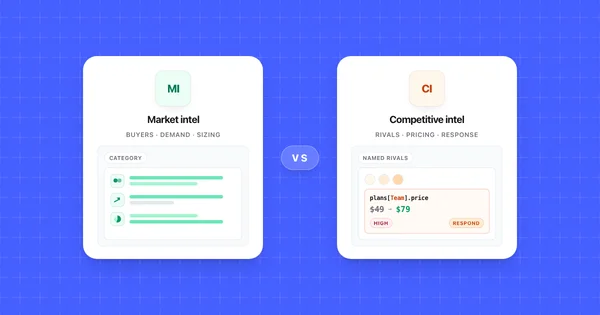
Adjacent labels overlap and still answer different questions. Market intelligence vs competitive intelligence is the longer split: market intelligence asks where buyers and demand are heading; competitive intelligence asks what to do about named rivals. This roundup sits on the rival-and-search side of that line. Customer-research tools (surveys, reviews, social listening) are a different buy. The question this quarter is which job you are hiring: watch a URL, research keywords, search filings, estimate traffic, enable sales, or keep structured evidence on competitor pages.
Marketing intelligence tools compared by job
Each marketing intelligence tool in this table wins a different job, and none of them wins the whole category. Visualping, Ahrefs, AlphaSense, Similarweb, Klue, and Kompyte cover page alerts, SEO, filings, traffic, and battlecards. Competiflow covers structured competitor monitoring, which those roundups usually omit.
| Tool | Primary job | Choose it if | Signal and evidence | Pricing | Main limitation |
|---|---|---|---|---|---|
| Visualping | Visual page-change alerts | You want cheap, self-serve watches on arbitrary URLs and will triage screenshots | Snapshot diffs, AI "important" flag, before/after images | Free (5 pages, 150 checks/month); paid from about $10/month; Business from about $100/month | A layout shift and a price move can look like the same alert |
| Ahrefs | SEO and keyword competitive research | Your gap is rankings, backlinks, and content gaps | Keyword, ranking, and backlink reports; no page-change record | Lite from about $129/month; Standard $249; Advanced $449 | Does not watch product, pricing, or copy changes |
| AlphaSense | Filings, transcripts, and document search | You need passages from 10-Ks, earnings calls, and broker research | Quoted passages and alerts inside a document corpus | Quote-only | Won't catch a pricing row or changelog entry |
| Similarweb | Traffic and channel estimates | You need directional share, channel mix, and audience overlap | Modeled visits and channel mix, not the competitor's analytics | Self-serve from about $125/month billed annually; starter data is limited; business packages quote-only | Estimates are relative, not exact counts |
| Klue | Battlecards and sales enablement | Rep adoption of cards is the KPI and you will staff a CI owner | Curated cards, win/loss inputs, CRM/Slack distribution | Quote-only; industry estimates for Klue-class programs often start in the mid five figures per year | Overkill for catching one plan price; implementation is a project |
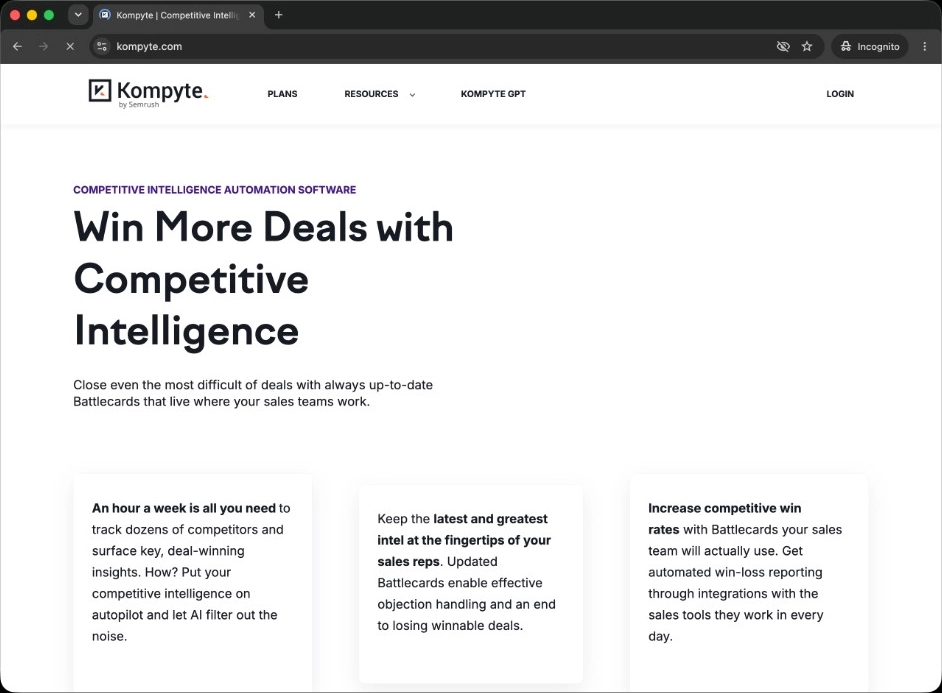
| Kompyte | Automated tracking into battlecards | You already live in Semrush and want CI in that stack | Site, ad, and job-post tracking pushed toward cards | Quote-only; per-competitor and per-user; Semrush bundles often lower entry | Cards still need an owner; automation does not replace that owner |
| Competiflow | Structured competitor monitoring | You want named field diffs on pricing, changelog, blog, docs, and homepage | Field path, old/new values, severity, why it matters, source URL. Growth and Pro add SEO scores on new posts | Free trial (100 checks); Starter $19/month; Growth $49; Pro $99 | No ranking research, traffic share, or filings search |
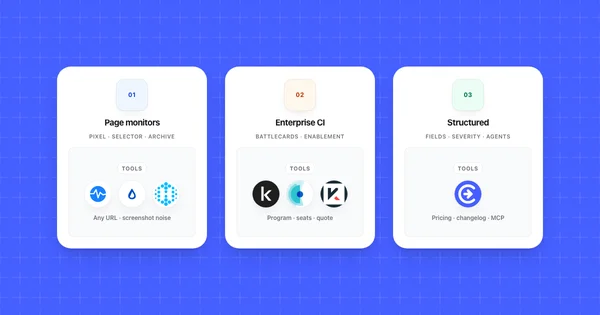
No row wins every column. Stay on Visualping for breadth across any public URL. Stay on Ahrefs for search. Stay on AlphaSense for documents. Stay on Similarweb for traffic share. Stay on Klue or Kompyte when enablement is the product. Use Competiflow when the deliverable is a named field and both values, with a source you can open.
Are page monitors, SEO, filings, and traffic tools interchangeable?
Page monitors, SEO suites, filings search, and traffic estimates all get sold as marketing intelligence. A screenshot, a ranking report, a 10-K passage, and a traffic estimate answer different questions. You cannot substitute one for the other.
Visualping
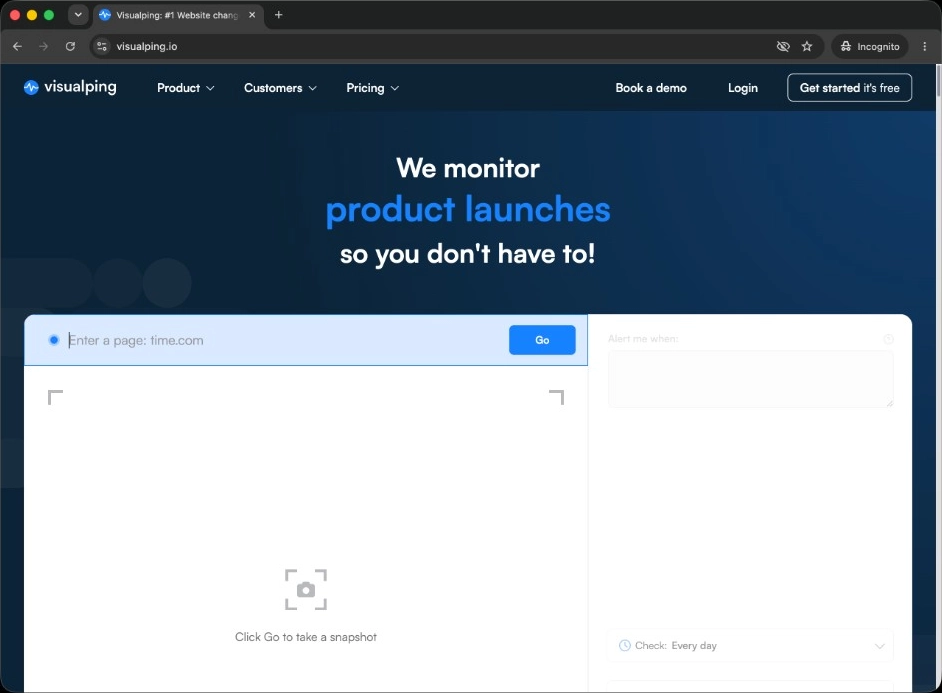
Visualping is a website change monitor. You point it at a URL, it screenshots the page or a cropped region on a schedule, and it emails a highlighted diff when the render moves. An AI summary and an "important" flag sit on top of that image. The free plan covers 5 pages and 150 checks a month. Paid Personal plans start around $10 a month. Business plans, with team workspaces plus Slack and Microsoft Teams alerts, start around $100 a month (Visualping's own 2026 roundup lists 200 pages, 20,000 checks, and 5 users at that tier). Verify current limits on their pricing page before you budget.
Stay on Visualping when the job is cheap, self-serve coverage of arbitrary public pages: a careers list, a regulator notice, a conference agenda, a static terms page. That breadth is the product. The trade-off is triage. On a SaaS pricing table with a chat widget, a currency toggle, and an A/B test, a cookie-banner shift and a plan-price rewrite can arrive as the same kind of screenshot. If you need named fields, read Competiflow vs Visualping.
Ahrefs
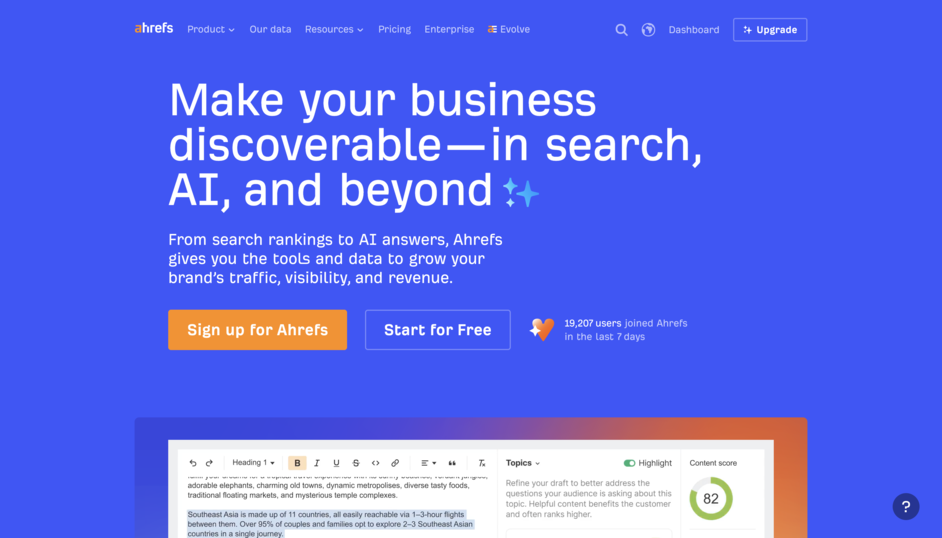
Ahrefs is an SEO research suite. Site Explorer, Keywords Explorer, and Rank Tracker tell you which queries a competitor ranks for, which pages collect links, and where you are gaining or losing positions. That is competitive marketing intelligence for search and content planning. Ahrefs will not tell you that a rival renamed a plan or shipped a changelog entry.
Lite is the usual paid entry for this job, from about $129 a month on Ahrefs' public pricing page at draft time. Standard is about $249 a month, Advanced about $449. Ahrefs also sells a narrower Starter tier; treat Lite as the working floor for competitor keyword work. Stay on Ahrefs when the gap is rankings, backlinks, and content gaps. Skip it when the brief is "did their pricing page change this week."
AlphaSense
AlphaSense searches a large document corpus: earnings transcripts, SEC filings, broker research, news, and press. The useful output is a passage you can cite, plus alerts when a company or theme shows up in that corpus. For B2B marketing and strategy teams watching public competitors, that is how you catch a phrasing change in a 10-K or an analyst note that never hits the homepage.
Pricing is quote-only and sold to team size and corpus access. Stay on AlphaSense when the job is document search: 10-Ks, transcripts, broker notes. Roundups file that under marketing intelligence even when the output feeds a market-sizing memo. AlphaSense will not pull the Team plan price off a pricing page. If your week is "what did they file," this is the right lane.

Similarweb
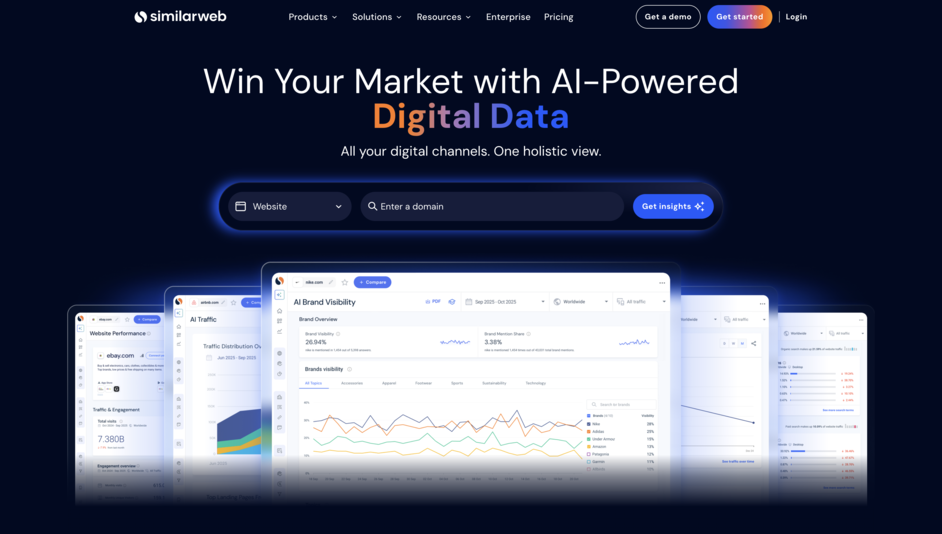
Similarweb estimates website traffic and channel mix across a large domain set. You get directional visits, search vs direct vs referral vs social, geography, and sometimes ad-intelligence overlays. The numbers are modeled (panel, ISP partnerships, algorithms), not the competitor's Google Analytics export. That is still useful for "did organic fall after an algorithm update" and for audience-overlap sketches. It is a poor source for an exact visit count in a board slide.
Self-serve Web Intelligence starts around $125 a month billed annually (about $199 month-to-month) on Similarweb's packages page at draft time. Starter views are limited. Business and enterprise packages are custom quotes. Stay on Similarweb when you need relative traffic and channel mix. Do not treat an estimate as an analytics-grade fact, and do not expect it to name the plan row that moved.
Battlecard enablement platforms
Battlecard enablement platforms exist to get competitive content into sales. They assume someone already caught the pricing row. Klue and Kompyte win that job when you will staff an owner.
Klue
Klue is enterprise competitive intelligence aimed at battlecards, deal support, and rep adoption across Salesforce, Slack, Gong, and Microsoft 365. Collection is a means. Distribution and usage are the product. There is no public self-serve price list. Industry and procurement estimates for Klue-class programs often start in the mid five figures per year; smaller quotes exist, and large seat counts run higher. Confirm with their team.
Stay on Klue when sales leadership measures success by whether reps open and use cards, and you will fund a CI or PMM owner through a multi-week rollout. Klue is a weak buy if the actual pain is "I need the Team plan price by Thursday" and nobody will maintain a library. Crayon sits in the same enablement lane; this post does not re-review it.

Kompyte
Kompyte, sold as Kompyte by Semrush after the 2022 acquisition, automates competitor site, ad, and job-post tracking and pushes updates toward battlecards and CRM-adjacent workflows. Pricing is quote-based, usually per competitor and per user. Semrush-bundled deals often undercut a standalone Klue-class invoice. The quote still rises as the watchlist grows.
Stay on Kompyte when the team already lives in Semrush and the missing piece is CI inside that relationship. You still need someone to own the cards. If cards go stale, another automation layer reprints the same unread library. Choose Klue when you want a heavier sales-enablement system of record and you are not optimizing for a Semrush bundle.
Structured competitor monitoring, the job those lists skip
Structured competitor monitoring is named field diffs on rival pages, with severity and a source URL. Competiflow does that job. Most marketing-intelligence roundups skip it.
You add a competitor by homepage URL. Discovery finds pricing, changelog, blog, docs, and homepage monitors. Each successful page read spends one check, whether or not the page changed. When a tracked field moves, the change record carries the path, old and new values, a severity, a summary, and the source URL. Stay on Visualping for arbitrary-URL screenshots. Stay on Klue for battlecards.
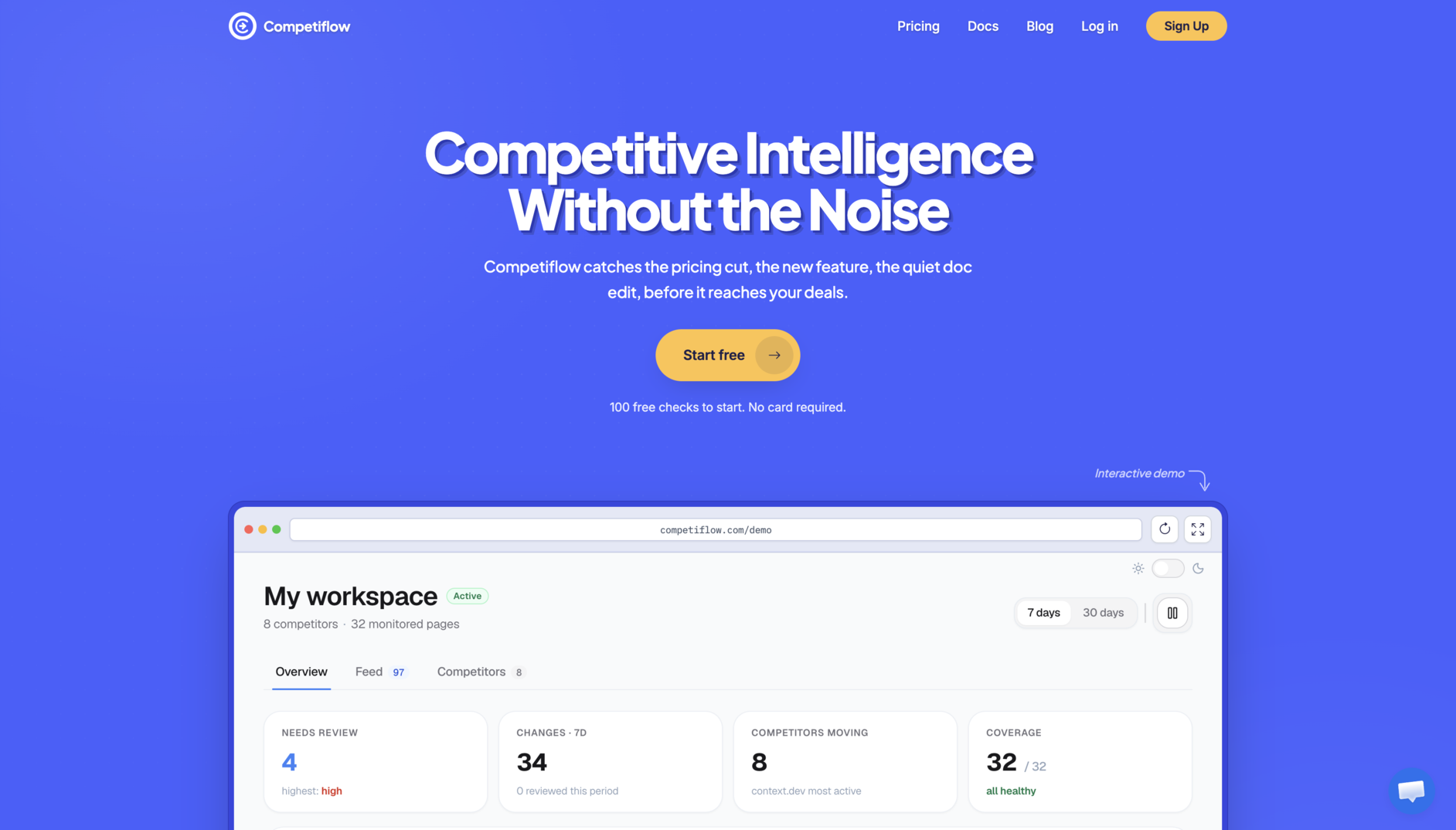
The free trial includes 100 checks, up to 3 competitors, and up to 15 monitors on a daily cadence. Starter is $19 a month for 2,000 checks and 20 monitors with unlimited competitors. Growth is $49 a month for 5,000 checks on a six-hourly cadence. Pro is $99 a month for 10,000 checks hourly. Plans meter checks, not seats. Growth and Pro also attach keyword volume and an opportunity score when a blog or docs URL is new. That score rides on the detected page. Ahrefs still owns ranking research.
Workspaces group the rivals you actually sell against. One product or market per workspace keeps the inbox honest. Adding a second competitor does not open a procurement thread about seats.
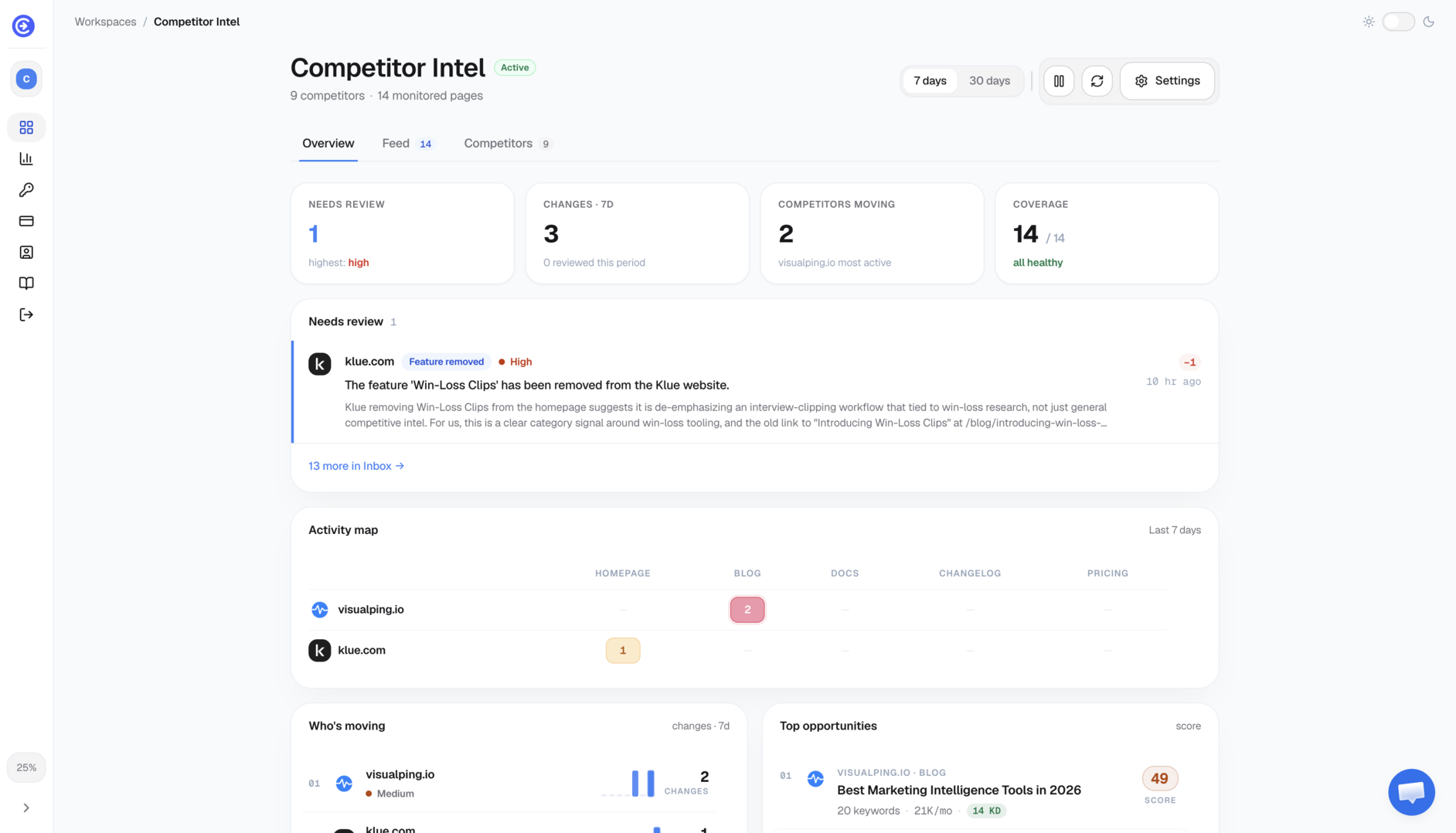
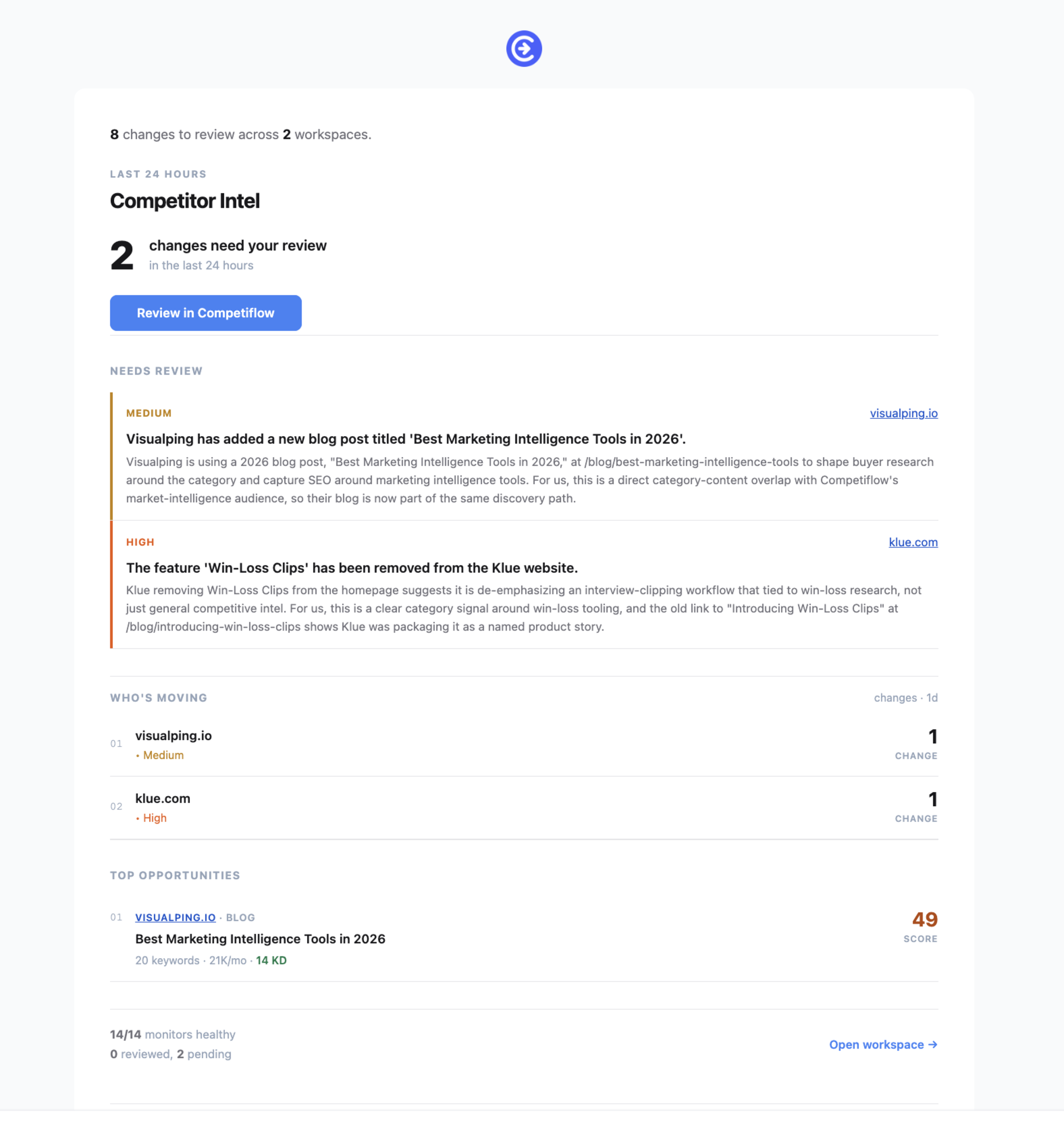
Here is a live example. Visualping's blog was already on a monitor. On August 20, 2026, Competiflow detected a new post on their blog index: "Best Marketing Intelligence Tools in 2026." That date is when the listing appeared, not Visualping's own byline. The change record below shows what a structured blog monitor returns: the post title, URL, severity, and an SEO opportunity score.
{
  "change": {
    "id": 176610,
    "workspace_id": 161312,
    "competitor": "visualping.io",
    "monitor_type": "blog",
    "severity": "medium",
    "summary": "Visualping has added a new blog post titled 'Best Marketing Intelligence Tools in 2026'.",
    "opportunity_score": 49,
    "created_at": "2026-08-20T21:04:10.062Z",
    "source_url": "https://visualping.io/blog",
    "field_diffs": [
      {
        "op": "added",
        "change_type": "blog_post_added",
        "path": "posts[https://visualping.io/blog/best-marketing-intelligence-tools]",
        "tier": "alertable",
        "new": {
          "url": "https://visualping.io/blog/best-marketing-intelligence-tools",
          "title": "Best Marketing Intelligence Tools in 2026",
          "published_at": null
        }
      }
    ]
  }
}
The useful part is the envelope: a named path, a change type, a title, a URL, a detection time, and an opportunity score on Growth and Pro. Visualping's roundup still describes those specialist tools. This is the layer that roundup leaves out: interpreted competitor-page monitoring you can triage without opening twenty tabs. For Distill, Hexowatch, and other page-monitor or CI names outside this roster, see the competitor monitoring tools roundup for SaaS.
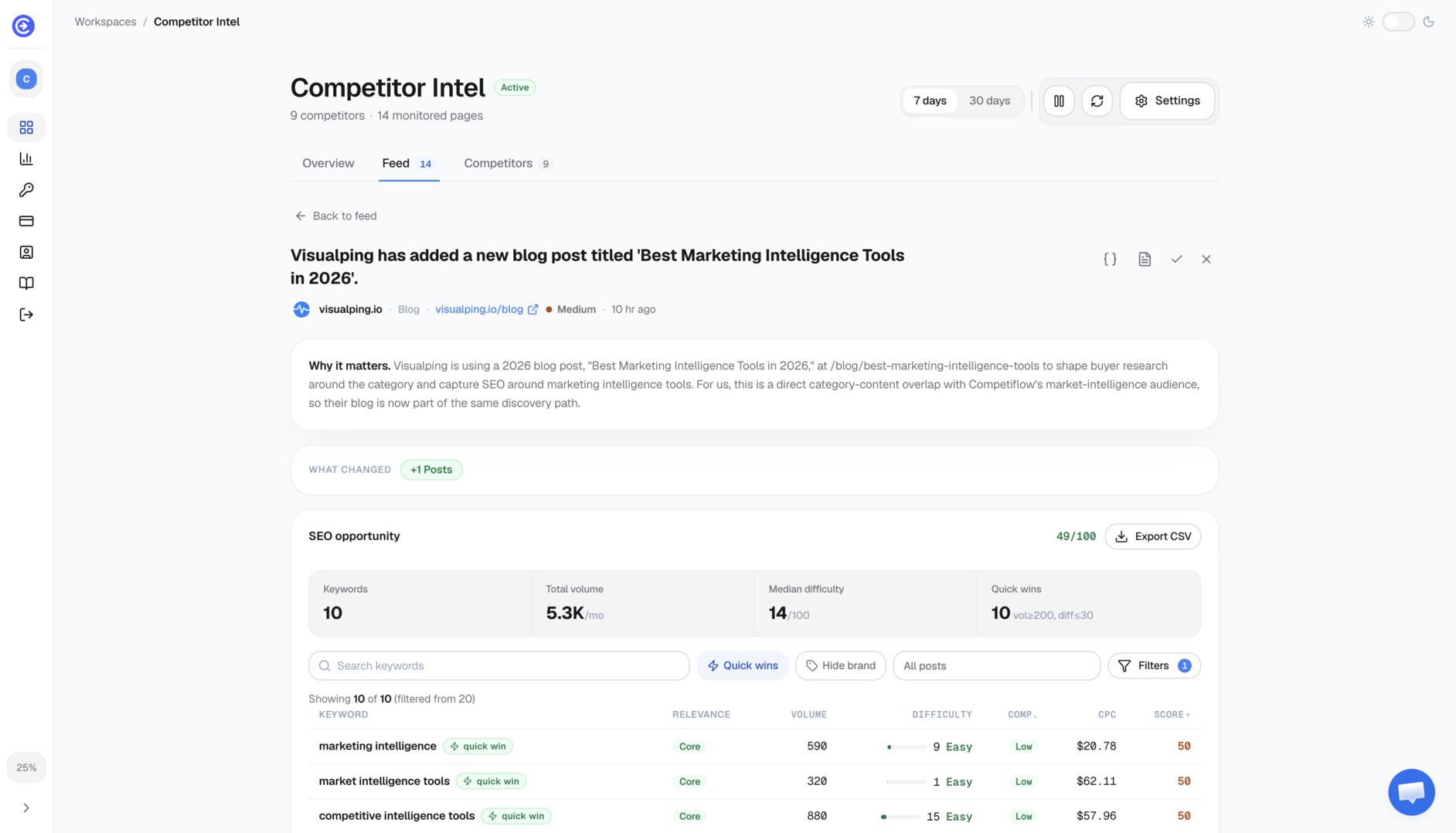
The same detection also lands in a digest email. The summary below shows both the Visualping blog post and a Klue homepage change, ranked by severity, with an SEO opportunity score and keyword volume for the new post.
How to choose a marketing intelligence stack
Choose a marketing intelligence stack by naming the jobs you will run this quarter, then pick one tool per job. Most teams need two or three products. A single ranked winner is the wrong shape.
| Your job this quarter | Choose | Stay on it when |
|---|---|---|
| Watch arbitrary public URLs and triage screenshots | Visualping | Careers, notices, static pages, cheap breadth |
| Keyword, backlink, and content-gap research | Ahrefs | SEO is the actual gap |
| Filings, transcripts, broker research | AlphaSense | Public-company document search |
| Directional traffic and channel mix | Similarweb | Relative share, not exact analytics |
| Battlecards, win/loss, rep adoption | Klue | You will staff a CI owner |
| CI inside an existing Semrush relationship | Kompyte | Bundle path matters more than a second suite |
| Named field diffs on pricing, changelog, blog, docs | Competiflow | You want a named field and both values |
Three common mistakes:
- Buying the roundup winner. Visualping, Ahrefs, and Klue can all be "best" on the same SERP and still fail your week.
- Treating marketing intelligence as market intelligence. TAM models and buyer surveys are a different budget. Competiflow does not replace that work, and neither does a page monitor.
- Watching fifteen competitors with no triage owner. Collection without review is an unread inbox, whether the vendor charges $10 or $80k.
A lean stack that stays honest: Ahrefs if search is in scope, Similarweb only if you will actually use traffic estimates, then either Visualping (arbitrary URLs, screenshot triage) or Competiflow (CI surfaces, field evidence). Add Klue or Kompyte only when sales leadership will measure card usage. Hybrid setups are valid. Keep Klue for enablement and point a structured monitor at the pricing URLs that create revenue risk when missed.
Plan math for Competiflow lives on billing and checks. One successful page read is one check. Failed reads are not billed.
Frequently Asked Questions
What is marketing intelligence?
Marketing intelligence is the ongoing practice of gathering competitor, search, document, and related signals that affect marketing decisions. It is a loop with owners and a cadence. Tools automate collection. People still decide what to do.
What are marketing intelligence tools?
Marketing intelligence tools are products that collect rival-page, search, document, traffic, and enablement signals for marketing decisions. The usual stack is page monitors, SEO suites, document search, traffic estimates, battlecard platforms, and structured competitor monitors. No single tool covers every job. This comparison does not cover survey or review platforms.
What is the difference between marketing intelligence and market research?
The difference is cadence. Market research is usually a project with a start and an end, such as a survey or an interview round. Marketing intelligence is continuous monitoring of competitor activity, search demand, documents, and related signals so you can act while the quarter is still open. Teams often run both. Overlap in the name is a poor reason to force one vendor.
What is the difference between marketing intelligence and competitive intelligence?
The difference is scope. Marketing intelligence is the broader marketing-signal loop. Competitive intelligence focuses on named rivals and your response. For the market vs competitive split, including where monitoring sits, see market intelligence vs competitive intelligence.
What is the difference between marketing intelligence and market intelligence?
The difference is the unit of analysis. Marketing intelligence is the marketing team's standing collection of signals that affect campaigns, content, and positioning. Market intelligence is the market-level practice of buyers, demand, sizing, and category structure. They share sources sometimes. They answer different questions. The same pillar post above is the longer definition.
Is Similarweb accurate?
Similarweb traffic figures are estimates built from panel data, partnerships, and models. They are useful for relative comparisons, channel mix, and large swings. They are modeled counts. Do not put an unrounded estimate in a board slide as if it were first-party data.
Can marketing intelligence tools replace an analyst?
Marketing intelligence tools cannot replace an analyst. Tools collect and, in some cases, summarize. An analyst still decides what a pricing rewrite means for positioning, whether to respond, and what to watch next. The value is fewer hours spent refreshing tabs so judgment has something clean to work on.
How many competitors should you monitor?
Start with three to five named rivals and specific surfaces: pricing, homepage, changelog or blog, maybe careers if hiring is a signal you use. Expand only if someone will triage the extra volume. More than about fifteen competitors with no review process usually produces noise.
There is no single best marketing intelligence tool. Visualping, Ahrefs, AlphaSense, Similarweb, Klue, and Kompyte each earn a stay-on path. Competiflow handles the structured competitor-monitoring job those lists skip. Pick it for field diffs.
If the job you are missing is named field diffs with evidence, add a homepage and let discovery seed the monitors. If the job is screenshots, ranking research, filings, traffic, or battlecards, keep the specialist you already shortlisted.
![Visualping screenshot noise versus Competiflow field diff: plans[Team].price $49 to $79 HIGH, hero.logo SKIP](/assets/blog/competiflow-vs-visualping/hero-thumb-0277fc8e08455d4c11b4534b07f63ef32c5070d5863e31c234b1bd2cb446eba0.webp)