
Your strategy offsite spent two hours on "the market." Someone quoted a sizing number from a deck last updated in Q3. Someone else waved a rival's pricing page as proof the category was consolidating. Both felt like market intelligence. Neither answered the same question.
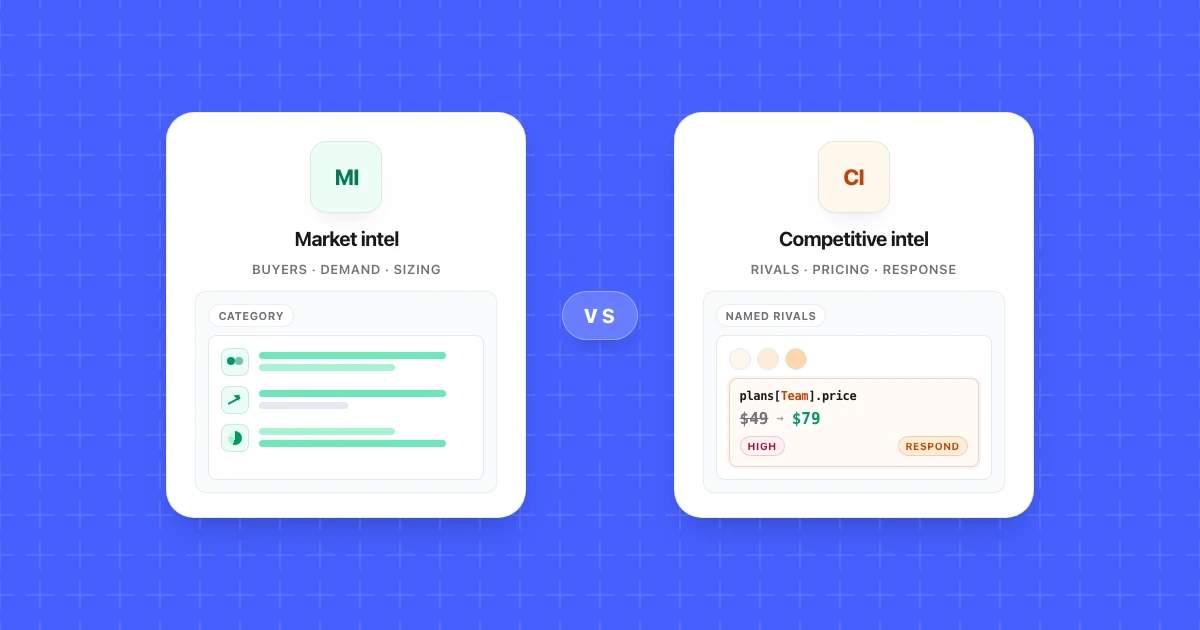
Market intelligence tracks buyers, demand, and category structure. Competitive intelligence tracks named rivals and what you should do about them. Mix the two up and you buy the wrong tools, staff the wrong owners, and ship reports that look thorough while the decisions that matter still arrive late.
This guide owns the market intelligence side of that boundary: what MI is, how it differs from competitive intelligence and market research, when each discipline earns a seat, and where continuous competitor monitoring sits in the stack.
What you'll learn
- A precise definition of market intelligence and the questions it answers
- How market intelligence differs from competitive intelligence (with a deep comparison table)
- How market research relates to ongoing market intelligence
- When to invest in MI vs CI, and how the two feed each other
- What market intelligence tools and platforms actually cover (by capability, not vendor list)
- Where competitor monitoring fits in the stack, and where it does not
- Common mistakes teams make when they treat MI and CI as the same job
TL;DR: Market intelligence is the ongoing practice of understanding buyers, segments, demand, sizing, and category shifts across the whole market. Competitive intelligence focuses on rivals and your response. Use MI for where the market is heading; use CI for what to do about named competitors. Monitoring feeds the CI collect layer; it is not a substitute for TAM models or survey research.
What is market intelligence?
Market intelligence is the continuous practice of understanding buyers, demand, sizing, and category structure so you can decide where to compete.
It looks outward at the category as a system: who buys, which segments are growing or shrinking, how large the opportunity is, what trends and regulations change the rules, and how the structure of the category is shifting. Pricing work in MI starts from demand; a rival homepage is one input. A pricing move by one competitor can appear inside MI work, but only as one data point among many. The unit of analysis is the market, not the rivalry.
Typical market intelligence outputs look like this:
| Output | What it answers |
|---|---|
| Segment sizing and TAM-style estimates | How big is the opportunity we are entering or exiting? |
| Demand and search or intent trends | Is buyer interest rising, flat, or rotating to a different job? |
| Category structure briefs | Are we in a consolidating market, a fragmented one, or a new wedge? |
| Buyer and ICP updates | Who actually buys, and what triggers a purchase? |
| Regulatory or macro risk notes | What external constraint changes go-to-market for everyone? |
Market intelligence is a standing capability. A one-off "market intelligence report" for a board meeting can be useful, but it ages the moment a segment definition, a regulation, or a buyer workflow changes. Teams that get value treat MI as a loop with owners and a cadence, not as a slide that survives until the next offsite.
For B2B SaaS, that usually means product marketing, strategy, or a founder wearing both hats. Sales enablement may consume MI, but it rarely owns the market model.
Market intelligence vs competitive intelligence
Market intelligence asks where the whole market is heading. Competitive intelligence asks what to do about your rivals and your position against them. Both inform strategy. They answer different questions, pull from different sources, and usually need different owners.
Competitive intelligence is the practice of turning competitor and market signals into decisions on product, pricing, positioning, and sales. For the full definition, the four types of CI, and the intelligence cycle, see what is competitive intelligence. This section stops at the boundary: enough CI to contrast cleanly with MI, without retelling that pillar.
Here is the comparison that matters when you are scoping a program or a tool budget:
| Dimension | Market intelligence | Competitive intelligence |
|---|---|---|
| Core question | Where is the market heading, and where should we play? | What should we do about our rivals and our competitive position? |
| Scope | Buyers, segments, demand, sizing, trends, regulation, category structure | Named competitors, competitive set, deal-level and strategic rivalry |
| Typical sources | Surveys, interviews, analyst notes, public market data, search/intent data, industry reports | Pricing pages, changelogs, homepages, job posts, win/loss, battlecards, review sites, monitoring feeds |
| Primary outputs | Sizing, demand shifts, segment priorities, category forecasts, opportunity/risk briefs | Battlecards, positioning memos, win/loss themes, response plans, strategy input on rivals |
| Usual owners | Strategy, PMM, founder/CEO, sometimes product ops | PMM, sales enablement, product, founder on a small team |
| Cadence | Quarterly models with monthly pulse checks; event-driven when a category shock hits | Weekly or continuous triage of rival moves; deeper reviews on a standing cycle |
| Decision it informs | Enter, exit, or re-segment; price architecture against demand; invest in a category bet | Match, hold, or ignore a rival move; arm sales; change messaging or roadmap against a named threat |
Read the table left to right when someone asks you to "own the market." If the ask is "how big is mid-market for this job-to-be-done," that is market intelligence. If the ask is "Harborline cut Pro from $79 to $49; do we respond," that is competitive intelligence fed by public-page monitoring and win/loss context.
A short composite example (illustrative, not a real company): Northwind Analytics sees category search interest for "usage-based analytics" rise over two quarters while enterprise RFPs mention usage pricing more often. That is an MI signal about demand. In the same window, Ardent ships a public usage tier on its pricing page. That is a CI signal about a rival. Strategy needs both: MI tells you the category is moving; CI tells you one competitor already moved and whether your response should be packaging, sales talk tracks, or something quieter.
Competitor monitoring sits under CI as the sensor that watches specific rival surfaces. It is not market intelligence by itself. For that layer, see what is competitor monitoring.
Market research vs market intelligence
Market research is usually a project. Market intelligence is usually a capability. Research answers a bounded question on a deadline. Intelligence keeps an outside-in picture alive so those projects (and the decisions between them) stay connected to reality.
| Market research | Market intelligence | |
|---|---|---|
| Shape | Project: survey, interview round, focus groups, secondary study | Ongoing system: models, pulses, briefs, watchlists |
| Trigger | A decision date (pricing test, segment entry, brand study) | Standing questions plus shocks (demand shift, regulation, category redefinition) |
| Time orientation | Often retrospective or snapshot ("what did buyers say last month") | Forward-looking enough to guide the next quarter, refreshed as inputs move |
| Relationship | A primary input into MI | Consumes research among other inputs (intent data, analyst notes, public signals) |
You can run excellent market research without a market intelligence program. You cannot run durable MI without some research muscle, even if that muscle is a founder doing twenty customer calls a quarter instead of a formal panel.
The trap is naming. Teams label a quarterly deck "market intelligence" when it is really one research project with nicer formatting. If there is no owner between projects, no standing questions, and no way to update the model when a segment definition changes, you have research outputs, not an MI loop.
When to use market intelligence vs competitive intelligence
Use market intelligence when the decision is about the category or the buyer. Use competitive intelligence when the decision is about a rival or your response to one. Many real decisions need both in sequence: MI for context, CI for the move inside that context.
Lean on market intelligence when you are asking:
- Should we enter this segment, or exit one that no longer fits?
- Is demand consolidating around a different job-to-be-done?
- How should we price against willingness to pay in a segment, not against one competitor's sticker?
- Is regulation or a platform shift changing the game for everyone in the category?
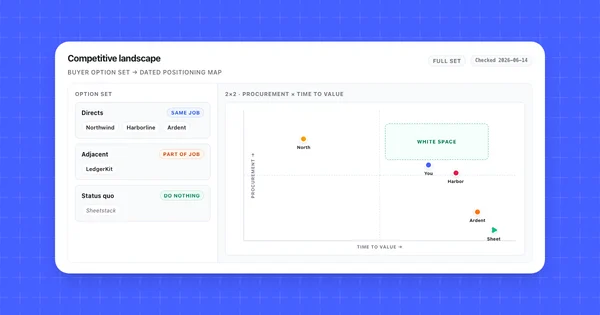
- Where does a competitive landscape analysis need fresh segment and option-set context?
Lean on competitive intelligence when you are asking:
- Did a named rival change pricing, packaging, positioning, or launch narrative?
- How should sales answer "why you vs them" this week?
- What does win/loss say about why we lose to a specific competitor?
- Should we match a feature, hold, or reframe?
Role cues that prevent thrash:
| Role | Usually owns | Pulls the other discipline when… |
|---|---|---|
| Strategy / founder | MI questions (where to play) | A rival move forces a category bet |
| PMM | Both, often the glue | MI sets messaging themes; CI keeps talk tracks current |
| Sales enablement | CI outputs (battlecards, objections) | MI explains a segment shift that changes who is in the deal |
| Product | CI for parity and roadmap threats; MI for segment bets | A demand shift makes a rival feature suddenly decisive |
If your calendar only has room for one standing ritual this quarter, pick based on the bottleneck. Late to every rival pricing change? Invest in CI and monitoring first. Winning deals but guessing wrong on which segment to hire for? Invest in MI and research first. Doing both poorly at once is how you get a thick "market pack" that still surprises sales on every call.
How market intelligence and competitive intelligence work together
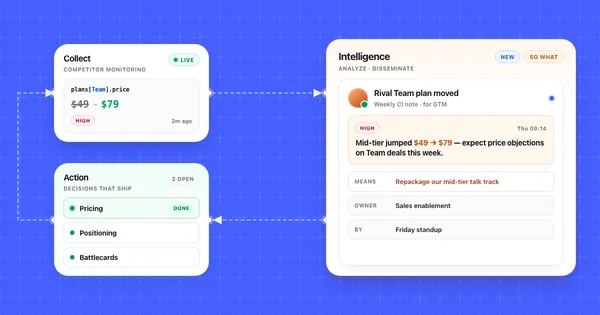
Market intelligence sets the frame. Competitive intelligence fills in the rivalry inside that frame. Competitor monitoring feeds the collect stage of CI so the rivalry picture is not built from screenshots and folklore.
In practice the stack looks like this:
- MI updates the map of demand, segments, and category structure.
- CI watches how named rivals move inside that map and recommends responses.
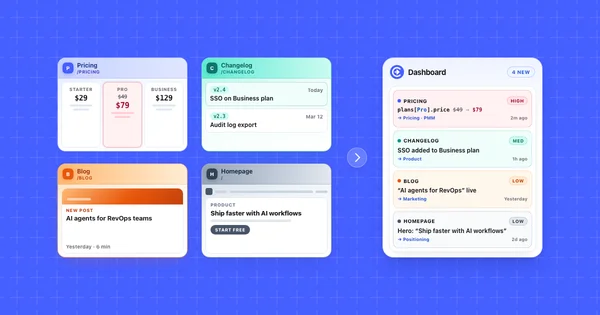
- Monitoring continuously reads public rival surfaces (pricing, changelog, homepage, docs) and produces dated, reviewable changes for CI.
- Artifacts such as landscape maps, win-loss analysis, and battlecards carry answers to the people who decide.
When those layers work, an MI demand shift and a monitored rival move land in the same weekly triage instead of two decks months apart. Without MI, you overreact to one rival. Without CI and monitoring, you underreact until a prospect narrates the change for you.
The practical rule: do not ask one dashboard to be the whole stack. Ask which layer is broken. Stale sizing and fuzzy ICPs are an MI problem. Surprise pricing cuts and outdated battlecards are a CI and monitoring problem.
What market intelligence tools and platforms actually cover
"Market intelligence tools" and "market intelligence platform" usually mean a bundle of capabilities, not a single product shape. Before you buy software, name which capabilities you actually need. A vendor roundup is less useful than a taxonomy of jobs.
| Capability cluster | What it covers | Typical outputs |
|---|---|---|
| Sizing and market models | TAM/SAM/SOM style models, segment estimates, growth rates | Investment memos, segment priority sheets |
| Customer and voice inputs | Surveys, panels, interview repositories, review mining | ICP updates, message tests, unmet-need themes |
| News, analyst, and secondary feeds | Industry news, analyst notes, curated secondary research | Briefings, risk flags, category narratives |
| Intent and demand signals | Search, content, or B2B intent data | Demand heatmaps, campaign focus |
| Competitive and web feeds | Rival news, review spikes, sometimes page monitors | Alerts and dossiers that blur into CI |
Most suites that market themselves as market intelligence platforms are strongest on the first four rows. Many also sell competitive modules. That blur is why teams think they bought "market intelligence" and still miss a silent pricing-row edit on a rival site. News and dossier feeds are not the same job as field-level checks on a pricing page.
When you evaluate market intelligence software, write the standing questions first, then map tools to rows in the table. Buying breadth before questions produces a login nobody opens. Buying a competitive feed and calling it MI produces rivalry noise without a market model.
Also decide what you will not automate. Segment judgment, willingness-to-pay interpretation, and "should we enter this market" still need humans. Tools gather and organize. They do not replace the decision.
Where continuous competitor monitoring fits (and where Competiflow does)
Continuous competitor monitoring belongs on the competitive intelligence side of the stack. It watches named rivals on specific public surfaces and reports when something meaningful changed. It does not size a market, run a survey, or replace an analyst feed.
That is the layer Competiflow is built for: structured competitor monitoring with field-level diffs, severity, a plain-language summary of why a change might matter, and evidence you can inspect. One successful page read costs one check, whether or not the page changed. For setup, start with the quickstart and the shape of changes.
Explicit limit: Competiflow is not a market intelligence platform. It does not produce TAM models, run buyer surveys, ingest analyst feeds, or forecast category demand. If your primary gap is sizing, research panels, or secondary-market briefings, choose tools built for those rows in the taxonomy above. Enterprise CI suites and generic page monitors solve adjacent jobs; pick them when you need battlecard workflows at scale or pixel-level visual change detection, not when you need MI.
Where monitoring earns its keep is the CI collect problem: screenshot folders and quarterly teardowns miss quiet edits on pricing, packaging, and positioning pages. Interpreted, dated changes give PMM and founders something to triage weekly without pretending that feed is your market model.
Common mistakes when teams mix up MI and CI
1. Treating competitive intelligence as market intelligence.
A battlecard refresh is not a segment strategy. Fix: label every brief with the question it answers. If the question names a rival, it is CI. If it names a buyer or a market, it is MI.
2. Buying a "platform" before owning standing questions.
Tool catalogs feel like progress. Empty dashboards do not. Fix: write five standing MI questions and five standing CI questions. Map spend to those lists. Cut anything that does not feed a named decision.
3. Skipping monitoring so CI runs on anecdotes.
If rival moves arrive from prospects first, your collect stage is broken. Fix: put pricing, changelog, and homepage URLs on a cadence, then spend human time on analysis. Do not confuse that sensor layer with MI.
4. Expecting an MI suite to catch pricing-row moves.
News alerts and market models rarely notice that Pro moved from $49 to $59. Fix: keep MI tools for market questions; keep page monitoring for public rival surfaces.
5. Shipping one quarterly "market intelligence report" with no standing loop.
The deck was true on the day it was presented. Fix: assign an owner, a monthly pulse (even if thin), and a rule for when a shock triggers an out-of-cycle update. A shorter living brief beats a thick dead PDF.
Frequently Asked Questions
What is market intelligence?
Market intelligence is the continuous practice of understanding your market environment: buyers, segments, demand, sizing, trends, and category structure, so you can decide where to compete. It is wider than watching named rivals and more ongoing than a single research project.
What is the difference between market intelligence and competitive intelligence?
Market intelligence focuses on where the market and buyers are heading. Competitive intelligence focuses on rivals and what your team should do about them. MI outputs include sizing and demand shifts; CI outputs include battlecards, response plans, and positioning against named competitors.
Market research vs market intelligence: what's the difference?
Market research is typically a bounded project (survey, interview round, study) that answers a specific question. Market intelligence is the ongoing capability that may consume research along with other outside-in inputs. Research can feed MI; it does not by itself keep a market model current between projects.
What does a market intelligence report include?
A useful market intelligence report usually covers segment definitions, sizing or demand evidence, buyer or ICP updates, category structure or trend notes, and clear implications for where to play. The best versions name sources and dates, state the decision they support, and get updated when inputs move, rather than living forever as a static PDF.
What are market intelligence tools (and platforms) used for?
Market intelligence tools and platforms are used to gather and organize market-facing inputs: sizing models, customer and survey data, analyst or news feeds, and demand or intent signals. Some suites also include competitive modules. They are not automatically a substitute for watching rival pricing and positioning pages in detail.
When should a team invest in market intelligence vs competitive intelligence?
Invest in market intelligence when your bottleneck is category or segment decisions (where to play, how demand is shifting). Invest in competitive intelligence when your bottleneck is rival response and sales readiness (pricing moves, positioning fights, battlecard freshness). Many teams need a thin version of both; start with the layer that is currently failing in public.
How do market intelligence and competitive intelligence work together?
Market intelligence supplies context about demand and category structure. Competitive intelligence uses that context to interpret rival moves and recommend responses. Monitoring feeds CI with dated public-page changes so rivalry analysis is not stuck on screenshots. Together they support strategy; separately they answer different questions.
Is competitor monitoring part of market intelligence or competitive intelligence?
Competitor monitoring is part of the competitive intelligence collect layer. It watches specific rival surfaces for meaningful changes. It can inform market views indirectly, but it does not replace sizing, surveys, or category forecasting.
Put the stack in the right order
Market intelligence owns the market. Competitive intelligence owns the rivalry. Monitoring owns the continuous collect work on public rival pages. When those jobs share one vague label, teams buy the wrong software and staff the wrong rituals.
Start by naming the question on the table. If it is about buyers and where the category is heading, build or buy for market intelligence. If it is about a named rival and what to do next, build CI and give it a real sensor layer.