
Klue competitive intelligence is built for enterprise sales enablement: curated competitor content, win/loss inputs, AI-assisted battlecards, and distribution into Salesforce, Slack, Gong, and Microsoft 365. That stack earns its keep when a dedicated CI owner runs cards as a sales system of record. It is a harder fit when a lean PMM or founder mostly needs clean pricing and changelog moves, and the quote lands in the roughly $30k to $80k a year band common for this category.
This guide compares Klue with Crayon, Kompyte, Contify, and Competiflow for teams hunting Klue alternatives without pretending every product does the same job. You will get a side-by-side table, the noise and onboarding pattern from enterprise CI reviews (including Segment8's public exit write-up), a pick matrix, and an honest stay-on-Klue path.
What you'll learn
- Why teams leave expensive Klue competitive intelligence implementations when the real job is lean monitoring, not a full battlecard program
- A comparison table of Klue, Crayon, Kompyte, Contify, and Competiflow on signal model, program fit, and pricing shape
- How alert noise, weeks-long onboarding, and battlecard upkeep show up in Klue-class reviews
- How to match each option to the job you will staff, including lean pricing and changelog monitoring with evidence
- When staying on Klue is still the correct call
- FAQ answers on Klue pricing, Klue alternatives, and adjacent Crayon competitive intelligence questions
TL;DR: Keep Klue when sales adoption of battlecards and win/loss inputs is the KPI and you staff a CI owner. Compare Crayon for collection-plus-enablement breadth, Kompyte if you already buy Semrush, Contify for broad market feeds, and Competiflow for structured pricing and changelog monitoring from $19 a month. Competiflow is not a full enterprise CI suite replacement.
Why teams look for Klue alternatives
Teams look for Klue alternatives when the enablement program they bought (battlecards, deal support, multi-seat rollout) is larger than the job they actually run week to week. Klue still works. The mismatch is scope, onboarding time, and cost, not a missing Salesforce connector.
Klue is an enterprise competitive intelligence platform aimed at sales enablement. It curates competitive content, folds in win/loss style inputs, helps build and refresh battlecards, and pushes that material into the systems reps already open. There is no public self-serve price list. Industry and procurement estimates for Klue-class enterprise CI commonly land around $30k to $80k a year, with smaller entry quotes sometimes lower and large seat counts much higher. Verify any figure with their sales team before you budget. For category framing across monitors and CI suites, see the competitor monitoring tools roundup for SaaS.

Three pressures show up most often for lean teams. First, implementation weight. Klue rollouts commonly take four to eight weeks, and setup effort appears as a recurring G2 theme (about 4% of Klue reviews in the Flares 500-review study of Klue, Crayon, Kompyte, and Contify from 2019 to 2026). Second, signal volume without enough analyst hours. Klue's share of reviews citing irrelevant alerts was about 3.3% in that corpus, lower than Crayon's ~10%, but Segment8's public exit post still described paying roughly $18k to cover a slice of the workflow, with tens of alerts a day and most of them noise. Third, battlecard maintenance. Cards that nobody owns go stale, content upkeep is ongoing work, and stale cards are worse than none for reps who stop trusting the library.
None of that means Klue is the wrong product for a mature sales-enablement function. It means a five-person SaaS with one PMM watching four rivals may be paying for a program layer they will not staff. Those teams usually want a narrower answer: fewer false alerts on pricing and launch pages, clearer evidence, and a cost curve that does not start like an enterprise software line item.
Klue alternatives compared
Crayon, Kompyte, Contify, and Competiflow sit next to Klue in buyer shortlists, but they solve different slices of competitive intelligence. Use the table to shortlist, then read the product notes for fit and non-fit.
| Tool | Category | Signal and program model | Pricing shape (verify) | Choose it if | Main limitation |
|---|---|---|---|---|---|
| Klue | Enterprise CI | Curated competitive content, win/loss inputs, AI-assisted battlecards, CRM/Slack distribution | Quote-only; often ~$30k-$80k/yr at program scale | Rep adoption and battlecard governance are the core job | Overkill for catching one pricing row; weeks-long implementation is common |
| Crayon | Enterprise CI | Multi-source collection, battlecards, newsletters, AI research agent | Quote-only; ~$25k-$70k/yr common enterprise band | You staff a formal CI/enablement program and need broad collection tied to sales | Implementation and cost skew enterprise; noise without analyst triage |
| Kompyte | Mid-market / Semrush CI | Automated competitor tracking into battlecards; Semrush bundle path | Quote-only; per-competitor + per-user; Semrush bundles often lower entry | You already live in Semrush and want CI in that stack | Shallow automated depth and stale content are recurring review themes |
| Contify | Market + competitive intelligence | Broad multi-source curation (news, filings, hiring) across many entities | Quote-only; procurement often ~$25k-$60k+/yr | You track a market of many entities, not three named rivals | Heavy configuration; AI filtering still leaves triage work |
| Competiflow | Structured competitor monitoring | Field-level diffs on pricing, changelog, docs, homepage with severity and evidence | Free trial (100 checks); Starter $19/mo (2,000 checks); Growth $49; Pro $99 | You want interpreted pricing/changelog moves without an enterprise CI suite | Not win/loss, not a battlecard CMS, not a Klue/Crayon replacement |
No row wins every column. Klue and Crayon win when enablement is the product. Kompyte wins inside Semrush. Contify wins on market breadth. Competiflow wins when the deliverable is a named field path and both values in the change record, not a battlecard library.
Crayon
Crayon is the usual Klue vs Crayon shortlist partner: enterprise competitive intelligence with multi-source collection, battlecards, stakeholder digests, and Sparks as an AI research layer. There is no public list price. Procurement estimates often put Crayon-class contracts around $25k to $70k a year. Confirm with their team. Crayon competitive intelligence fits CI and PMM orgs that want collection breadth and enablement in one program. The trade-offs mirror the category: alert noise was the highest of the four in the Flares sample (~10% of Crayon reviews), battlecard editing was the top dislike theme (~18.7%), and signal without a dedicated analyst piles up. Crayon is a weak swap if your complaint about Klue was simply "I need the Team plan price by Thursday" and you have no battlecard program to run. For a Crayon-first alternatives write-up, see Crayon alternatives for lean competitive intelligence.

Kompyte
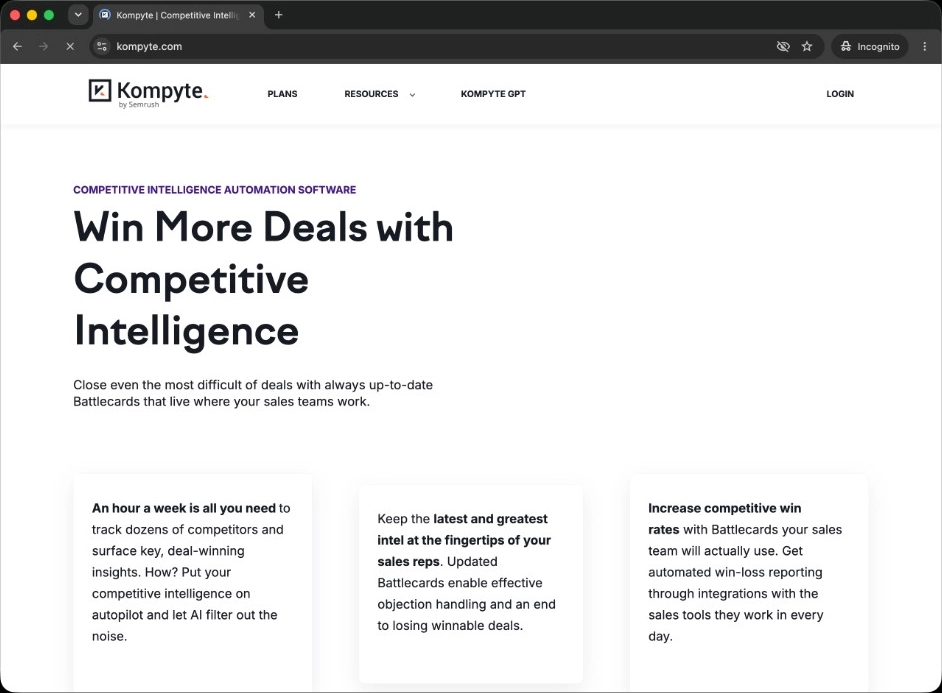
Kompyte, sold as Kompyte by Semrush after the 2022 acquisition, automates competitor tracking into battlecards inside the Semrush commercial relationship. Pricing is quote-based, typically per competitor and per user. Bundled Semrush deployments often start lower than a Klue program quote; standalone scope still grows with the watchlist. Verify current packaging before you model total cost of ownership.
For Klue leavers, Kompyte matters when the complaint was time-to-value: you wanted CI without another four-to-eight-week enablement rollout. Living in Semrush already shortens procurement and day-to-day habit. It does not erase maintenance. Flares themes that still apply after a Klue exit: shallow automated intel depth (about 9% of Kompyte G2 reviews), content going stale (about 13%), and battlecard work that remains manual. Faster start is real; a self-updating card library is not.
Contify
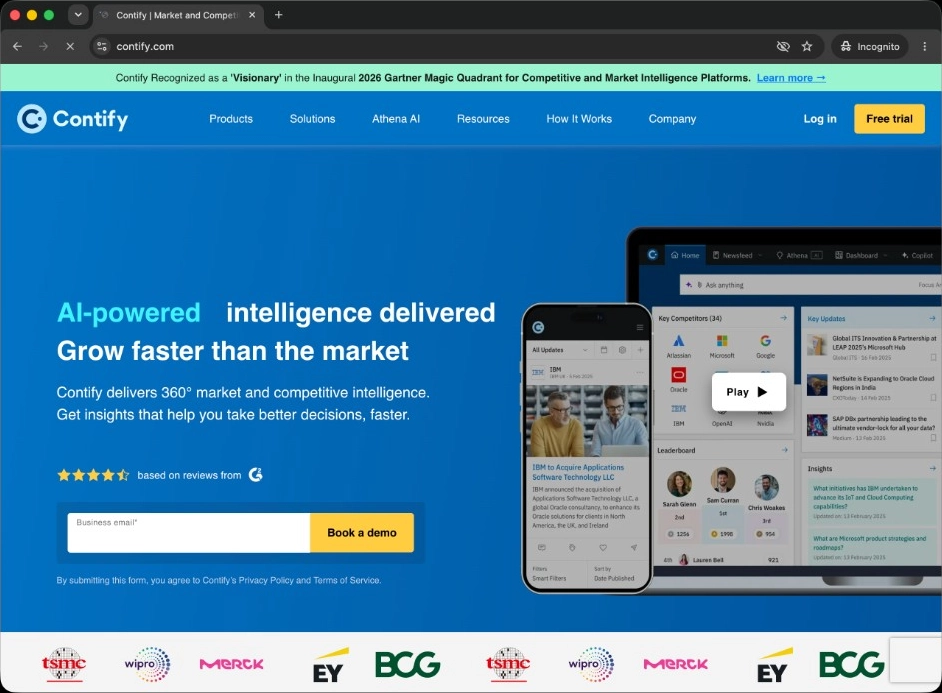
Contify is a market-intelligence platform more than a Klue-shaped sales-enablement system. It curates news, filings, hiring signals, and related sources across many entities. Pricing is quote-only; procurement estimates often land around $25k to $60k-plus per year.
Choose Contify after Klue when the real gap was market breadth, not battlecard distribution into Salesforce. If onboarding pain was the reason you left Klue, know that Contify brings its own configuration tax: steep learning curve (about 9% in the Flares sample), vendor-dependent customization (about 8%), and AI filtering complaints (about 6%). Time-to-value is measured in taxonomy work, not a Friday pricing watch. Skip Contify if you only need three named rivals' public pages kept honest while you rebuild a lighter enablement habit elsewhere.
Competiflow
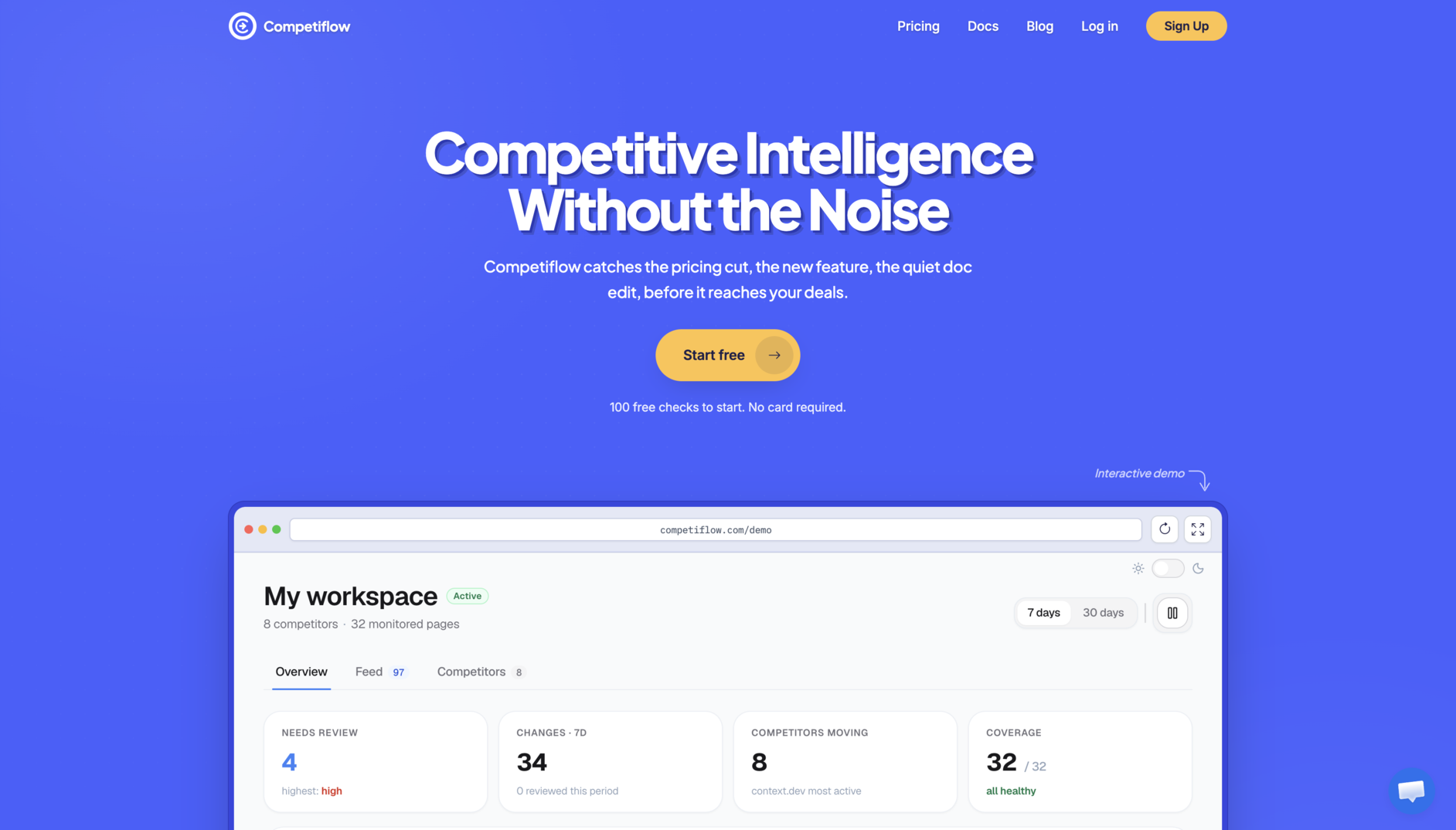
Competiflow is structured competitor monitoring for teams that need field-level evidence faster than an enterprise enablement rollout. Add a competitor by homepage URL; discovery finds pricing, changelog, docs, and related surfaces; monitors run on a cadence; each successful read spends one check. When a tracked field moves, the change names the path (for example plans[Team].price), shows old and new values, assigns severity, and adds why it matters as competitive context. Trial: 100 checks, up to 3 competitors, and up to 15 monitors on a daily cadence. Starter is $19 a month for 2,000 checks and 20 monitors with unlimited competitors; Growth is $49 for 5,000 checks on a six-hourly cadence; Pro is $99 for 10,000 checks hourly. Billing is by checks, not seats.
For Klue leavers, the fit is time-to-value on public pages: a pricing row you can trust before the next deal cycle, without waiting on a multi-week CSM-led implementation. It is a non-fit if you still need win/loss interview repos, a battlecard CMS, or Slack/Salesforce card distribution as the product. Keep Klue or move to Crayon for that program layer. Competiflow covers the factual monitor; your team still owns the narrative. See the competitor battlecards guide for card craft outside the suite.
Alert noise, onboarding, and stale battlecards
For Klue leavers, the sequence is usually onboarding first, then inbox quality, then card freshness. You paid for sales enablement. Weeks passed before reps saw a governed library. By the time the system was live, triage still needed a human owner.
Onboarding is the Klue-specific weight. Four-to-eight-week implementations are common for enterprise CI, and Klue's G2 corpus calls out setup effort and UI friction at about 4% each in the Flares 500-review study of Klue, Crayon, Kompyte, and Contify (2019 to 2026). That timeline is normal for CRM wiring and content governance. It is a bad fit if you expected a pricing page watched by Friday.
Alert volume compounds the slow start. Klue's share of reviews citing irrelevant alerts was about 3.3% in that corpus, lower than Crayon's ~10%, Contify's ~6%, and Kompyte's ~5%. Lower is better, but not free. Segment8's public write-up on leaving Klue put the labor cost plainly: roughly $18k spent to cover a slice of the workflow, with tens of alerts a day and most of them noise. After a long rollout, that noise feels like a second invoice.
Stale battlecards close the loop. Across the Flares corpus, Crayon's top dislike theme was battlecard editing, and Kompyte's top theme was content going stale. Klue's sales-enablement strength is also its maintenance burden: cards are hand-authored documents loosely coupled to live signal. When the owner changes roles, trust collapses. Sales stops opening the library. That is a program ownership failure, not a missing connector, and swapping suites without funding an owner rarely fixes it.
For lean teams, the practical split is simple. If you need a governed enablement program and will staff the rollout, stay in the Klue/Crayon lane. If you mainly need prices, plan names, and changelog entries kept honest while enablement lives in the wiki or CRM you already use, pair a structured monitor to the factual layer. Time-to-value improves when you are not waiting on a multi-week implementation to learn a competitor changed a plan price. For definitions that separate monitoring from full CI programs, see what competitive intelligence is.
Who should pick which tool?
Pick the tool that matches the job you will actually staff: enterprise sales enablement, collection-first CI, Semrush-bundled CI, market-wide research, or structured page monitoring. There is no universal winner among competitive intelligence tools.
| Your situation | Choose | Because |
|---|---|---|
| Dedicated CI/PMM owner Battlecards in CRM/Slack Win/loss inputs Sales adoption is the KPI |
Klue or Crayon | Enterprise CI suites are built for that program layer |
| Prefer Crayon's collection-first posture and digests over Klue's sales-enablement focus |
Crayon | Broad multi-source collection plus enablement Still enterprise cost and setup |
| Already on Semrush Want CI without a second mega-vendor relationship |
Kompyte | Bundle path and Semrush distribution Watch per-competitor metering |
| Track many market entities (news, filings, hiring) Not a short rival list |
Contify | Breadth-first market intelligence |
| Lean PMM or founder watching pricing and changelogs with field-level evidence |
Competiflow | Checks-based structured monitoring from $19/mo Starter; not a suite |
| Need win/loss interview repos plus battlecard CMS at enterprise scale |
Stay on Klue or Crayon | Competiflow explicitly does not replace that stack |
Competiflow appears once on purpose. It covers the monitoring job. It does not absorb the enablement job. If your RFP lists battlecard libraries, win/loss modules, and CSM-led rollout, shortlist Klue and Crayon. If your RFP lists "Team plan moved from $49 to $79 with evidence before the next deal cycle," shortlist structured monitoring and keep enablement elsewhere.
When staying on Klue is the right call
Staying on Klue is the right call when you already run (or will fund) the program Klue is sold for: battlecard governance, win/loss inputs, CRM and Slack distribution, and a human who owns the queue. Switching to a lighter monitor to "save money" while keeping the same enablement expectations usually fails.
Stay if sales leadership measures success by rep usage of cards, not by how fast a pricing row is detected. Stay if deal support, internal contributions, and CRM battlecard surfaces are in scope for the same platform. Stay if procurement already negotiated seats and the enablement team is productive inside Klue's workflow. In those cases Crayon is the real alternative conversation, not a $19 structured monitor.
Also stay when the pain is staffing, not software. If alerts are noisy because nobody triages, a different suite will reproduce the inbox. Hire or assign an owner before you rip out Klue. Hybrid setups are valid too: keep Klue for enablement, and point a structured monitor at the few pricing URLs that create revenue risk when missed. You do not have to make one vendor own every competitive workflow.
Do not stay only because migration is annoying if you never staffed the program and the invoice is the main artifact. At that point the alternative is a narrower job definition, not a feature matrix contest between four enterprise platforms.
Frequently Asked Questions
What is Klue competitive intelligence used for?
Klue competitive intelligence is used to curate competitor content, support win/loss style inputs, and run battlecards for sales and marketing stakeholders. It fits organizations with a dedicated CI or enablement owner. It is heavier than a page monitor when all you need is a pricing or changelog change with evidence.
What are the best Klue alternatives for lean teams?
The best Klue alternatives depend on the job. Crayon fits enterprise collection-plus-enablement programs. Kompyte fits Semrush-centric stacks. Contify fits broad market feeds. Competiflow fits structured pricing and changelog monitoring. None of them is a perfect clone of Klue.
How much does Klue pricing cost?
Klue pricing is quote-only. Industry and procurement estimates for Klue-class enterprise CI commonly fall around $30k to $80k a year, with larger deployments higher. Always confirm with Klue sales. For comparison, Competiflow Starter is $19 a month for 2,000 checks and covers a much narrower job.
Should I switch from Klue to Crayon?
Switch to Crayon if you want collection-first CI and digests more than Klue's sales-system battlecard model, and you accept another enterprise implementation. Stay on Klue if onboarding is done, reps already use the library, and the remaining pain is staffing. If the complaint was time-to-value on pricing pages alone, a structured monitor is the narrower alternative, not a second suite RFP.
How do Klue and Crayon differ for a Klue buyer?
From a Klue seat, Crayon usually trades some enablement focus for broader multi-source collection. Klue usually stays stronger when CRM/Slack battlecard adoption is already the KPI. Weigh cutover cost and another weeks-long rollout against the collection gains you expect. Run a short pilot on the same two rivals before you rip out a working enablement habit.
Does Competiflow replace Klue or Crayon?
No. Competiflow does not replace Klue or Crayon for enterprise win/loss programs, battlecard CMS workflows, or sales-enablement distribution. It watches public competitor surfaces and returns field-level changes with severity and evidence. Keep Klue or Crayon when that program layer is required.
What competitive intelligence tools should SMB teams shortlist?
SMB teams should shortlist by job, not by brand prestige. For lean pricing and changelog monitoring, structured tools like Competiflow are usually enough. For formal battlecards and win/loss at sales scale, Klue or Crayon remain the category. Kompyte and Contify fit Semrush-bundled CI and broad market research respectively.
Can I keep Klue and add a lighter monitor?
Yes. Many teams keep Klue (or Crayon) for enablement and add a structured monitor on pricing and changelog URLs so factual blocks stay current between card edits. That hybrid avoids ripping out a working sales workflow while cutting triage time on the pages that move revenue.
Klue remains the right enterprise CI platform when you staff battlecards, win/loss inputs, and sales enablement as one program. The alternatives above solve adjacent jobs: Crayon for collection-first CI, Kompyte inside Semrush, Contify for market breadth, and Competiflow for structured competitor page monitoring.
If you are choosing for lean pricing and changelog coverage after Klue, run a two-week bake-off focused on time-to-value. Keep your current Klue (or spreadsheet) habit on two rivals, and point one finalist at the same pricing URLs on day one. Note when the first trustworthy plan-price change landed, how many hours of setup it took, and how many alerts still needed a human to extract the number. Prefer the path that answers the deal question this week, not the suite that needs another implementation cycle to feel useful.