
A competitor raised their mid-tier plan from $49 to $79 three weeks ago. Your reps never heard about it, so they kept discounting to beat a price that no longer existed. Nobody connected it until the quarterly review.
That lag is the problem competitive intelligence exists to solve. The signal was public the whole time. What was missing was the system that turns a pricing row, a changelog entry, and three needless discounts into one decision someone actually makes.
This guide defines competitive intelligence for B2B SaaS teams: what it is, the four types worth knowing, how the intelligence cycle actually runs, and where lightweight monitoring feeds it without an enterprise program.
What you'll learn
- A precise definition of competitive intelligence and what it is not
- How it differs from market intelligence and competitor monitoring
- The four types of CI and which team owns each
- The six-stage intelligence cycle, and where monitoring fits inside it
- How to gather CI information, and what a finished CI report looks like
- How a small team runs CI without hiring an analyst
- Which tools fit enterprise programs versus lightweight ones
TL;DR: Competitive intelligence is the discipline of turning competitor and market signals into decisions. It runs as a cycle: plan, collect, process, analyze, disseminate, and feedback. Monitoring handles the collect stage. The analysis and dissemination stages are where a small team earns its keep.
What is competitive intelligence?
Competitive intelligence is the practice of gathering and analyzing information about your competitors and market, then using it to make better product, pricing, positioning, and sales decisions. That is the definition in one line. In practice, the meaning comes down to one test: the output is a decision someone can act on, not a growing pile of screenshots.
Most teams collect far more than they use. A folder of competitor screenshots sits idle. A battlecard that tells a rep how to handle "your rival is 40% cheaper" gets opened before the next call. Someone processed the raw signal into an answer to a question a person was actually going to ask.
Competitive intelligence is also not corporate espionage. It works from public and ethically sourced information: pricing pages, changelogs, job postings, earnings calls, review sites, analyst reports, and your own win/loss interviews. If you need a definition to defend in a compliance review, that is the line. Legitimate CI never involves misrepresentation, hacking, or lifting a competitor's confidential documents.
And it is not a one-time project. Markets move continuously, so intelligence that was current in Q1 is stale by Q3. The teams that get value treat CI as a standing capability that feeds decisions all year, not a slide deck someone builds before the annual planning offsite.
CI vs competitor intelligence
People use "competitive intelligence" and "competitor intelligence" almost interchangeably, but there is a useful difference in scope.
Competitor intelligence is narrow. It is everything you know about specific named rivals: their pricing, roadmap, positioning, hiring, and go-to-market. Competitive intelligence is broader. It includes competitor intelligence plus the market context around it: category trends, buyer behavior, adjacent entrants, and regulatory shifts that change the game for everyone.
In practice, most teams say "competitive intelligence" and mean both. The one time the distinction bites you is scoping a program. If you only track named competitors, you will miss the new entrant nobody put on the list yet. Good CI watches the category, not just the roster.
Competitive intelligence vs market intelligence vs competitor monitoring
Competitor monitoring watches specific rivals on specific pages. Competitive intelligence turns those signals plus market context into decisions. Market intelligence tracks the whole category. Here is how the three layers stack.
| Discipline | Question it answers | Scope | Typical output |
|---|---|---|---|
| Competitor monitoring | Did a specific rival move on a surface we watch? | Named competitors, specific pages | Interpreted change with severity and evidence |
| Competitive intelligence | What should we do about our competitors and market position? | Rivals plus category context | Battlecards, win/loss themes, strategy input |
| Market intelligence | Where is the whole market heading? | Buyers, segments, macro trends | Sizing, demand shifts, category forecasts |
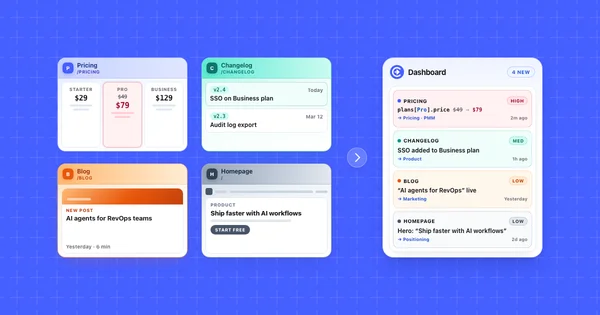
Competitor monitoring is the sensor layer. It answers "did the Team plan move from $49 to $79" with a dated diff you can verify. For the full breakdown of what monitoring is and how field diffs cut noise, see what is competitor monitoring, which owns that topic in depth.
Competitive intelligence sits above monitoring. It consumes those change feeds along with win/loss calls and analyst input, then produces the artifacts a PMM or founder acts on. Monitoring tells you a rival raised prices. Intelligence tells you whether to hold, match, or reposition against it.
Market intelligence is wider still and often owned by a different team. It asks where buyer demand is shifting, how big a segment is, and whether the category is consolidating. A rival's pricing move is a CI signal; imagine a hypothetical 30% drop in category search demand over two quarters, and that is a market intelligence signal. Both feed strategy, but they answer different questions and usually come from different sources.
The practical takeaway: you need monitoring to feed CI, and you need CI plus market intelligence to make strategy calls. Skipping the monitoring layer means your intelligence runs on anecdotes and stale screenshots.
The four types of competitive intelligence
Competitive intelligence splits into four types by time horizon and audience: strategic, tactical, product and technical, and market and customer. Most teams do some of each without naming them, but naming them helps you assign owners and avoid gaps.
Strategic intelligence is the long view. It informs where the company should compete over the next few quarters or years: category positioning, pricing architecture, which segments to enter or exit. The audience is founders, the executive team, and product leadership. A rival pivoting from SMB to enterprise is strategic signal, because it changes who you are fighting and how.
Tactical intelligence is the near-term, deal-level layer. It arms sales and marketing for the fights happening this week: battlecards, objection handling, competitive landing pages, and rapid responses to a competitor's campaign. The audience is reps, sales engineers, and demand gen. When a prospect says "your competitor throws in onboarding for free," tactical intelligence is what lets the rep answer in the moment.
Product and technical intelligence tracks what rivals ship and how they build. It covers feature parity, changelog velocity, API surface, integrations, and platform bets. The audience is product managers and engineers. A rival shipping an MCP server or a public API is a product intelligence signal that can reshape your own roadmap priorities.
Market and customer intelligence looks at buyers and the broader category rather than any single competitor. It covers segment demand, buyer sentiment on review sites, analyst coverage, and shifting evaluation criteria. The audience is product marketing and strategy. When buyers start asking every vendor about SOC 2 or data residency, that is a market signal that reprioritizes work across the whole competitive set.
You do not staff four separate functions for these. On a small team one person often covers all four with help from monitoring tools. The value of the taxonomy is that it exposes blind spots: teams heavy on tactical battlecards frequently have no strategic or market intelligence at all, which is how a category pivot catches them flat-footed.
Here are the four types side by side:
| Type | Horizon | Usual owner | Example decision | Typical source |
|---|---|---|---|---|
| Strategic | Quarters to years | Founders, executive team | Move upmarket or stay in SMB | Funding news, hiring patterns, analyst reports |
| Tactical | This week to this quarter | Sales, enablement, demand gen | How a rep answers "they include onboarding free" | Win/loss notes, pricing pages, rival campaigns |
| Product and technical | Next few releases | Product managers, engineers | Whether to build the integration a rival just shipped | Changelogs, docs, API references |
| Market and customer | Ongoing | Product marketing, strategy | Which evaluation criteria to answer on the website | Review sites, buyer interviews, analyst coverage |
Other splits exist. Veridion, for example, lists seven types: market, brand, supplier, product, customer, technology, and environmental intelligence.
The intelligence cycle: how competitive intelligence actually runs
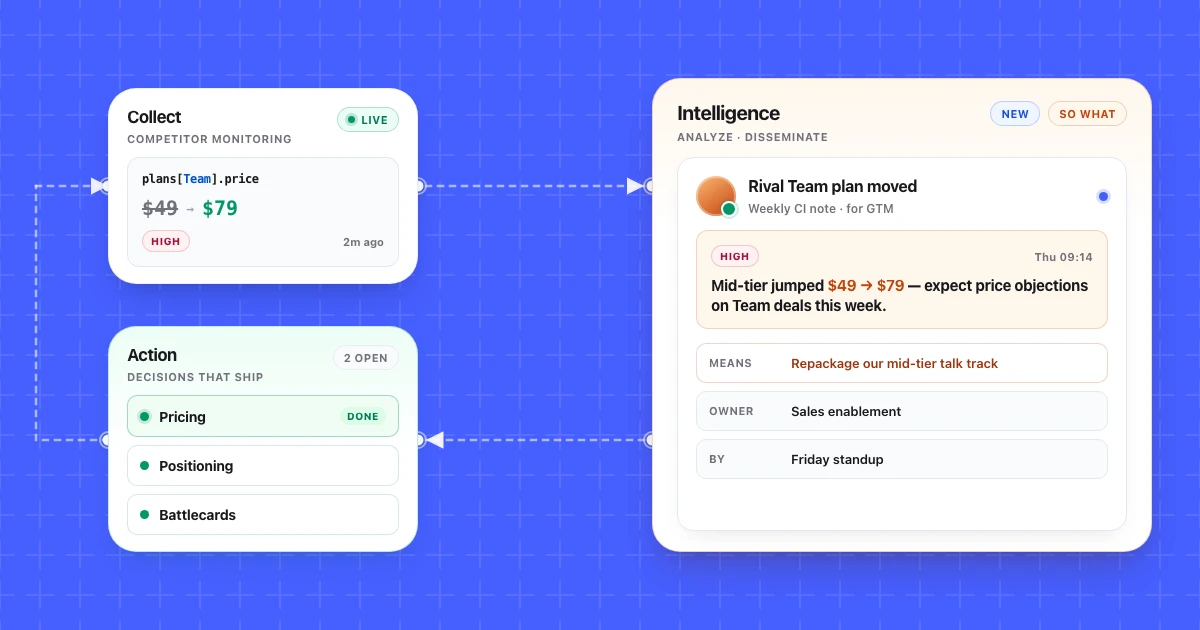
Competitive intelligence runs as a repeating six-stage loop known as the intelligence cycle: plan, collect, process, analyze, disseminate, and feedback. Each stage feeds the next, and the feedback stage restarts the loop with sharper questions.
1. Plan (direction). You define the questions worth answering. Not "watch everyone," but "which of our top three rivals is most likely to undercut us on price, and how would we know early?" Good planning names the decision the intelligence will support. Vague direction is the most common reason CI programs produce noise nobody reads.
2. Collect. You gather signals against those questions. This is where competitor monitoring lives. Scheduled checks on pricing pages, changelogs, docs, and homepages produce a continuous change feed. Collection also pulls from win/loss interviews, analyst reports, review sites, job postings, and earnings calls. Monitoring automates the repetitive web-facing part so humans spend their time on the sources software cannot read.
3. Process. Raw signals get normalized and filtered. A pricing page that changed becomes a structured, reviewable change you can verify before it reaches sales. Processing is what separates "the page changed" from "the Team plan went from $49 to $79." Skip this stage and analysts drown in raw data and alert noise from cookie banners, layout shifts, and other cosmetic diffs.
4. Analyze. Someone interprets what the processed signals mean together. One pricing move is a data point. That move plus a hiring spike in enterprise sales plus a new security page is a pattern that says "they are going upmarket." Analysis is the stage that produces judgment, and it is the stage software cannot fully replace.
5. Disseminate. The answer reaches whoever decides, in a form they will actually use. A battlecard in the sales wiki, a Slack digest to the PMM channel, a one-paragraph memo to the founder. Intelligence that dies in a dashboard nobody opens failed at this stage, no matter how good the analysis was.
6. Feedback. The decision-maker responds, and that response sharpens the next planning cycle. Sales says the battlecard missed the real objection. The founder asks a follow-up the collection plan did not cover. Feedback is what turns a linear report into a loop that gets more useful each pass.
Monitoring compresses stages two and three so a small team can spend its scarce human hours on four and five, where the actual value is. The changes feed is the collect-and-process output; the analysis and dissemination are yours to own.
Small SaaS teams often run the same loop as five stages: plan, gather, analyze, report, and refine. Processing folds into gathering, and feedback becomes the start of the next plan. The competitive intelligence process guide runs that five-stage version week to week.
Why competitive intelligence matters for SaaS teams
Competitive intelligence matters because SaaS moves faster than planning cycles, and the teams that decide from current signal beat the ones deciding from last quarter's anecdotes. The payoff shows up differently for each role.
For product marketing, CI is the difference between a battlecard that reflects reality and one reps quietly ignore. When a rival changes packaging, the PMM who catches it that week updates positioning before the next demo, not after losing five deals to it.
For founders and GMs, CI is early warning on existential moves. A category pivot, an aggressive free tier, or a pricing reset can reshape your market. Hearing about it from a churned customer is the expensive way. Hearing about it from your own feed, with evidence, is the cheap one.
For RevOps and sales enablement, CI keeps the competitive content current without a standing research meeting. Dated evidence flows in; enablement turns it into talk tracks reps trust because the underlying facts are verifiable.
Put those together and most CI programs chase some mix of four goals:
- Win more competitive deals, and keep customers a rival is courting
- Keep positioning accurate as rivals rewrite their messaging and packaging
- Feed the roadmap with what rivals ship and what buyers keep asking for
- Give leadership early warning on moves that change strategy, like a push upmarket or a new free tier
Here is a concrete scenario. A competitor raises their most popular plan from $49 to $79 per month.
In a team with no CI system, that surfaces weeks later as a quarter's worth of discounts nobody needed to give. In a team with one, the change lands in the feed the day it ships with old and new values attached.
The PMM writes a repositioning memo the same week: the rival is now about 60% more expensive on their flagship plan, so lead with value-per-dollar in the mid-market segment and give sales a fresh comparison line. Same public signal, completely different response time. A human still makes the call. The system just makes sure the call happens while there is still time to act.
Competitive intelligence for marketing teams
Marketing competitive intelligence is CI applied to what buyers see before they talk to sales: your messaging, your pricing page, and your comparison pages. It answers one question: does our public story still hold up next to the rival's current one?
Each of those surfaces has its own trigger. When a rival rewrites its homepage headline around security, your messaging review belongs in that week's plan. When its pricing page drops a tier, your own pricing FAQ may need a new answer. And every "us vs them" comparison page you publish needs the rival's current plans and features with a checked date, or it becomes the stale battlecard problem in public, where prospects can see it. For the tools marketing teams use for this job, see marketing intelligence tools.
How to gather competitive intelligence: where the information comes from
You gather competitive intelligence from three places: the public web, the people around your deals, and third-party market sources. Most of the skill is knowing which of the three answers your question fastest.
| Source group | Examples | How to gather it | Watch out for |
|---|---|---|---|
| Public web | Pricing pages, changelogs, docs, job posts, patent filings | Scheduled checks on the pages you would otherwise reopen by hand, each change dated and captured | Shows what moved, rarely why |
| People and deals | Win/loss interviews, sales call notes, support tickets that name a rival, exit notes from churned customers | A standing "which rival came up?" line in call notes, plus a handful of win/loss calls a month | Small samples; one loud deal can skew the picture |
| Market and third-party | Review sites, analyst reports, earnings calls, industry news | A quarterly read of reviews and reports, plus alerts on each rival's name | Lag, since reviews and reports describe last quarter |
The least obvious sources are often the most useful. A rival posting three enterprise account executive roles in a new region is telling you its go-to-market plan before any press release does. A patent filing can hint at product direction long before a launch. Review sites show which complaints keep repeating, and that is where your positioning has room.
Check every claim before it reaches sales. Each piece of competitive data that lands in a battlecard should carry a source link and the date someone last verified it. Secondhand claims, like a prospect saying a rival is "about to drop SSO pricing," stay marked as unconfirmed until a public page or a second source backs them up. A wrong fact in a rep's talk track costs more trust than a missing one. The competitive intelligence process guide covers how to split human time between primary and secondary sources week to week.
What does a competitive intelligence report look like?
A competitive intelligence report is a short document that answers one question with dated evidence, says what the change means for you, and names who acts on it. The good ones fit on one screen. Here is a sample built from the $49 to $79 price raise above. The rival and the dates are made up; the fields are the ones to keep.
| Field | Example |
|---|---|
| Question | Is our top rival changing pricing in a way that affects mid-market deals? |
| What changed | Their Team plan moved from $49 to $79 per month, first seen on the pricing page three weeks ago |
| Evidence | Link to the pricing page capture showing the old and new values, with the check date |
| So what | The rival is now about 60% more expensive on its flagship plan. Reps still discounting to match $49 are giving away margin. |
| Recommendation | Hold our price. Lead mid-market demos with value per dollar and add one comparison line to the battlecard. |
| Owner | PMM drafts the talk track by Friday; sales enablement rolls it out on Monday's team call |
Keep the same fields every time so readers learn where to look. A competitive report that changes shape each week gets skimmed, then ignored. When several changes land in one week, the weekly report stacks two or three of these blocks, highest stakes first.
A report and a battlecard do different jobs. The report helps someone decide how to respond. The battlecard tells reps what to say once that decision is made, which is why a good report often ends in a battlecard update.
How to run lightweight competitive intelligence (without an enterprise program)
You can run useful competitive intelligence with one person, a monitoring tool, and a weekly habit. You do not need a dedicated analyst or a six-figure platform to start. The trick is to run the full cycle at small scale rather than skipping stages.
Start narrow and prove the loop works:
- Plan one question. Pick the single decision you most want early warning on. Usually it is "is our top rival about to change pricing or positioning in a way that hurts us?" Write it down. That question scopes everything else.
- Collect with monitoring. Add your top competitor and let discovery seed pricing, changelog, and homepage monitors. Scheduled checks produce the change feed so you are not opening tabs by hand. The quickstart walks through adding your first competitor in a couple of minutes.
- Process automatically. Let the tool turn page reads into interpreted changes so you review "the Team plan moved to $79," not a wall of raw HTML or pixel noise. Each successful page read costs one check, whether the page changed or not. See what is competitor monitoring for how structured diffs work under the hood.
- Analyze weekly. Spend twenty minutes on the feed. For each real change, ask one question: does this alter a decision we would make? Most do not. The one or two that do are the whole point.
- Disseminate in one place. Post the week's meaningful moves to a single Slack channel or a short memo. One paragraph per change: what moved, why it matters, what you recommend.
- Feed it back. When sales or leadership responds, adjust what you watch next week. Add a surface, drop one that never earns its checks.
That is a complete intelligence cycle a solo PMM can run in under an hour a week. Scale it by adding competitors and surfaces only after the loop is delivering decisions, not before. The most common failure mode is buying coverage first and never building the weekly analysis habit, which leaves you with a bigger feed and the same lack of decisions.
Competitive intelligence tools and software
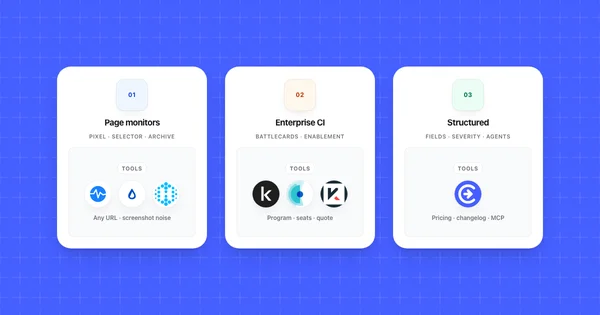
Competitive intelligence tools fall into two broad camps: enterprise CI platforms with analyst services, and lightweight monitoring tools that push interpretation to the user. Which one fits depends on whether you have a dedicated CI function or a busy PMM doing it on the side.
Enterprise CI platforms vs lightweight tools
Enterprise platforms bundle collection, analysis, and battlecard management into one system, usually priced per seat and aimed at teams with a dedicated CI role.
| Tool | Category | Best fit |
|---|---|---|
| Klue | Enterprise CI | Dedicated CI teams managing battlecards at scale |
| Crayon | Enterprise CI | Sales-led orgs wanting broad market and competitor tracking |
| Kompyte | Enterprise CI | Teams automating competitor tracking into sales enablement |
| Contify | Market and competitive intelligence | Analysts needing news, market, and competitor feeds together |
| Visualping | Website change detection | Watching any page for visual, text, or code changes |
| Competiflow | Lightweight structured monitoring | PMMs and founders who want interpreted change without a dashboard habit |
Enterprise suites earn their price when a CI analyst lives in the tool daily and the org has the budget for seats and services. Their risk is adoption: a platform that only the analyst opens produces intelligence the rest of the team never sees, which fails the disseminate stage of the cycle.
Lightweight tools trade breadth for fit. They focus on the collect-and-process layer, deliver interpreted changes through digests and APIs, and leave the analysis with you. Visualping sits at the change-detection end, useful for watching any page for visual, text, or code changes, with an AI flag for whether a change looks important. Competiflow sits between raw detection and full enterprise CI: structured field diffs, severity, and why it matters, metered in checks rather than seats.
Competitive intelligence services: outsource, buy a platform, or run it in-house?
You can get competitive intelligence done three ways: hire a CI services firm, buy a CI platform, or run it in-house with a monitoring tool and a weekly review. Pick by what you lack: research hours, software for an analyst you already have, or a steady feed a busy PMM can work from.
| Option | What you get | Fits when | Trade-off |
|---|---|---|---|
| Competitive intelligence services (agency or consultant) | Analysts who research, run interviews, and write reports for you | A one-off deep dive, such as a market entry or a pricing overhaul | Reports age fast, and the knowledge leaves when the engagement ends |
| CI platform | The enterprise suites in the table above, seat-priced, with battlecards and distribution built in | A dedicated CI role exists and works in the tool daily | Needs a full-time owner, or it turns into a dashboard nobody opens |
| In-house with monitoring | The lightweight route above: a change feed with evidence, and you do the analysis and distribution | A PMM or founder runs CI part time | The weekly analysis competes with everything else on their plate |
Plenty of teams mix them. An agency handles a yearly market study, and monitoring covers the weeks in between. Whichever route you take, someone inside the company still has to own the decision at the end of each report.
AI and agent-driven CI
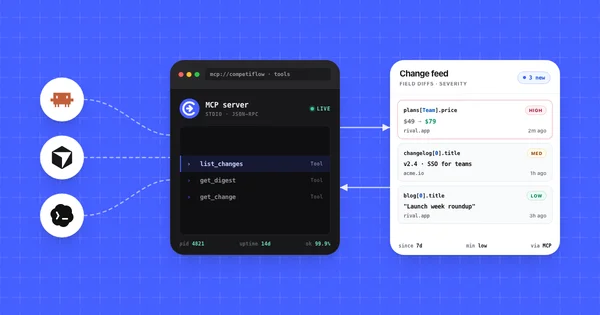
The newer camp is agent-driven CI, where an AI agent in your editor calls monitoring tools directly instead of you opening a dashboard. Your agent lists unreviewed pricing changes, pulls the evidence, and drafts a battlecard bullet in the same session, which collapses the collect, process, and dissemination stages into one conversation.
This works because the analysis stage still needs a human, but the mechanical stages around it do not. If you want to wire monitoring into an agent workflow, see how to monitor competitors with AI agents. For a side-by-side of the monitoring tools in this category, see the best competitor monitoring tools for SaaS.
Common misconceptions about competitive intelligence
A few beliefs quietly wreck CI programs. Naming them is the fastest fix.
"CI means watching everything." More coverage is not more intelligence. A feed that tracks fifty surfaces produces fifty streams of noise and zero decisions. Intelligence comes from answering a specific question, so scope collection to the decisions you actually make.
"Monitoring is competitive intelligence." Monitoring is the collect stage, not the whole cycle. If you stop at the feed, you have data, not intelligence. The value is in the analysis and the decision, which is the stage software cannot do for you.
"CI is only for large companies." The cycle scales down to one person and an hour a week. A solo PMM running the loop on their top rival gets more value than an enterprise that bought a platform nobody opens.
"CI is a research project you finish." Markets move continuously, so intelligence has a shelf life. A battlecard built once and never updated is worse than none, because reps trust stale facts. CI is a standing capability, not a deliverable.
"Good CI requires secret information." The signals that matter are almost all public: pricing pages, changelogs, job posts, review sites, earnings calls. Ethical CI uses only sources you can cite in a compliance review. If a tactic would embarrass you in a deposition, it is a liability, not intelligence.
"More alerts mean better CI." Alert volume is the opposite of intelligence. Scoping collection to the decisions you make, then processing noise out before it reaches humans, is what keeps a lightweight program usable week after week.
Frequently Asked Questions
What is competitive intelligence?
Competitive intelligence is the discipline of gathering and analyzing public information about your competitors and market, then using it to make better product, pricing, positioning, and sales decisions. It is a decision-support capability built on ethically sourced information.
What is CI?
CI stands for competitive intelligence, the practice of turning competitor and market signals into decisions your team can act on. In this context it does not mean continuous integration. Most teams use "CI" and "competitive intelligence" interchangeably.
What is market intelligence?
Market intelligence tracks buyer demand, segment sizing, category trends, and macro shifts across the whole market. Competitive intelligence focuses on named rivals and your immediate competitive set. Both feed strategy, but they answer different questions.
Is competitive intelligence ethical and legal?
Yes, when it uses public and ethically sourced information such as pricing pages, changelogs, job postings, analyst reports, and your own win/loss interviews. Legitimate competitive intelligence never involves misrepresentation, hacking, or obtaining a competitor's confidential documents.
What is the difference between competitive intelligence and market intelligence?
Competitive intelligence focuses on your competitors and the immediate competitive set, producing battlecards and positioning input. Market intelligence looks wider at buyer demand, segment sizing, and category trends across the whole market. CI asks what to do about rivals; market intelligence asks where the market is heading.
How do you do competitive intelligence?
Run the intelligence cycle at a scale your team can sustain: plan one question, collect signals (monitoring handles the web-facing part), process them into reviewable changes, analyze what matters weekly, disseminate the answer to whoever decides, and use feedback to sharpen the next cycle.
How does competitive intelligence relate to competitor monitoring?
Competitor monitoring is the collect stage that watches rival surfaces and reports interpreted changes with evidence. Competitive intelligence is the full cycle built on top, adding analysis, dissemination, and decision-making. Monitoring tells you a rival moved; intelligence tells you what to do about it. See what is competitor monitoring for the monitoring layer in depth.
What is the difference between competitive intelligence and battlecards?
A battlecard is one output of competitive intelligence, usually owned by the tactical type for sales enablement. Competitive intelligence is the whole discipline and cycle that produces battlecards, positioning memos, win/loss themes, and strategy input. You can have CI without a battlecard template; you cannot have a useful battlecard without a CI process feeding it.
What are the types of competitive intelligence?
The four main types of competitive intelligence are strategic, tactical, product and technical, and market and customer intelligence. They differ by time horizon and audience: strategic intelligence guides leadership over quarters or years, while tactical intelligence arms sales for this week's deals. Some frameworks split CI into as many as seven types.
What does a competitive intelligence report include?
A competitive intelligence report includes the question it answers, the dated change with evidence, what the change means for you, a recommendation, and a named owner. Keep it to one screen. A report that ends without an owner rarely turns into a decision.
What are examples of competitive intelligence sources?
Examples of competitive intelligence sources include competitor pricing pages, changelogs, job posts, patent filings, review sites, analyst reports, earnings calls, and your own win/loss interviews. Public pages show what a rival changed. Interviews and sales notes explain why buyers care.
Do I need competitive intelligence services?
You need competitive intelligence services only when you want outside analysts for research your team has no time for, such as a one-off market study. Most small SaaS teams get further running CI in-house with a monitoring tool and a weekly review hour. A CI platform makes sense once someone owns competitive intelligence full time.
Where to start with competitive intelligence
Competitive intelligence turns public signals into decisions your team makes on time. The four types tell you what to watch and who owns it. The competitive intelligence cycle tells you how to run it as a loop instead of a one-off report. Monitoring handles the repetitive collection so your scarce human hours go to the analysis that actually moves a decision.
Start with one question and one competitor. Let monitoring feed the collect stage, spend a focused hour a week on analysis, and put the answer where your team already works. That is a complete competitive intelligence cycle a solo PMM can run, and it beats an enterprise platform nobody opens.
When you are ready to wire up the collect stage, start free and follow the quickstart. To connect intelligence to an agent in your editor, read how to monitor competitors with AI agents. For the monitoring layer that feeds CI, see what is competitor monitoring. If you need to compare competitor surfaces side by side, build a competitive matrix on top of what monitoring discovers.