
Your team built a competitive landscape slide for the board in January. Twelve logos on two axes, a neat story about where you sit, and a note that said "refresh quarterly."
In June a prospect named three alternatives on a discovery call. Two of them were not on the slide. One was a point tool your buyers already used for half the job. The third was status quo: stay on spreadsheets. Your deck still showed the category as three direct SaaS rivals and you.
That is the usual failure mode. Landscape analysis gets treated as a positioning exercise you run once, then file. The buyer option set keeps changing. Pricing pages move. Adjacent tools add the feature that puts them in your deals. The status-quo option never leaves the shortlist, even when nobody puts a logo for it on the map.
This guide is the working method: map the full set of options a buyer actually weighs, place them on axes that match how deals are decided, pull a smaller deal matrix from that map, find white space, and keep the picture current with structured monitoring instead of quarterly archaeology.
What you'll learn
- The difference between landscape analysis, CI, a matrix, a battlecard, and SWOT
- How to map the full buyer option set, including adjacents and status quo
- How to gather sources with dates, then plot competitive positioning on two axes
- How to pull a deal matrix from the landscape without rebuilding matrix steps here
- How to run a light SWOT on clusters, find white space, and turn the map into decisions
- When to watch pricing and positioning pages so the map stays current
TL;DR: Competitive landscape analysis maps every option a buyer considers in your category, including direct rivals, adjacent tools, and doing nothing. Plot them on buyer-real axes, pull three to five deal rivals into a matrix, find white space, then watch pricing and positioning pages so the map stays true past the slide deck.
What competitive landscape analysis is
Competitive landscape analysis is the work of identifying every option a buyer could choose instead of you, placing those options relative to each other, and deciding where you compete. The unit of analysis is the buyer's choice set, not your internal competitor shortlist.
That distinction matters. Teams often start from "who looks like us" and end up with a tidy cluster of near-twins. Buyers start from a problem and end up with a messier list: an incumbent, a cheaper self-serve tool, a horizontal platform that "does enough," a specialist that covers one painful slice, and the option to keep the current process. If your map only contains lookalikes, you will miss the deals you lose to "good enough" and "not now."
A useful landscape answers four questions in order:
- Who or what is in the buyer's option set for this job?
- How do those options cluster on the criteria that decide deals?
- Where is there white space worth owning, and where are we crowded?
- Which names belong in deeper artifacts (matrix, battlecards) and which stay on a watchlist?
Market sizing and category forecasts can sit next to this work. They are not substitutes. Landscape analysis tells product, marketing, and leadership how the choice set looks today and where you should push.
For the broader discipline this feeds, what is competitive intelligence defines CI as the cycle that turns signals into decisions. Landscape analysis is one strategic input inside that cycle.
Landscape vs competitive intelligence vs the competitive matrix
A competitive landscape (also called a competitor landscape) shows the full buyer option set. Competitive intelligence is the ongoing discipline that consumes that map along with win-loss, monitoring, and market context. A competitive matrix narrows the set to three to five deal rivals scored on shared criteria. Battlecards and SWOT are derived artifacts with different jobs.
Teams collapse these into one spreadsheet and then wonder why nobody trusts it. Use the table when someone asks which document to open.
| Artifact | Question it answers | Scope | Typical shape |
|---|---|---|---|
| Competitive landscape | Who is in the buyer's option set, and how do they cluster? (leadership, product, marketing) | Full set: directs, adjacents, status quo | Two-axis map or cluster list with notes |
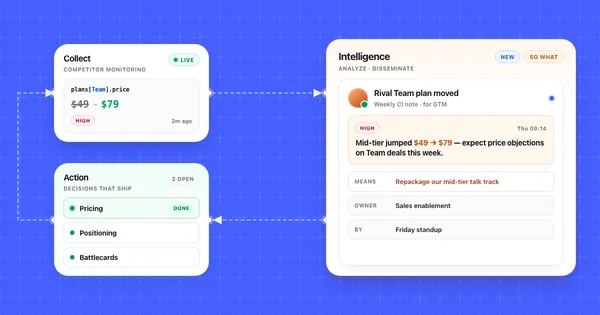
| Competitive intelligence | What should we do about rivals and market position? (PMM, founders, enablement) | Rivals plus category context over time | Cycle: collect, analyze, disseminate |
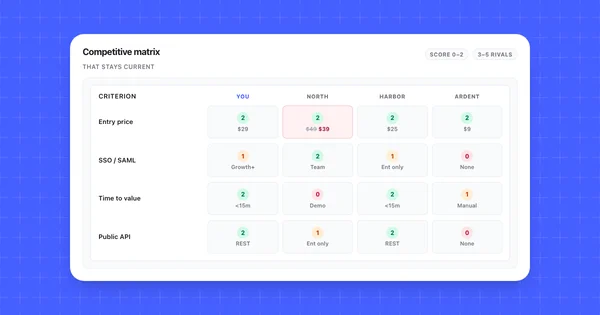
| Competitive matrix | How do we compare on criteria buyers weigh? (product, marketing, leadership) | 3–5 deal rivals | Grid: competitors by criteria, one fact per cell |
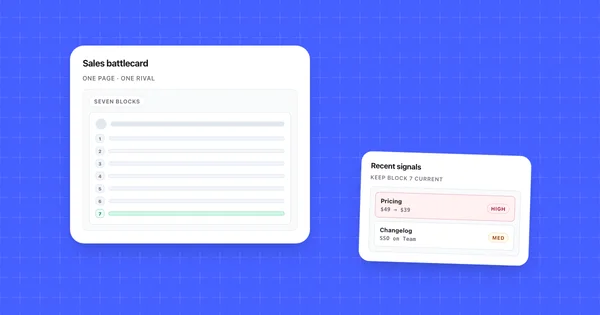
| Battlecard | What do I say on a call against this one rival? (sales, in the moment) | One competitor | Objections, traps, talk tracks |
| SWOT | What is true about us, internally and externally? (leadership, planning) | Usually one company (or one cluster) | Four quadrants |
Two boundary lines keep the work honest.
First, landscape is wider than the matrix. The matrix is a zoom lens on the names that decide deals. If you try to score twelve logos across ten criteria, the sheet dies of maintenance before the next planning cycle. Build the landscape first, then pull a smaller grid. The full matrix method lives in how to build a competitor comparison matrix; this post stops at the handoff.
Second, landscape is not CI by itself. A map without a refresh habit and without decisions is a slide. CI is the operating system: questions, collection, analysis, and distribution. Landscape analysis is a recurring planning product inside that system. Monitoring is the sensor layer that keeps the map from rotting; what is competitor monitoring covers that layer in depth.
When you need a one-rival talk track for a live deal, derive a competitor battlecard from one column of the matrix, not from the whole landscape map. When leadership asks "are we positioned where we want," open the landscape. When a rep asks "what do I say about Harborline," open the battlecard.
Map the full buyer option set
Start with every option a serious buyer weighs for the job you sell, then group those options into directs, adjacents, and status quo. Do not start with a logo list from a category report. Start from lost-deal reasons, discovery notes, and the alternatives prospects name unprompted.
Use three buckets. Directs compete for the same budget with a similar promise. Adjacents win part of the job or expand into your job from a neighboring one. Status quo is the current process, spreadsheet, or "wait until next year" decision. Status quo almost always belongs on the map, even though it has no homepage.
Worked scenario (illustrative)
Imagine you sell a mid-market workflow platform for ops teams. Northwind, Harborline, and Ardent are composite competitors with illustrative numbers used through this guide.
- Northwind is the incumbent direct. Bigger, older, wins on procurement comfort, loses on time-to-value. Appears in most competitive deals.
- Harborline is the fast-follower direct. Similar price band, ships weekly, lands features you announced last quarter. Wins on momentum.
- Ardent is the price-led direct. Self-serve, undercuts everyone, thin on contracts and compliance. Wins under about $5,000 a year.
- LedgerKit (adjacent) is a finance ops tool buyers already own. It added a lightweight workflow module last year. Prospects say "we might just use LedgerKit for this."
- Sheetstack (status quo) is the shared spreadsheet plus Slack reminders the team runs today. No vendor. Highest switching cost is habit and sunk process.
Your landscape has five options, not three. If you only map Northwind, Harborline, and Ardent, you will over-invest in parity against directs and under-invest in migration stories against LedgerKit and Sheetstack. Those two are often where deals stall, even when your product wins a feature bake-off against Northwind.
Inclusion tests
Promote a name onto the landscape when it passes at least one of these:
- It appears in CRM lost-deal reasons in the last two quarters.
- Buyers name it unprompted on discovery calls.
- It ranks on comparison or category keywords your buyers search.
- It already sits in the tech stack of your target accounts and can absorb the job.
Failing all four puts the name on a watchlist. Watchlist names get a one-line note and a quarterly glance. They do not get axes, SWOT cells, or battlecards.
Cap the active landscape at roughly eight to twelve options. Past that, clustering gets muddy. If the category is crowded, map clusters and keep individual logos for names that show up in deals.
Gather sources with dates attached
Every claim on the landscape needs a fact, a source, and a checked date. Without provenance, the map becomes a negotiation between whoever spoke last in the planning meeting.
Rank sources the same way you would for a matrix. Published vendor pages (pricing, homepage, docs, changelog, security) sit at the top. Your own trials sit next. Public filings move slowly and score high. Win-loss notes tell you what buyers believed. Review sites are leads to verify. Competitor claims relayed by prospects stay parked until you confirm them on a vendor page or in a trial.
You need less cell density than a matrix, but you still need dated facts for the attributes that place a logo on the axes: entry price band, time-to-value posture, compliance readiness, and the homepage lead claim.
A practical capture format (pricing figures are illustrative):
| Option | Fact used for placement | Source | Checked |
|---|---|---|---|
| Northwind | Team plan $39/mo + $0.02/unit | https://northwind.example/pricing |
2026-07-14 |
| Harborline | Homepage lead: "Ship workflow in a day" | https://harborline.example |
2026-07-14 |
| Ardent | Entry $9/mo, no SSO | https://ardent.example/pricing |
2026-07-10 |
| LedgerKit | Workflow module listed under Finance Ops add-ons | https://ledgerkit.example/modules |
2026-06-28 |
| Sheetstack | Status quo: shared sheet + Slack, no vendor | Win-loss notes, 12 deals | 2026-07-01 |
Notice the dates disagree. That is useful. A landscape where every row shares one stamp usually means nobody checked after the deck was built.
Pricing facts deserve extra care because they move without press releases. For those surfaces, how to monitor competitor pricing pages is the tactical companion.
Plot competitive positioning
Competitive positioning on a landscape map means placing each option on two axes buyers actually use to decide, then reading the clusters. The axes are the product. Pretty logo clouds with vague labels like "innovation" and "completeness" produce meetings, not decisions.
Pick axes from deal reality. Good pairs for B2B SaaS look like:
- Price predictability vs breadth of workflow
- Time-to-first-value vs procurement readiness
- Self-serve simplicity vs enterprise control
- Specialist depth vs platform coverage
Bad pairs are internal: "our roadmap maturity," "brand strength," "AI-native." If a buyer would not use the axis in a shortlist meeting, scrap it.
Place the worked set
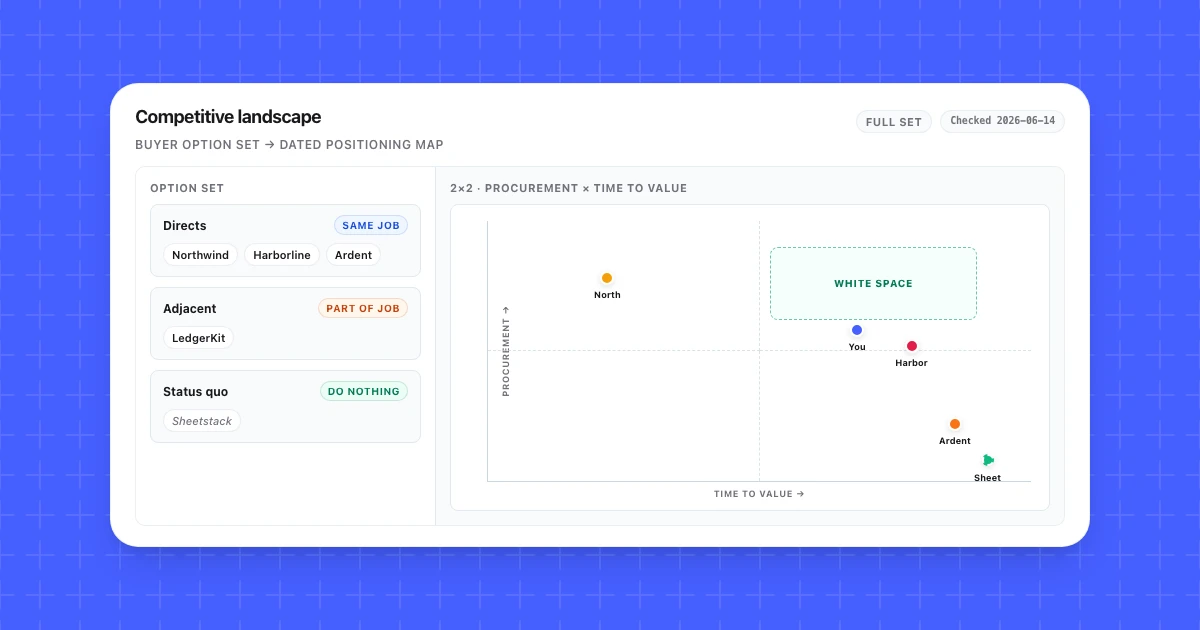
On a two-by-two grid with time-to-value on the x-axis and procurement readiness on the y-axis, the options land like this:
| Option | Time-to-first-value | Procurement readiness | Cluster |
|---|---|---|---|
| Ardent | Fast | Low | Cheap / quick |
| Harborline | Fast | Medium | PLG challenger |
| You | Fast | Medium-high | PLG with IT path |
| Northwind | Slow (demo-gated) | High | Incumbent |
| LedgerKit | Medium (already installed) | High if already vendor | Adjacent incumbent |
| Sheetstack | Immediate (already running) | N/A | Status quo |
Ardent lands in the bottom-right (fast, low readiness). Harborline sits mid-right (fast, medium readiness). You sit near Harborline but a notch higher on procurement. Northwind sits top-left (slow, high readiness).
Read the map by clusters, not by every pairwise gap. In this sketch you sit near Harborline on speed, with a slight edge on procurement readiness. Northwind owns the slow-but-safe quadrant. Ardent owns price-led speed. LedgerKit and Sheetstack sit outside the "buy a new workflow tool" frame entirely, which is why demos that only compare you to Northwind miss the real objection.
Write one positioning sentence per cluster, not per logo. Example: "Against PLG challengers we win on IT path without giving up speed. Against incumbents we win on time-to-value. Against status quo we need a migration story, not a feature list." Those sentences are what leadership reuses. The logo cloud is the draft behind them.
Revisit axes when loss reasons change. If deals start dying on data residency instead of setup time, the map needs new coordinates.
Pull a deal matrix from the landscape (don't rebuild it here)
Once the landscape is mapped, promote three to five deal rivals into a competitive matrix and leave everyone else on the watchlist. The matrix answers "how do we compare on criteria buyers weigh." The landscape answers "who is even in the set." Different zoom levels, different maintenance costs.
Promotion rules are simple. A name enters the matrix when it shows up in lost deals or live shortlists. A name stays on the landscape-only layer when it shapes category perception or stalls deals (LedgerKit, Sheetstack) but does not need eight scored criteria. Status quo rarely becomes a matrix column; it becomes a row of migration criteria and a battlecard objection instead.
For the worked scenario, the matrix columns are You, Northwind, Harborline, and Ardent. LedgerKit and Sheetstack stay on the landscape with notes. That keeps the grid maintainable while the wider map still explains "we lost to the tool they already pay for."
Do not rebuild matrix steps in this post. Criteria selection, 0–2 scoring, provenance columns, and the monthly cell-refresh ritual are already covered in how to build a competitor comparison matrix. Use that guide when you are ready to fill cells. Use this guide when you are still deciding which logos deserve cells at all.
Handoff in one page: columns to include and exclude, candidate decisive criteria from loss reasons, dated sources already collected, and open questions that need a trial. Without that brief, people rebuild the landscape inside the matrix tab.
Run a lightweight SWOT on clusters, not every logo
Run SWOT on clusters that share a competitive shape, not on every logo on the map. A twelve-logo SWOT set is theater. Three or four cluster SWOTs produce decisions.
For the worked set, useful SWOT units are: incumbent cluster (Northwind), PLG challenger cluster (Harborline + you, scored honestly), price-led cluster (Ardent), and non-purchase options (LedgerKit + Sheetstack). You still need an honest SWOT on your own company. You do not need a full SWOT on every adjacent that appears once a year.
Keep each SWOT short. Five bullets across the four quadrants beats twenty. Example for the incumbent cluster (illustrative):
| Quadrant | Notes |
|---|---|
| Strengths (theirs) | Procurement comfort, SSO on Team, support SLA |
| Weaknesses (theirs) | Demo-gated trial, usage pricing surprises at scale |
| Opportunities (for you) | Speed-to-value messaging in mid-market; predictability story |
| Threats (to you) | They cut entry price or ship a true self-serve path |
SWOT here translates the map into action. If a quadrant does not change a roadmap item, positioning line, or talk track, cut it. Never let SWOT replace the landscape or the matrix; those are where the dated facts live.
Find white space and competitive gaps
White space is a buyer need where the option set is weak or absent. A competitive gap is a place where you are weak relative to options buyers already consider. Teams confuse the two and ship parity features while ignoring open ground.
White space (across the map). Look for attributes where most options score poorly or stay silent. Worked example from the illustrative set: Northwind bills metered usage that jumps at 10x volume (pricing page checked 2026-06-12), Harborline meters after a soft cap (checked 2026-06-14), Ardent stays flat but stops at mid-market, and Sheetstack has no published ceiling because finance runs the model by hand. Mid-market buyers who ask "what do we pay at 10x?" get no clean answer from any option. If win-loss repeats that objection, predictable price at scale is white space you can own this quarter without waiting on a feature grid.
Gaps (in your column). Every place you lose to Northwind on SSO comfort or to Ardent on entry price is a gap. Gaps are roadmap or packaging decisions. Record whether you will close, hold, or reframe each one. An unrecorded gap returns in every planning meeting. For scoring those names on deal criteria, use how to build a competitor comparison matrix.
False white space. Empty space on a two-axis map is not automatically opportunity. Sometimes the quadrant is empty because buyers do not want that combination (cheap plus heavy compliance, for example). Validate against win-loss before you bet a roadmap on a blank region of a slide.
Monthly read: which criteria have no strong owner, which losses repeat, which adjacent is absorbing budget, and one line each for close, hold, or reframe. That log beats a prettier map.
Turn the map into decisions
A landscape earns its keep when it produces a short list of decisions with owners and dates. A slide with no decision log is unfinished work.
Aim for five decision types. You will not hit all five every quarter.
| Decision type | Example from the worked set | Owner |
|---|---|---|
| Positioning line | Own "predictable price at 10x usage" against Northwind's metered model | Marketing |
| Roadmap hold or close | Keep SSO on Growth; do not race Ardent on $9 entry | Product |
| Packaging | Publish a migration offer aimed at Sheetstack teams | Product + marketing |
| Sales enablement | Battlecard section for "we'll just use LedgerKit" | Enablement |
| Watchlist promotion | If LedgerKit appears in three more losses, promote to matrix | PMM |
Write decisions as sentences a skeptic can test. Bad: "Differentiate on experience." Better: "In mid-market deals against Northwind, lead with flat pricing and time-to-first-result; do not lead with feature breadth."
Common mistakes:
- Logo collecting past eight to twelve options
- Axes chosen so you sit alone in the "best" quadrant
- Scoring the whole landscape like a deal matrix
- Undated claims
- Omitting status quo
- Shipping the picture with no decision log
When not to overbuild
Skip a full landscape program when you have one clear rival, fewer than roughly fifteen deals a quarter, and leadership already agrees on positioning. In that case a living matrix plus two battlecards beats a twelve-logo map. Build the wider landscape when buyers name divergent alternatives, when adjacents start winning budget, or when a new segment needs a fresh choice-set read.
Also skip giant CI platforms on day one if you do not have a dedicated analyst. Enterprise suites such as Klue and Crayon fit teams that staff a full-time CI analyst running battlecard programs, stakeholder newsletters, and win-loss calls. Page-diff tools such as Visualping and Distill fit watching arbitrary URLs for any visual or DOM change. Those are different jobs from mapping buyer options and keeping pricing and positioning facts current for a small SaaS team. Pick the job first, then the tool.
Keep the landscape current
Keep a competitive landscape current by pairing a monthly map pass with ongoing watches on pricing, packaging, homepage positioning, and changelogs. Those surfaces move quietly; if you wait for the next planning cycle, a deal exposes the lie first. When an interpreted change alters an axis note or a decision, update the map the same week.
Attach cadence by surface:
| Surface | Why it moves the map | Suggested cadence |
|---|---|---|
| Pricing / packaging | Changes axis placement and gap math | Daily or near-daily watch |
| Homepage / positioning | Moves cluster story and lead claims | Weekly |
| Changelog / docs | Signals adjacent expansion or new tier gates | Daily for fast shippers |
| Security / compliance | Moves procurement readiness | Monthly |
| Win-loss themes | Reveals new options entering the set | Continuous from CRM |
Generic website monitors can tell you a page changed. They rarely tell you whether the change alters competitive positioning. Enterprise CI platforms can hold the narrative layer for large teams. For a small team, you want structured reads on the pages that place logos on the map, with enough interpretation to decide whether the map moves.
Competiflow fits as the refresh layer: add competitors by homepage URL, let discovery seed monitors for pricing, changelog, docs, and homepage. Then review interpreted changes with severity and a plain-language summary instead of a screenshot region. Use that feed to update axis notes and matrix cells. Monitor setup lives in Monitors. A weekly or monthly rollup of what moved is what Digest is for.
The ritual stays small. Thirty minutes at month start: read landscape-critical changes, move logos whose facts shifted, promote or demote watchlist names from CRM, rewrite the positioning sentences that no longer hold, and stamp the date. No archaeology.
That is the gap worth owning. Anyone can place logos once. The teams that win keep the buyer option set current while rivals are still updating the page.
Frequently Asked Questions
What is a competitive landscape?
A competitive landscape is the full set of options a buyer could choose in your category, including direct rivals, adjacent tools, and the do-nothing or status-quo path. Mapping it means naming those options and placing them relative to how buyers decide.
What is a landscape analysis?
A landscape analysis is the structured process of listing the buyer option set, gathering dated facts, plotting competitive positioning on buyer-real axes, and turning clusters into decisions. The deliverable is a living map plus a decision log, not a one-time slide. Refresh cadence is part of the analysis.
What must a competitive landscape include?
A competitive landscape should cover every option that can win budget or stall a deal: direct peers, adjacent tools already in the stack, and status-quo inertia. A shortlist of lookalike SaaS vendors is incomplete. If buyers raise the name on discovery calls or in win-loss notes, it belongs on the map even when it is not "your category."
How do you do a competitive landscape analysis?
Start from lost deals and discovery notes to list options, group them into directs, adjacents, and status quo, then attach dated sources for the facts that place each option on two axes. Plot clusters, pull three to five deal rivals into a matrix, run a light SWOT on clusters, find white space, write decisions with owners, and watch pricing and positioning pages so the map stays current.
How do you map the competitive landscape?
Place each buyer option on two decision axes and read the clusters that form. Use axes buyers would recognize in a shortlist meeting, such as time-to-value versus procurement readiness. Then write one positioning sentence per cluster and decide which names deserve a deeper matrix or battlecard.
What is an example of landscape analysis?
An example: a mid-market workflow vendor maps Northwind (incumbent), Harborline (fast follower), Ardent (price-led), LedgerKit (adjacent tool already in-stack), and Sheetstack (spreadsheet status quo). They plot time-to-value against procurement readiness, keep LedgerKit and status quo on the landscape only, and pull the three directs into a scored matrix. (Northwind, Harborline, Ardent, LedgerKit, and Sheetstack are illustrative composites.)
What is white space analysis?
White space analysis asks where the current option set is weak or silent, then tests whether that empty space is real demand or an empty quadrant nobody wants. It differs from gap analysis, which focuses on where you personally are weak. White space feeds positioning and roadmap bets; gaps feed parity and packaging choices.
What is competitive positioning?
Competitive positioning is the deliberate choice of what you are best at for a specific buyer, relative to the alternatives that buyer considers. On a landscape map it shows up as the cluster you occupy and the sentence you can defend with dated facts. Positioning copied from a column you win, rather than a need you uniquely own, tends to get matched within a few quarters.
The landscape is only as good as the last dated fact on it. Map the full buyer option set, place options on axes that match real deals, pull a smaller matrix for the names that decide revenue, and write down the decisions the picture implies.
Then keep watching the pages that move the map. Pricing, homepage claims, and changelogs rewrite competitive positioning without asking permission. A thirty-minute monthly pass beats another landscape-v4 deck that is already wrong.