
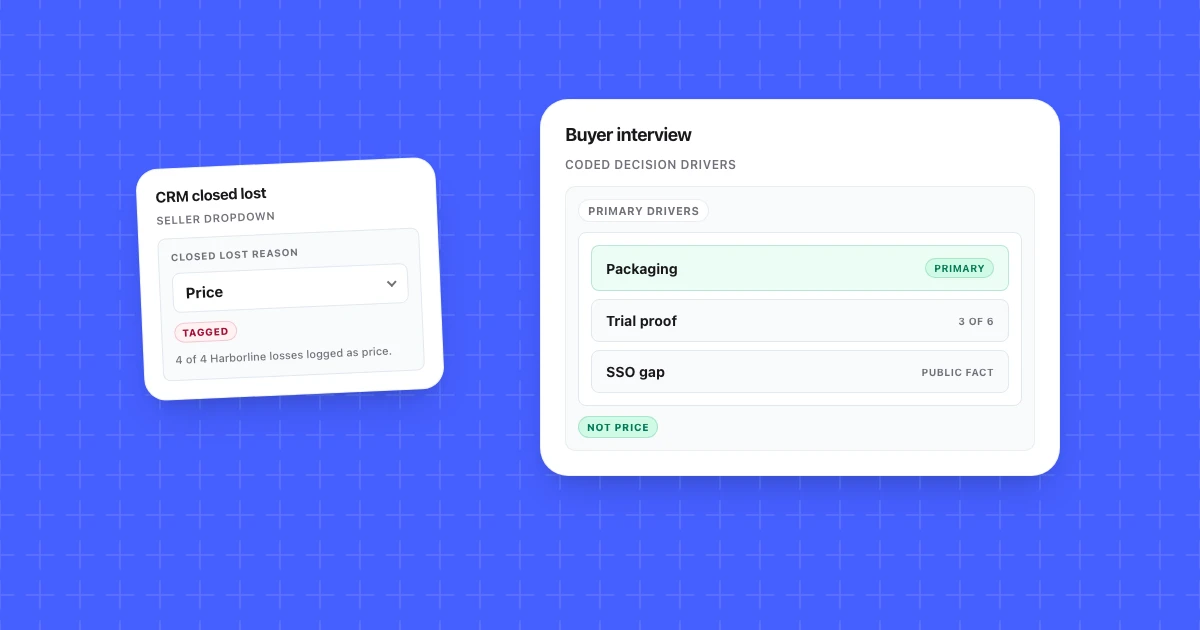
Your CRM says the deal died on price. The rep logged "too expensive," and the QBR slide treats that label as fact.
Three weeks later a buyer interview reverses it. Budget was real, the rival's packaging matched how they buy, and your trial never reached the workflow that would have justified the spend. Price was the polite exit line, not the decision driver.
Win-loss analysis catches that gap: structured buyer interviews on closed deals, coded into themes, then checked against public competitive facts.
What you'll learn
- What win-loss analysis is, and which jobs belong elsewhere
- Why CRM loss reasons mislead, with a named Harborline scenario
- Who should own the program, and why sales must not interview
- How to run interviews, code decision drivers, and ladder past price
- How to triangulate themes with public facts and ship enablement in 90 days
TL;DR: Win-loss analysis finds why deals close by interviewing buyers on wins and losses, coding themes into decision drivers, and checking those themes against public competitive facts. Do not trust CRM loss reasons alone. Run a steady cadence, keep sales out of the interviewer chair, and ship enablement updates within 90 days.
What win-loss analysis is (and what it is not)
Win-loss analysis is a program that interviews buyers on recently closed deals, codes what they say into recurring decision drivers, and turns those themes into product, messaging, and sales moves. It explains why a deal went your way or a rival's. It does not replace a category map, a fact spreadsheet, or a talk track for the next call.
Teams blur these jobs into one "competitive" folder and then wonder why nobody trusts any of it. Use the table when someone asks which document to open.
| Artifact | Question it answers | Shape | Typical owner |
|---|---|---|---|
| Win-loss analysis | Why did we win or lose this set of deals? | Interviews, theme codes, decisions | PMM or strategy, with RevOps support |
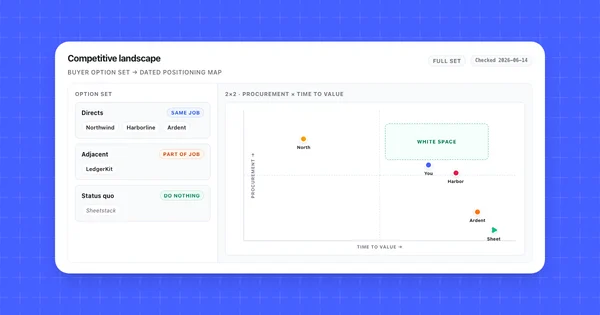
| Competitive landscape analysis | Who is in the buyer's full option set? | Map or cluster list | Product, marketing, leadership |
| Competitive matrix | How do we compare on criteria buyers weigh? | Grid: rivals by criteria | Product and PMM |
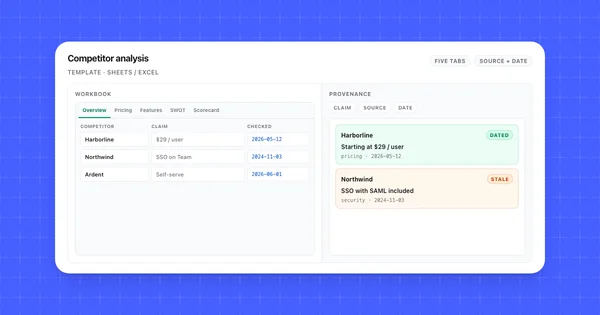
| Competitor analysis template | What do we know about each rival, with sources? | Multi-tab workbook | PMM, analyst |
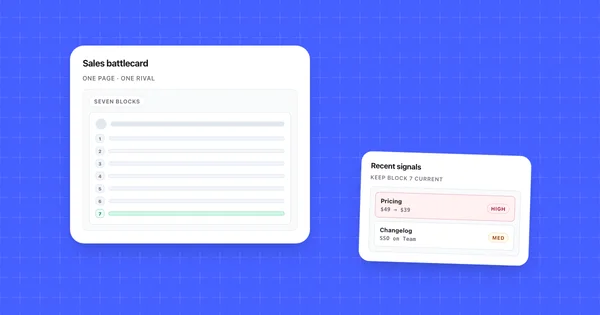
| Sales battlecard | What do I say on a call against one rival? | One page, one competitor | Sales + PMM |
One more boundary: win-loss is not a CRM report with nicer charts. If the only input is the "Closed Lost Reason" field a rep clicked under time pressure, you still only have a reporting habit. Interviews collect what buyers actually decided; the CRM tag is only a hypothesis to test.
Why CRM loss reasons mislead
CRM loss reasons mislead because they compress a multi-party decision into one dropdown chosen by the seller, usually within minutes of a painful call. "Price," "no decision," and "went with competitor" feel precise. They are often placeholders.
Named scenario: Harborline looks cheaper until you ask
(Illustrative composite. Harborline is a near-twin peer used as a worked example. Numbers and quotes are invented for teaching.)
Acme sells a workflow product at $79 per seat per month on Team. Harborline lists $49 per seat on a comparable tier. In Q2, Acme loses four mid-market deals where the AE logged Price in Salesforce. Leadership starts a discount program.
PMM runs six win-loss interviews across those losses and two wins against Harborline. The pattern that shows up:
- Buyers compared effective cost, not list price. Harborline's Team plan included SSO and audit logs. Acme gated both behind Business. Procurement quotes matched once packaging was equalized.
- Three buyers said Acme's trial never connected to their identity provider, so the "must-have" security story stayed theoretical.
- One "price" loss was actually a champion who left mid-cycle. The new buyer defaulted to the incumbent Harborline seat they already knew.
Public facts available the whole time: Harborline's pricing page showed SSO on Team; Acme's docs put SAML on Business. Nobody needed a secret discount war to see the packaging gap. The CRM said price. The interviews plus public pages said packaging and proof during evaluation.
| Signal | What CRM captured | What interviews + public facts showed |
|---|---|---|
| Loss reason | Price (4 of 4) | Packaging parity on SSO / audit; trial never reached security proof |
| Competitor named | Harborline | Harborline as near-twin, not a discount specialist |
| Recommended fix (early) | Broader discounting | Move SSO to Team or prove it earlier in trial; update battlecard packaging block |
| Time to wrong conclusion | Same day as close | 2–3 weeks of interviews to reverse the story |
Treat every CRM loss reason as a ticket to investigate. The finding starts when a neutral interviewer hears the buyer say it in their own words, then you check whether public competitive facts agree.
Five principles for a win-loss program that sticks
A win-loss program sticks when five habits hold. Skip any one and the program becomes a slide that dies after the first board pack.
- Interview both wins and losses. Wins tell you what to protect and what buyers over-index on in your pitch. Losses tell you what to fix. A losses-only program trains the company to narrate failure and miss the reasons you already win.
- Keep a steady cadence. Quarterly bursts feel productive and then vanish. A lighter monthly or biweekly interview habit beats an annual research project that never leaves the drive.
- Separate the interviewer from the deal team. The AE who lost the deal is the wrong person to ask "why did we lose?" Buyers soften answers, and reps hear confirmation. Use PMM, a trained operator, or a third party for the call.
- Code themes, do not collect quotes forever. A folder of transcripts is not analysis. Decide a small codebook of decision drivers, tag every interview, and report frequency plus severity (how often it decided the deal).
- Close the loop in 30 to 90 days. Every cycle should change something visible: a battlecard block, a pricing FAQ, a trial checklist, a product bet. If findings only appear in a deck, the next cycle will be harder to staff.
Who should run win-loss (and who should not interview)
Product marketing or a strategy lead should own the win-loss program. Sales and customer success should help recruit buyers and act on findings. Neither should run the interviews on their own deals.
Ownership looks like this in practice:
| Role | Owns | Does not own |
|---|---|---|
| PMM / strategy | Cadence, guide, codebook, synthesis, enablement briefs | Closing the original deal |
| RevOps | Sample pulls from CRM, stage definitions, win/loss hygiene | Interviewing buyers |
| Sales leadership | Access to champions, intros, acting on talk tracks | Writing the final theme codes alone |
| AE / SE on the deal | Context notes before the interview | Conducting the interview |
| Product | Intake of product-weighted themes | Replacing interviews with roadmap opinions |
Sales should not interview for a simple reason: incentives and memory. The buyer wants to stay kind. The rep wants the story to fit the forecast narrative. You get softer language ("timing," "budget freeze") when the deciding issue was trust, packaging, or a missing integration.
If your company is small, one person may wear two hats. Still split the roles in time: the person who owned the deal does not run that interview. Have a peer, founder-not-on-the-deal, or external researcher take the call. Neutrality is the product.
How to run win-loss interviews
Run win-loss interviews as short, structured conversations within a few weeks of close, on a mix of wins and losses, until themes start to repeat. Treat sample size as practice guidance.
Cadence and timing
Aim to interview while the decision is still fresh: ideally within two to four weeks of close date. Past sixty days, buyers reconstruct a neater story than the one they lived.
A workable rhythm for a mid-market SaaS team:
- Pull a weekly list of closed-won and closed-lost opportunities above a deal-size floor.
- Book two to four interviews per month (mix of wins and losses).
- Synthesize monthly; deep-dive quarterly for leadership.
If volume is low, interview every closed deal above your floor instead of waiting for a perfect sample.
Sample size as practice guidance
You do not need a hundred interviews to start. You need enough that the same drivers show up without you steering answers toward what you expect.
| Stage | Interviews (guidance) | What "enough" looks like |
|---|---|---|
| Pilot | 6–8 across wins and losses | Two or three themes repeat; CRM labels already look thin |
| Steady program | 8–15 per quarter for a focused segment | Codes stabilize; new interviews mostly reinforce |
| Segment deep dive | 10+ in one ICP or competitor pair | You can rank drivers for that slice with confidence |
Stop chasing N for its own sake. If the fifth Harborline loss repeats the same packaging story, write the finding and move enablement. Add interviews when a new segment, product line, or rival enters the mix.
Interview mechanics
- Ask for 25 to 35 minutes. Record with permission. Take notes even with a transcript.
- Open with the buyer's job and evaluation process, not your product pitch.
- Walk the timeline: trigger, shortlist, proof, procurement, decision.
- Ask who else was in the room and what each person optimized for.
- Name competitors only after the buyer does, then dig into comparison criteria.
- Close with "what would have changed the outcome?" and "what should we tell the next buyer like you?"
Do not argue with their memory on the call. Argue with your product and packaging afterward.
Win-loss interview questions that ladder past price
Good win-loss interview questions start with the buyer's process, then ladder into criteria, proof, and tradeoffs so "price" cannot end the conversation. Price is often real. It is rarely the whole story.
Use a short guide. Adapt wording. Keep the ladder. Work through the groups in order: process first, then criteria, comparison, the price ladder, and a short close.
Process and shortlist
- What triggered the search, and what did "done" look like for you?
- Which options made the shortlist, including staying put or building internally?
- Who owned the decision, and who could veto it?
Criteria and proof
- What criteria mattered in week one versus week six?
- Where did you need to see proof, and did each vendor give you that proof in time?
- Which integration, security, or workflow check almost killed the deal?
Comparison and tradeoffs
- When you compared us to [named rival], what did you put side by side?
- Where did packaging (what was included in which tier) change the math?
- If price was a factor, what number were you comparing, and what was included in each quote?
Ladder past "it was price"
- Help me understand the price gap: list price, discounted, or total cost with add-ons?
- If we had matched price, would you still have chosen the same way? Why?
- What non-price risk felt bigger than the invoice difference?
Close
- What would you tell a peer evaluating the same category next month?
- What should our team stop saying, because it did not match your experience?
Do not defend on the call. When every answer collapses to price, switch to total cost and proof: seats, mandatory add-ons, implementation, time-to-value. That is usually where the real driver sits.
Code themes into decision drivers
Code each interview into a small set of decision drivers so you can count what repeated, not only what sounded memorable. This light win-loss analysis template is a codebook you can reuse each quarter.
A practical codebook
Start with eight to twelve drivers. Merge ruthlessly. If a code appears once, it may be color; if it decides three deals, it is a driver.
| Code | Definition | Example buyer language |
|---|---|---|
packaging_parity |
What is included at which tier changes the comparison | "SSO was on their Team plan" |
time_to_value |
Speed to a working proof in trial or POC | "We never got past sample data" |
security_proof |
Ability to clear IT / security in cycle | "Questionnaire sat for three weeks" |
champion_risk |
Deal depends on one internal advocate | "Our sponsor left in May" |
integration_fit |
Must-have system connection | "No native sync to our CRM" |
incumbent_inertia |
Switching cost or familiarity bias | "We already had seats elsewhere" |
price_tco |
True cost after discounts and add-ons | "Their quote looked higher once we added SSO" |
trust_proof |
References, brand, or implementation risk | "We needed a peer in our industry" |
status_quo |
Decide later / keep current process | "We pushed to next budget year" |
Tagging rules
For each interview, tag:
- Primary driver: the one issue that most decided the outcome (forced choice).
- Secondary drivers: up to two contributors.
- Competitor named: who they chose or almost chose (including status quo).
- Segment: ICP slice, deal size band, or region.
- Evidence quote: one sentence in the buyer's words.
- CRM reason: the dropdown value, kept for the gap analysis.
Report themes as frequency of primary driver, then call out where CRM and codes disagree. That disagreement column is often the whole point of the program. Keep interview themes in the codebook; store rival facts (list prices, feature claims, URLs) in your competitor analysis template.
Triangulate interviews with public competitive facts
Interview themes get sharper when you check them against public pricing, packaging, and positioning facts dated to the evaluation window. Buyer memory explains motives. Public pages explain what the buyer could have seen without you in the room.
Run a simple triangulation after each synthesis cycle:
- List the top three decision drivers from interviews.
- For each driver, ask: which public page would confirm or contradict this?
- Open pricing, docs, security, and homepage positioning for you and the named rival.
- Capture source URL and checked date next to the theme.
- Mark each theme as
confirmed by public facts,buyer-only, orneeds product proof(something a page cannot show, like implementation quality).
Back to the Harborline example: interviews said packaging parity on SSO decided losses tagged as price. The public pricing and docs pages either confirm that gap or show you fixed it later. If the pages still disagree with your battlecard, the enablement problem is factual drift. Buyers were reading different packaging than your card claims.
This is also where continuous monitoring helps. If your team already watches rival pricing and positioning pages, you can attach a dated change to an interview theme ("SSO moved to Team on 2026-05-12") instead of reconstructing history from memory. Competiflow watches those public pages and surfaces interpreted changes for triage (monitors docs). It is not a win-loss interview platform. If you want the monitoring piece, you can start free.
When public facts and interviews conflict, believe the buyer about their criteria, then fix your facts and messaging. When they agree, you have a decision-ready finding: change packaging, change the trial path, or change what reps say in the first call.
Turn findings into sales enablement in 30–90 days
Win-loss findings earn their keep when something a seller or buyer sees changes within 30 to 90 days. Analysis without a ship date is a research hobby.
Use a short runway:
| Window | Ship | Owner |
|---|---|---|
| 0–30 days | Update the packaging and "where we lose" blocks on the relevant battlecard; send a one-page note to AEs | PMM + sales enablement |
| 30–60 days | Fix trial checklist gaps that interviews named (SSO, sample data, security packet); revise homepage or pricing FAQ if claims were wrong | PMM + product ops |
| 60–90 days | Rank product bets from repeated drivers; kill or pause discount experiments that interviews disproved | Product + leadership |
Do not rebuild the full battlecard craft here. The seven-block card, what to automate, and what stays human live in the competitor battlecards guide. Your job after win-loss is narrower: feed the blocks that interviews and public facts just corrected. Close each quarterly cycle with a one-page "what changed because of win-loss" note. That document is how you keep recruiting interviews next quarter.
Mistakes that waste a win-loss program
Most wasted win-loss programs fail from process shortcuts, not from missing a fancy framework. Fix the shortcuts below before you buy another tool or hire another consultant.
| Mistake | What it looks like | Fix |
|---|---|---|
| Trusting CRM dropdowns | Leadership steers from "42% price" charts | Treat CRM as a hypothesis; interview before you change pricing |
| Losses only | Every story is a postmortem | Interview wins in the same segments |
| Seller as interviewer | AE "catch-up" calls after a loss | Neutral interviewer; AE can provide prep notes only |
| Quote museum | Long decks of colorful buyer lines, no codes | Force a primary driver per interview |
| Annual big bang | One research sprint, then silence | Monthly interviews, quarterly synthesis |
| No public-fact check | Themes float free of pricing pages | Triangulate every top driver with dated URLs |
| Findings die in slides | No battlecard or product change in 90 days | Require a ship list with owners |
| Segment soup | Mixing enterprise and self-serve into one pie chart | Code and report by ICP or deal band |
The expensive failure mode is acting on the wrong driver: cutting price when packaging was the issue. Win-loss earns budget when it prevents that move.
Frequently Asked Questions
What is win loss analysis?
Win-loss analysis interviews buyers on closed deals, codes reasons into decision drivers, and turns those themes into product, messaging, and sales moves. It covers wins and losses. It is not a CRM loss-reason report.
Who should run win-loss analysis?
Product marketing or a strategy owner runs cadence, guide, coding, and synthesis. RevOps pulls the sample. Sales helps with intros and acts on talk tracks.
How many win-loss interviews do we need?
Start with six to eight across wins and losses. A steady program often lands around eight to fifteen per quarter for one focused segment. Stop when drivers repeat and enablement can act.
Should sales run the win-loss interviews?
No. Sales should not interview on their own deals. Have PMM, a trained neutral operator, or a third party run the call. Sales can still prep context and thank the buyer afterward.
Is win-loss analysis only for losses?
No. Interview wins and losses. Wins show what to protect. Losses show what to fix.
How often should we run win-loss analysis?
Interview on a monthly or biweekly habit, synthesize monthly, and brief leadership quarterly. Time calls within a few weeks of close while memory is fresh.
When is price not the real reason?
Price is often a polite summary when packaging, proof, champion risk, or incumbent inertia decided the deal. Ladder with follow-ups: which numbers were compared, what was included, and whether matching price would have changed the choice. Then check public pricing and packaging pages.
Start with interviews
Treat CRM loss reasons as tickets to investigate. Run a short interview cadence, keep sales out of the interviewer chair, and code what buyers say into decision drivers you can count. Check those drivers against public competitive facts, then ship one battlecard or trial fix within 90 days.
Six honest interviews and one corrected packaging story beat a hundred unread transcripts. If you already keep rival facts and battlecards, plug win-loss into that loop and keep the interviews focused on why buyers chose.