
Your competitor analysis template is a shared spreadsheet that started clean in Q1. Five tabs, three rivals, a notes column nobody reads. By June a rep quotes a price that left the pricing page in March, and the SWOT tab still describes a feature Harborline shipped eight weeks ago.
Nobody lied. The cells were true the day someone typed them. A template without a source URL and a checked date on every fact is a photograph with the timestamp torn off. This guide gives you the tab names, column headers, and fill rules so you can paste the structure into Google Sheets or Excel and keep it usable past the first planning cycle.
(Northwind, Harborline, and Ardent are composite competitors used as worked examples throughout. Numbers and URLs are illustrative.)
What you'll learn
- What a competitor analysis template is for, and which jobs belong in other artifacts
- How to name and structure the workbook tabs in Sheets or Excel
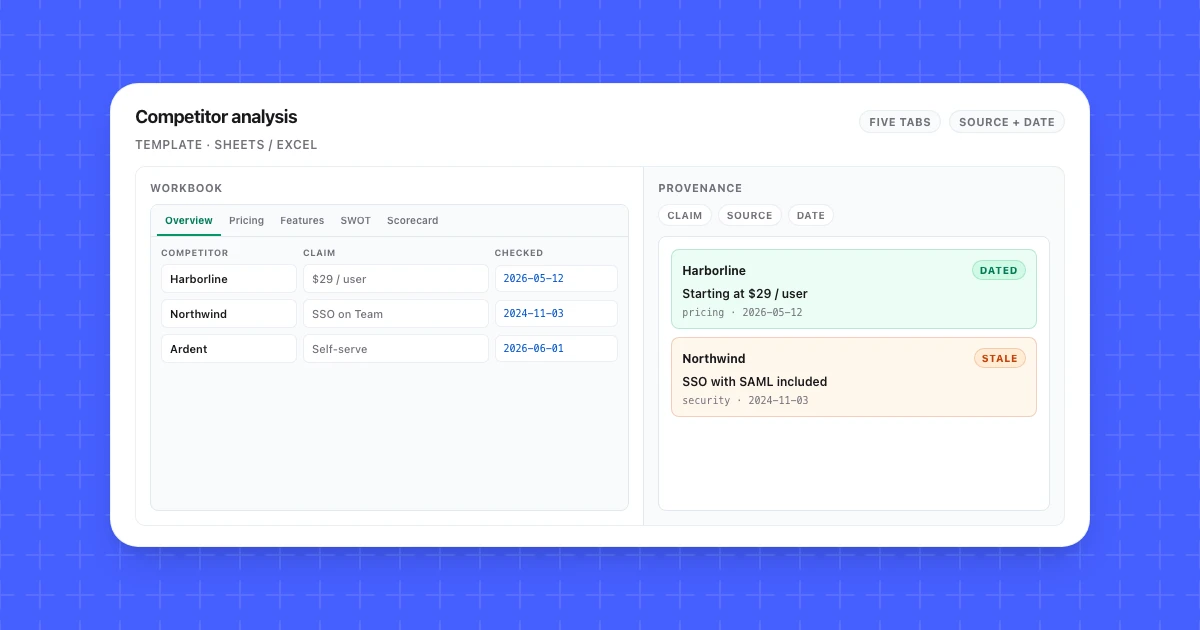
- How to fill the competitor overview template with provenance columns
- How to add pricing, features, SWOT, and scorecard sheets without rebuilding a matrix guide
- Why every fact cell needs a source URL and a checked date
- How to keep the competitor analysis spreadsheet current without quarterly rebuilds
- Mistakes that make a competitive analysis template quietly wrong
TL;DR: Paste a competitor analysis template into Sheets or Excel with five working tabs: overview, pricing, features, SWOT, and scorecard. Put one fact, a source URL, and a checked date on every cell that claims something about a competitor. Refresh volatile rows on a cadence instead of rebuilding the file each quarter.
What a competitor analysis template is (and is not)
A competitor analysis template is a reusable spreadsheet structure for capturing rival facts in fixed columns so the next person does not invent a new layout. It is a working file for product, marketing, and leadership. It is not a sales talk track, a category map, or a file you never customize.
The job is narrow on purpose. You open the sheet to record who a rival is, what they charge, what they ship, how you score against them, and where the evidence lives. When the same file also tries to win a live deal and plot twelve logos on two axes, nobody trusts any of the tabs.
| Artifact | Answers | Shape | Belongs in this template? |
|---|---|---|---|
| Competitor analysis spreadsheet | What do we know about each rival, with sources? | Multi-tab workbook: overview, pricing, features, SWOT, scorecard | Yes. This is the file. |
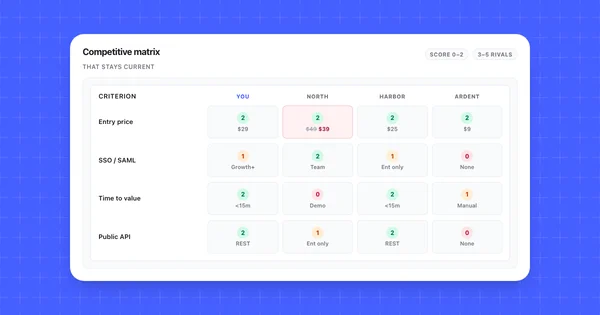
| Competitive matrix | How do we compare on criteria buyers weigh? | Grid: competitors by criteria, one fact per cell | Related. Build steps live in how to build a competitor comparison matrix. Your scorecard tab can feed it. |
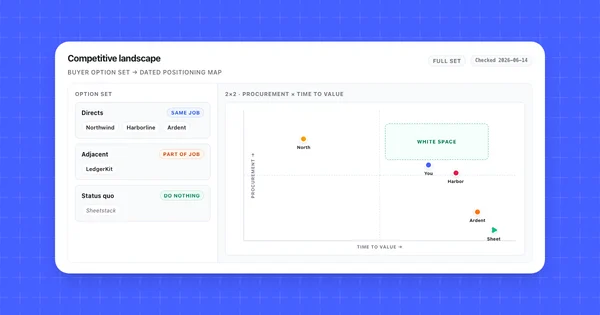
| Competitive landscape | Who is in the buyer's full option set? | Two-axis map or cluster list | No. Do that work in competitive landscape analysis, then pull three to five names into this workbook. |
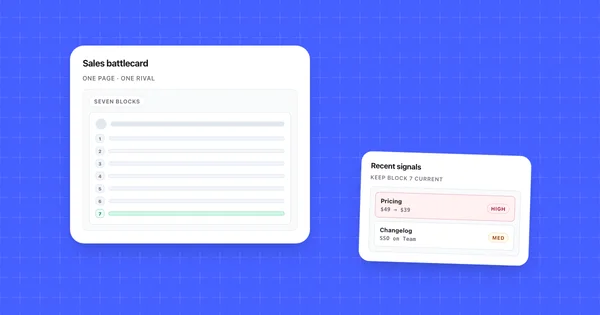
| Battlecard | What do I say on a call against one rival? | One competitor, objections and traps | No. Derive from one overview column; see competitor battlecards. |
| SWOT | What is true about us, internally and externally? | Four quadrants, usually one company | Yes as a thin tab. One SWOT per rival or one for you. |
Two rules keep the template honest. If a claim cannot carry a URL and a date, it stays in Notes until someone verifies it. If a tab does not get opened in a normal month, delete it. Fancy formatting is optional. Provenance is not.
Build the workbook: tabs and naming
Create one workbook with five working tabs plus a shallow watchlist, name each tab so a stranger can find the right sheet, and freeze the header row on every tab. Do this in Google Sheets or Excel the same way. You are copying structure, not fetching a branded blank file.
Suggested file name: competitor-analysis-YYYY-MM. When the schema changes, bump the month. Avoid v3-final clones in the same folder.
| Tab name | Purpose | Rows you expect |
|---|---|---|
00_readme |
Owners, refresh cadence, scoring rule, composite disclaimer | 10 to 20 lines |
01_overview |
One row per competitor: identity, ICP, positioning, status | 3 to 5 rivals + you |
02_pricing |
Plans, list prices, packing, verifiable discounts | One row per plan per competitor |
03_features |
Capabilities buyers ask about | 8 to 15 criteria |
04_swot |
Strengths, weaknesses, opportunities, threats | One block per competitor (or one for you) |
05_scorecard |
Shared criteria with 0 to 2 scores and provenance | Same criteria as your deal matrix |
99_watchlist |
Names not yet in the active set | Name, why, URL |
Numbered prefixes keep tab order stable. On 00_readme, write owner (one person), refresh cadence, the 0 / 1 / 2 scoring rule, and whether any rivals are composites. Use ISO dates in every checked_date column, put URLs in their own column, and keep one fact per cell. Do not paint your own column green by default.
Cap active rivals at three to five. For the worked file: Northwind is the incumbent, Harborline is the near-twin, and Ardent is the cheap self-serve option. Everyone else stays on 99_watchlist until they appear in lost deals or unprompted discovery mentions.
Fill the competitor overview template
Fill the overview tab with one row per competitor, identity fields first, then positioning and status, and attach a source URL and checked date to every claim that is not a proper noun. This is the competitor overview template most people mean when they ask for a company profile sheet.
| Column | What goes in it | Example (Harborline, illustrative) |
|---|---|---|
competitor |
Display name | Harborline |
homepage_url |
Canonical homepage | https://harborline.example/ |
category_role |
Incumbent / peer / price-led / adjacent | Peer (fast-follower) |
primary_icp |
Who they sell to in one line | Mid-market ops teams, 50 to 500 seats |
entry_motion |
Self-serve, sales-led, or hybrid | Hybrid: trial, then AE |
positioning_claim |
Their homepage promise in their words | "Ship competitive insights without a CI team" |
positioning_source_url |
Page where that claim appears | https://harborline.example/ |
positioning_checked |
Date you verified the claim | 2026-07-14 |
status |
Active / watchlist / retired | Active |
owner_notes |
Internal only: why they matter | Shows up in 30% of lost mid-market deals |
last_full_review |
Date of last pass across all tabs | 2026-07-14 |
Worked overview rows (illustrative composites):
| competitor | category_role | entry_motion | positioning_claim | positioning_checked |
|---|---|---|---|---|
| You | (your role) | Self-serve + AE | Your real homepage line | 2026-07-14 |
| Northwind | Incumbent | Demo required | "The trusted platform for competitive ops" | 2026-07-14 |
| Harborline | Peer | Hybrid trial | "Ship competitive insights without a CI team" | 2026-07-14 |
| Ardent | Price-led | Self-serve only | "Competitor tracking that stays cheap" | 2026-07-14 |
Quote positioning in the rival's words. Skip vanity fields you cannot refresh. Put yourself on the sheet. Soft judgment (owner_notes, ICP guesses) can skip source columns if labeled internal. Everything else gets a URL and a date.
Add pricing and features sheets
Add pricing for plan economics and features for buyer-facing capabilities. Keep each tab to column schema and fill rules. Pricing and features are the sourced fact tabs; SWOT and scorecard sit later because they layer judgment on those cells.
02_pricing
One row per published plan.
| Column | Example (Northwind Team, illustrative) |
|---|---|
competitor |
Northwind |
plan_name |
Team |
list_price |
$39 / mo |
price_unit |
Per workspace + $0.02 / unit |
billing_options |
Monthly, annual (-20%) |
source_url |
https://northwind.example/pricing |
checked_date |
2026-07-14 |
confidence |
High (vendor page) |
| competitor | plan_name | list_price | price_unit | checked_date |
|---|---|---|---|---|
| You | Growth | $29 / mo | Per workspace, flat | 2026-07-14 |
| Northwind | Team | $39 / mo | Per workspace + $0.02 / unit | 2026-07-14 |
| Harborline | Pro | $25 / mo | Flat to 50k events | 2026-07-14 |
| Ardent | Starter | $9 / mo | Per workspace, flat | 2026-07-14 |
If a price came from a prospect repeating a sales quote, set confidence to Low until you see it on a page or in a trial.
03_features
Rows are capabilities a buyer asks about. Columns are competitors. Keep a provenance block under the grid so the pretty table never becomes the only record.
| criterion | You | Northwind | Harborline | Ardent |
|---|---|---|---|---|
| Time to first useful result | Under 15 min, self-serve | Demo required before trial | Under 15 min | Fast signup, manual setup |
| SSO / SAML at buyer tier | Growth and above | Included on Team | Enterprise only | Not offered |
| Public REST API | Documented, no gating | Enterprise only | Documented | None |
| Data export in-app | CSV and JSON | CSV via support | CSV in-app | CSV, weekly cap |
| cell | fact | source_url | checked_date |
|---|---|---|---|
| Northwind · SSO | SAML included on Team | https://docs.northwind.example/sso |
2026-07-14 |
| Harborline · SSO | SAML GA, Enterprise only | https://harborline.example/changelog/saml |
2026-07-18 |
| Ardent · API | No public API | https://ardent.example/docs |
2026-07-14 |
Eight to fifteen criteria is enough. A forty-row feature dump dies first. Pull criteria from lost-deal reasons and discovery questions, not from your roadmap wishlist.
Add SWOT and scorecard sheets
Add a thin SWOT tab for judgment and a scorecard tab that points at sourced facts. Keep both short enough that someone can refresh them in the monthly pass.
04_swot
Four bullets per quadrant, max. Example Harborline block (illustrative):
| Quadrant | Notes |
|---|---|
| Strengths | Weekly ship cadence; clear mid-market pricing; API documented |
| Weaknesses | SSO gated to Enterprise; support is next-business-day only |
| Opportunities | Buyers asking for "lighter than Northwind"; win-loss mentions setup speed |
| Threats | Could drop SSO a tier; usage metering may appear above 50k events |
SWOT is judgment layered on facts. If a bullet cannot point at a sourced cell on pricing or features, label it as a hunch.
05_scorecard
Use one row per shared criterion and columns for each competitor plus score, one_line_fact, and a pointer to the sourced pricing or features cell. Put the scoring scale on 00_readme once. For choosing criteria and reading white space end to end, use the competitive matrix guide. Do not average scores into a vanity total. When names leave the deal set, demote them to 99_watchlist.
Require a source URL and checked date in every fact cell
Every fact cell in a competitor analysis template needs three parts: the claim, the source URL where you saw it, and the date you checked. Without those two provenance fields, the sheet cannot be audited, refreshed, or defended in a planning review. Most competitive analysis templates skip this and leave "where did we learn that" as optional notes. Optional notes are where stale prices hide.
| Field | Required on | Example |
|---|---|---|
fact |
Overview claims, pricing, features, scorecard | Team plan is $39/mo + $0.02/unit |
source_url |
Same | https://northwind.example/pricing |
checked_date |
Same | 2026-07-14 |
confidence |
Pricing and anything not from a vendor page | High / Medium / Low |
| Tier | Source | Allowed in fact cells? |
|---|---|---|
| 1 | Vendor pricing, docs, changelog, security page | Yes |
| 2 | Your own trial or free account | Yes |
| 3 | Public filings, marketplace listings | Yes, with date |
| 4 | Win-loss and CRM notes | Yes for buyer belief; verify before treating as product fact |
| 5 | Review sites and community threads | Only after tier 1 or 2 check |
| 6 | Competitor claims relayed by prospects | No. Log as a lead, then verify. |
Worked provenance rows for the illustrative Northwind price change:
| cell | fact | source_url | checked_date | confidence |
|---|---|---|---|---|
| Northwind · Team price | $39/mo + $0.02/unit | https://northwind.example/pricing |
2026-07-14 | High |
| Northwind · Team price (prior) | $49/mo flat | https://northwind.example/pricing |
2026-04-02 | High (archived check) |
| Harborline · SSO | SAML on Enterprise only | https://harborline.example/changelog/saml |
2026-07-18 | High |
| Ardent · SSO | "SSO is coming" via prospect | (none yet) | 2026-07-10 | Low · not a fact cell yet |
Keep the prior price with its own checked date. Prefer adjacent columns (fact | source_url | checked_date) so you can sort for staleness. Cell comments work for rare overview fields; they fail for pricing.
Staleness rule for 00_readme: high-volatility fields (price, plan packing, feature tier gates) older than 30 days are unverified until someone re-opens the URL. Security and support commitments can sit at 90 days. If two people disagree about a cell, the URL decides.
Keep the competitor analysis spreadsheet current
Keep the spreadsheet current by attaching a refresh cadence to each row type, reviewing volatile tabs monthly, and watching public pages so you learn about price and feature moves before a prospect does. The usual failure mode is a file built once, cited for months, and wrong in silence.
| Row or tab | How often it moves | Suggested refresh |
|---|---|---|
| Pricing list prices and packing | A few times a year, often quiet | Weekly eyes or a page monitor |
| Feature tier gates and API surface | Monthly for fast shippers | Weekly on changelog and docs |
| Homepage positioning claims | Quarterly | Monthly overview pass |
| SWOT bullets | When facts move | After pricing or feature changes |
| Scorecard scores | When the underlying fact moves | Same day as the fact update |
| Security / SOC status | Yearly | Quarterly manual |
| Watchlist names | Event-driven | Monthly skim of lost-deal reasons |
Monthly refresh ritual
First Monday, about thirty minutes:
- Sort
02_pricingand03_featuresbychecked_dateascending. - Re-open every URL older than your staleness rule.
- Update the fact, stamp today's date, adjust the scorecard if the score changed.
- Rewrite any SWOT bullet that pointed at the old fact.
- Promote or demote watchlist names from CRM loss reasons.
Manual review works for two rivals and a handful of URLs. Past that, page monitoring pays for itself on pricing, changelog, docs, and homepage surfaces. Example: an interpreted pricing change for Northwind Team lands Tuesday; the owner updates 02_pricing list_price, stamps checked_date, and adjusts the matching scorecard row the same day.
Competiflow is optional here: add a competitor by homepage URL, seed monitors for those surfaces, and treat interpreted changes as a queue of cells to update. Monitor setup is in Monitors. You still need a cadence and an owner first. Update price and packaging cells the same day you learn about them; medium changelog items can wait for Monday.
Common mistakes when using a competitive analysis template
Competitive analysis templates fail when they sprawl, skip provenance, mix audiences, or sit without an owner.
- Too many active competitors. Cap at five. Park the rest on
99_watchlist. - No source URL or checked date. Six months later nobody knows where Ardent's price came from.
- One tab doing four jobs. Split overview, battlecards, landscape, and SWOT. Link out when those jobs appear.
- Feature rows written from your roadmap. Pull criteria from lost-deal reasons and discovery questions.
- Relayed sales claims treated as facts. Verify on a tier 1 or 2 source first.
- No owner and no cadence. Name a person. Put the monthly pass on a calendar.
- Pretty scorecard, empty provenance. Scores without URLs are opinions with formatting.
- Never retiring rows. Delete cosmetic criteria and dead rivals.
Trust in month four comes from short tabs, dated cells, and an owner who can say "we do not know yet."
Frequently Asked Questions
What is a competitor analysis template?
A competitor analysis template is a reusable spreadsheet layout for recording rival facts in fixed columns across overview, pricing, features, SWOT, and scorecard tabs. It exists so every claim sits next to a source URL and a checked date. It is a working research file, not a battlecard and not a landscape map.
What is a competitive analysis template?
A competitive analysis template is a reusable spreadsheet structure for capturing rival facts in fixed columns across overview, pricing, features, SWOT, and scorecard tabs. Teams use "competitive analysis template" and "competitor analysis template" for the same multi-tab file. What matters is the schema and the provenance, not the filename label.
How do you create a competitor analysis spreadsheet?
Create a workbook with a readme, overview, pricing, features, SWOT, scorecard, and watchlist tab. Add three to five active rivals, define a 0 to 2 scoring rule once, and require source_url and checked_date on every fact. Fill overview and pricing first, then features and scores. Set a monthly refresh pass before you share the file widely.
What should a competitor overview template include?
A competitor overview template should include name, homepage URL, category role, ICP, entry motion, a quoted positioning claim with source and date, status, and internal notes. Skip vanity metrics you cannot re-verify. Include a row for your own company scored with the same coldness as every rival.
Competitor analysis template Excel or Google Sheets: which is better?
Either works if the columns stay the same. Google Sheets is easier for shared ownership and simultaneous edits. Excel is fine when the file lives in a controlled drive with clear check-in habits. Pick the tool your team already opens weekly. The schema matters more than the vendor.
How often should you update a competitor analysis template?
Update pricing and tier-gated features at least monthly, and sooner when you learn about a change. Re-check homepage positioning monthly. Refresh SWOT when underlying facts move. Run a full pass across active rivals each month with one named owner. Volatile rows deserve page monitoring once manual tab-opening falls behind.
What is the difference between a competitor analysis template and a competitive matrix?
A competitor analysis template is the multi-tab evidence workbook (overview, pricing, features, SWOT, scorecard). A competitive matrix is the criteria-by-competitor grid used to compare deal rivals on buyer decision factors. The scorecard tab can mirror a matrix, but the full method for choosing criteria and reading white space is in how to build a competitor comparison matrix.
Can I use a free competitor analysis template without a download?
Yes. Use the template generator at the end of this article to copy Markdown or download an Excel workbook (.xlsx — import into Google Sheets keeps the tabs), or copy the tab names and column headers from this guide into a blank Sheet. The value is the structure, the provenance columns, and the refresh habit.
A competitor analysis template is only worth building if someone can trust a cell three months later. That trust comes from short tabs and a source URL plus checked date on every fact.
Paste the structure into Sheets or Excel, fill overview and pricing first, and put one owner on a monthly pass. When a price moves, update the cell the same day. The sheet stays a tool. It never becomes competitor-analysis-v3-FINAL.