
The quarterly competitive deck looked sharp in January. By April, three rivals had changed packaging, one had cut a mid-tier plan, and sales was still quoting the January slide. Nobody updated the deck because nobody owned the loop between "we noticed something" and "we changed how we compete."
A competitive intelligence process fixes that lag. It is a standing operating system: key intelligence questions, continuous collection, analysis, reporting, and a clear owner on a cadence your team can keep. This guide shows how to run that CI workflow for B2B SaaS without turning it into a research project that dies after the offsite.
What you'll learn
- How a CI process differs from one-off competitor analysis
- How to write key intelligence questions that scope the work
- The five-stage CI workflow that loops instead of ending
- Which primary and secondary sources earn a place in the system
- How to turn raw signals into analysis and usable reports
- Who should own CI, and how often to run it
- Mistakes that quietly break the process
TL;DR: A competitive intelligence process is a repeating CI workflow: define KIQs, gather signals, analyze them against decisions, report in formats people use, then feed results back into sharper questions. Run it weekly for triage and monthly for synthesis. Scope collection to the decisions you actually make.
What a competitive intelligence process is (vs one-off analysis)
A competitive intelligence process is a standing system that repeatedly answers key questions about rivals and your position, then puts those answers in front of the people who decide. One-off analysis is a project with a finish date. The process has owners, cadence, sources, and feedback. The project has a slide deck and a quiet archive folder.
Teams confuse the two because both start the same way: open a few competitor sites, take notes, build a matrix. The difference shows up ninety days later. The project is stale. The process has already absorbed three pricing moves and one positioning shift, and sales has a battlecard that still matches reality.
| Dimension | One-off competitor analysis | Competitive intelligence process |
|---|---|---|
| Trigger | Offsite, board ask, new entrant panic | Standing KIQs plus event-driven spikes |
| Time shape | Project: start, research, deliver, stop | Loop: gather, analyze, report, refine questions |
| Output shelf life | Weeks, often less | Living briefs with dated evidence |
| Owner | Whoever drew the short straw | Named role with a calendar ritual |
| Success looks like | A complete deck | Decisions made on time with current facts |
| Failure mode | Beautiful slides nobody opens after Q1 | Empty inbox rituals, or noise nobody trusts |
If you need the category definition of competitive intelligence itself (what CI is, the four types, and the classic intelligence cycle), see what is competitive intelligence. This post owns the operating layer: how to run the CI process week after week.
A useful test: if your last competitive deliverable has no refresh date, no owner, and no list of questions it was meant to answer, you ran analysis. You have not yet built a process.
Start with key intelligence questions (KIQs)
Key intelligence questions are the specific decisions your CI process exists to support. Write them before you open a single competitor tab. Without KIQs, collection becomes "watch everything," and analysis becomes a pile of interesting facts with nowhere to land.
Good KIQs name a decision, a time horizon, and a signal you could observe. Weak KIQs sound like topic labels.
| Weak (topic) | Strong (decision-shaped KIQ) |
|---|---|
| Competitor pricing | Which of our top three rivals is most likely to undercut us on the mid-market plan in the next 90 days, and how would we know early? |
| Product launches | Did Harborline ship anything this month that changes our "why us vs them" story for enterprise deals? |
| Positioning | Has Northwind shifted messaging toward security or compliance in a way that would make our homepage claims look thin? |
| Win themes | Why are we losing late-stage deals to Ardent, and is the objection price, packaging, or proof? |
Write three to seven KIQs for the quarter. More than that and you are back to watching everything. Rank them: if you could only answer two this month, which two would change a real choice in product, pricing, or sales?
Keep KIQs visible. A Notion page, a wiki stub, or the top of your weekly triage note is enough. When a new alert arrives, ask: which KIQ does this touch? If none, it is either out of scope or a candidate for a new question next quarter, not an automatic research fire drill.
KIQs also protect ethics and scope. You collect against questions you can answer from public and ethically sourced material. You do not invent a need for confidential data just because a dashboard can store it.
The CI workflow: five stages that loop
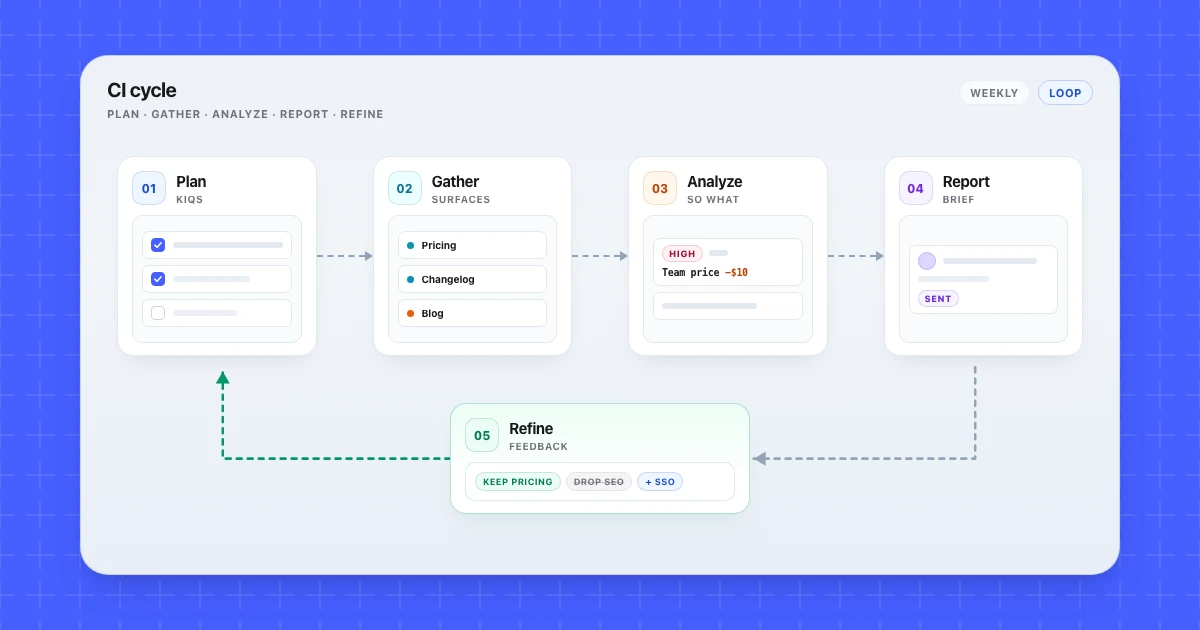
The CI workflow is five stages that repeat: plan with KIQs, gather signals, analyze, report and disseminate, then refine the questions from feedback. Classic intelligence cycles often list six stages (plan, collect, process, analyze, disseminate, feedback). For a small B2B SaaS team, process folds into gather, and feedback folds into the next planning pass. The stages keep repeating on a cadence instead of ending when a deck ships.
1. Plan. Lock the KIQs and the decisions they support. Name the competitors and surfaces in scope. Decide what "done for this week" means (for example: every high-severity public-page move reviewed, one brief posted).
2. Gather. Collect primary and secondary signals against those KIQs. Continuous public-page monitoring covers the repetitive web work. Humans still own interviews, win/loss notes, and judgment calls software cannot make.
3. Analyze. Interpret signals together. One pricing edit is a data point. That edit plus a hiring spike plus a new security page is a pattern. Analysis answers "so what for our KIQs," not "what changed on the internet."
4. Report. Put the answer where the decision happens: Slack, a battlecard, a short memo, a monthly exec note. Format follows audience. A rep needs two lines before a call. A founder needs the pattern and the recommended response.
5. Refine. Capture what sales or leadership said back. Drop KIQs that never earned a decision. Add the question that kept coming up in deals. Adjust which surfaces you watch so checks go to pages that matter.
Treat the five stages as a weekly micro-loop and a monthly synthesis loop. Weekly: gather and triage. Monthly: deeper analysis and reporting. Quarterly: rewrite KIQs. That cadence is the competitive intelligence cycle in practice for a team without a dedicated analyst bench.
Competitive intelligence sources: primary and secondary
Competitive intelligence sources split into primary (you or your market generate them) and secondary (public pages, reports, and third-party collections). A durable CI process uses both. Public SaaS surfaces keep the feed current. Primary sources explain why buyers care.
| Source type | Examples | What it is good for | What it misses |
|---|---|---|---|
| Primary | Win/loss interviews, sales call notes, customer advisory boards, support tickets mentioning rivals | Real objections, deal-level truth, why you win or lose | Silent packaging changes buyers have not hit yet |
| Secondary (public web) | Pricing pages, changelogs, docs, homepages, job posts, review sites | Early warning on pricing, launches, positioning | Intent behind the move; private roadmap |
| Secondary (market) | Analyst notes, industry news, earnings calls, category reports | Category context, funding and expansion clues | Field-level detail on a single pricing row |
Primary sources are slow and high signal. A structured win/loss analysis program will tell you which objection is actually killing deals. Secondary sources are fast and continuous. Pricing and changelog pages move without asking your permission, which is why continuous monitoring belongs in the gather stage.
For the monitoring layer specifically (what it is, how field diffs cut noise), see what is competitor monitoring. Sizing and demand questions are a different job from "did Harborline cut Pro this week," so scope this process to rival-focused KIQs.
Practical rule for a small team: automate the secondary web surfaces you revisit every week by hand. Keep human time for primary sources and for analysis. If your calendar only has room for one interview round a month, that still beats twenty unread browser alerts.
Gather continuously on public SaaS surfaces
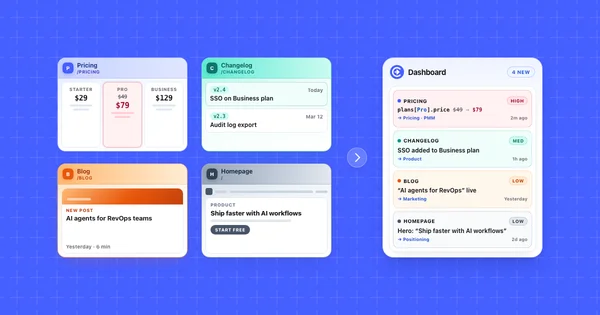
Continuous gathering is scheduled checks on the public SaaS surfaces that answer your KIQs, plus a reviewable change feed you can triage without a Monday tab tour. Start with pricing, changelog, docs, homepage, and any comparison or security page that shows up in deals.
Competiflow is built for that gather layer. You add a competitor homepage; discovery seeds monitors on the surfaces that usually matter for B2B SaaS. Scheduled checks produce interpreted changes with severity, a summary, why it matters, and evidence you can inspect. One successful page read costs one check, whether or not the page changed. The product docs cover quickstart, monitors, and the change feed if you want the setup detail. A weekly digest rollup is available when you want synthesis instead of a raw inbox.
Explicit limit: Competiflow is not an enterprise CI suite, not a battlecard CMS, and not a win/loss platform. It does not replace Klue-style enablement workflows, interview repositories, or analyst research desks. It watches public competitor pages and turns field-level changes (with severity and evidence) into something a PMM or founder can triage. Analysis, battlecards, and interview programs stay yours.
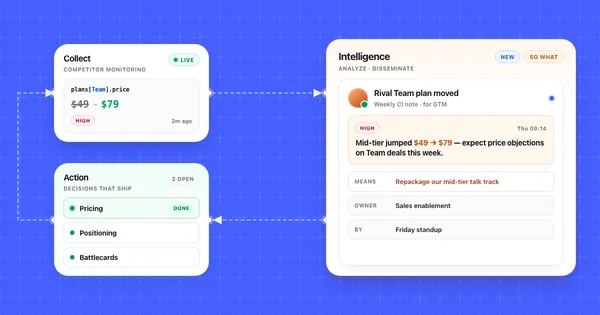
A composite week (illustrative): Northwind's pricing page moves Pro from $79 to $99. The change lands in the feed with old and new values. Harborline ships a changelog entry about SSO. Your KIQ about enterprise readiness lights up. You still decide whether to match, hold, or reframe. The gather system only makes sure you see the moves while there is still time to respond.
Turn signals into competitive intelligence analysis
Competitive intelligence analysis is the judgment step that turns dated signals into answers to your KIQs. Collection tells you what moved. Analysis tells you whether it changes a decision, and which one.
Run analysis as a short, repeatable ritual you can finish in a calendar block:
- Cluster. Group this week's moves by KIQ, not by competitor. Three Northwind items that all touch packaging belong together.
- Severity filter. Spend time on high and medium moves first. Cosmetic homepage churn rarely earns a memo.
- Pattern check. Ask what else moved in the same window: hiring, messaging, a review-site spike, a win/loss theme. One data point is a fact. Two or three aligned facts are a story.
- Decision line. Write one sentence: hold, match, watch, or act (and who acts). If you cannot name the decision, you are still in collection.
- Evidence attach. Keep the source URL and the before/after. Reps trust dates and diffs more than vibes.
| Signal alone | Analysis that earns a seat |
|---|---|
| Harborline Pro: $79 → $49 | Mid-market price pressure; update comparison table and brief AEs on value-per-dollar talk track this week |
| New /security page on Northwind | Enterprise readiness narrative; check whether our SOC 2 proof is one click from homepage CTAs |
| Ardent hired three enterprise AEs (job posts) | GTM shift upmarket; watch packaging and security pages next before you rewrite the feature matrix |
Templates help when they force the decision line. A blank competitor analysis template is useful once; a living note tied to KIQs is useful every week. Skip the thirty-page teardown unless a board or fundraising event actually needs that depth.
Software can normalize fields and summarize a page diff. It cannot decide whether you should cut price. Keep that line human, short, and dated.
Competitive intelligence reporting and dissemination
Competitive intelligence reporting is how answers leave the analyst's head and reach the person who will use them. Dissemination fails when the work is excellent and the delivery is a dashboard nobody opens. Pick formats by audience and decision speed.
| Audience | Format that works | Cadence | Length target |
|---|---|---|---|
| AEs / SEs | Battlecard bullets, objection lines, Slack ping with evidence link | Event-driven + monthly refresh | 5–15 lines |
| PMM / product | Weekly triage note: what moved, why it matters, recommended response | Weekly | Half page |
| Founder / exec | Pattern memo: two or three themes, risk, ask | Monthly (or after a high-severity spike) | One page |
| Whole GTM | Digest or channel post: "needs review" list | Weekly | Bullet list |
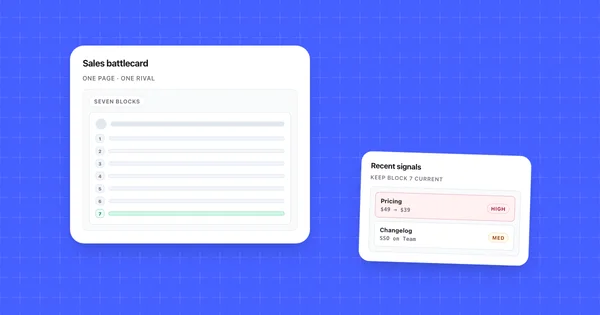
For battlecard-shaped outputs, keep a single source of truth and refresh from the feed, not from memory. The mechanics of building and maintaining those artifacts are covered in the competitor battlecards guide.
Dissemination rules that keep a CI process honest:
- One home. Pick Slack, email, or the sales wiki. Do not fan out the same brief to five places and wonder why nobody knows the current version.
- Date everything. "As of 2026-07-28, Harborline Pro is $49/mo" beats "Harborline is cheaper."
- Separate fact from recommendation. Fact: the price moved. Recommendation: hold our price and lead with onboarding speed. Readers can disagree with the second without discarding the first.
- Close the loop. When sales says the talk track failed, that note returns to the refine stage. Reporting without feedback never improves the next week's KIQs.
If a report format never changes a meeting agenda, kill the format. Reporting exists to move decisions.
Who owns CI, and how often you run it
Product marketing usually owns the competitive intelligence program, and the standing cadence is continuous gather, weekly triage, monthly patterns, and a quarterly KIQ reset. Sales enablement consumes tactical outputs; product contributes on roadmap threats. Founders own CI when the company is still small enough that "PMM" is a hat rather than a hire. RevOps often owns tooling and distribution, while analysis stays with the DRI.
| Company stage | Usual owner | Support | Cadence that usually sticks |
|---|---|---|---|
| Solo founder / tiny team | Founder or first PMM | Sales notes as primary input | Weekly 30-minute triage; monthly one-pager |
| Growth SaaS | PMM | Enablement for battlecards; product for parity | Weekly triage; monthly themes; quarterly KIQ rewrite |
| Sales-led with CI budget | CI analyst or enablement lead | PMM for messaging; ops for systems | Daily inbox; weekly synthesis; quarterly strategy pack |
How often should you run CI? Match cadence to decision speed:
- Continuous gather on public pages (daily or near-daily checks on pricing; slower on quiet docs pages).
- Weekly analysis for triage and dissemination to GTM.
- Monthly reporting for patterns and exec visibility.
- Quarterly planning to rewrite KIQs and reset competitor scope.
Event-driven spikes sit on top of that baseline. A public price cut or a category launch is not "wait until Monday." The standing process makes the spike cheaper because sources, owners, and report homes already exist. Name one DRI, give them a recurring calendar block, and measure the program by decisions informed.
Common mistakes that break a CI process
The mistakes that break a CI process are usually process design errors, not missing tools: collection without KIQs, monitoring without analysis, quarterly-only reporting, and no place to publish. Naming them is faster than buying another seat.
1. Collection without KIQs.
You watch fifty URLs and still miss the move that mattered. Fix: three to seven KIQs per quarter. Cut surfaces that never touch a question.
2. Treating monitoring as the whole process.
A full inbox is not intelligence. Fix: protect weekly analysis time. If the calendar only has gathering, the process stops before judgment. Prove the loop on one rival and one report format before you add platforms.
3. Quarterly-only reporting.
Markets move between offsites. Fix: weekly triage notes plus a thinner monthly exec brief. Reserve deep teardowns for real triggers.
4. No dissemination home.
Brilliant notes in a private doc help one person. Fix: one Slack channel or wiki page with dates and owners.
5. Skipping primary sources.
Public pages show what rivals shipped. Win/loss shows what buyers believed. Fix: a light interview cadence tied to the same KIQs.
6. Stale battlecards with no refresh trigger.
Reps learn to ignore the wiki. Fix: high-severity public moves and monthly reviews both force an update, or the card gets marked outdated in public.
7. Ethics drift.
Pressure to "just get the roadmap" leads to bad tactics. Fix: public and ethically sourced only. If you would not cite the method in a compliance review, it is not part of the process.
Frequently Asked Questions
What is the intelligence cycle?
The intelligence cycle is the repeating loop used to produce competitive intelligence: plan, collect, process, analyze, disseminate, and feed results back into the next plan. Small SaaS teams often compress process into gather and treat feedback as the start of the next KIQ pass. The point is the loop, not the exact stage count.
What is a CI workflow?
A CI workflow is the operating sequence your team runs to answer key intelligence questions on a cadence: plan, gather, analyze, report, refine. It is the competitive intelligence process in motion, with owners and formats attached, rather than a one-time research project.
How do you do competitive intelligence?
You do competitive intelligence by answering KIQs on a cadence with gather, analyze, report, and refine stages. Start narrow: one rival, a few surfaces, a weekly triage, and one place to publish. Widen coverage only after that loop informs decisions.
Who owns competitive intelligence?
Product marketing usually owns competitive intelligence on B2B SaaS teams. Sales enablement owns tactical distribution; product contributes on roadmap threats. Founders own it on very small teams. Name one DRI even if several people contribute sources.
How often should you run CI?
Run continuous gathering on public pages, weekly analysis and GTM updates, monthly pattern reporting, and a quarterly KIQ reset. Add event-driven reviews when a high-severity rival move hits. Cadence should match how fast your deals and pricing decisions move.
What are key intelligence questions?
Key intelligence questions (KIQs) name a decision, a time horizon, and an observable signal your CI process must answer, which scopes collection and analysis. Prefer "Which rival is most likely to undercut our mid-market plan in 90 days?" over a vague topic like "competitor pricing."
How do you share or disseminate competitive intelligence?
Share competitive intelligence in the channel where the decision happens: battlecards and Slack for sales, short weekly notes for PMM and product, one-page pattern memos for executives. Date the facts, separate recommendations, and keep a single source of truth so versions do not fork.
What is the difference between a CI process and one-off competitor analysis?
A CI process is a standing loop with KIQs, owners, cadence, and feedback; one-off competitor analysis is a project that ends when the deck is delivered. Analysis can feed a process; it does not replace one. If there is no refresh ritual, you had a project.
Start the loop this week
A competitive intelligence process beats a heroic quarterly deck because it keeps answers current while decisions are still cheap. Write three KIQs. Put your top rival's pricing and changelog on a gather cadence. Block thirty minutes for weekly analysis. Publish one short note where GTM already works. Next week, refine the questions from whatever sales said back.
That is a full CI workflow at small-team scale. Expand competitors and report formats only after the loop is already informing real decisions.