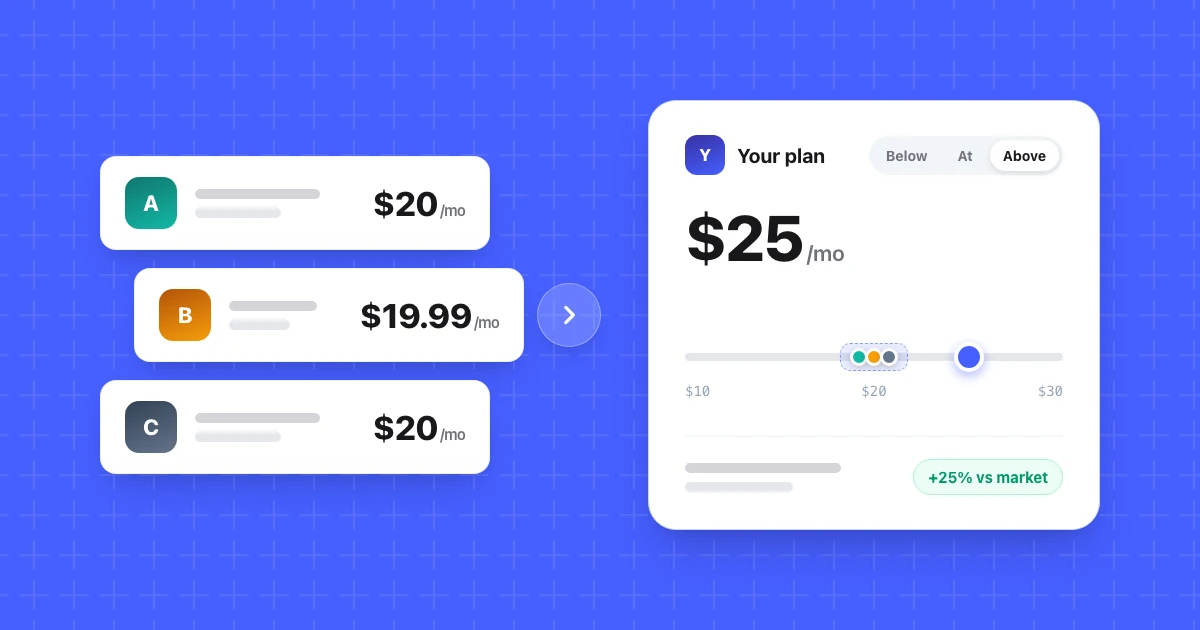
Between February 2023 and February 2024, OpenAI, Anthropic, and Google launched ChatGPT Plus, Claude Pro, and Gemini Advanced at $20, $20, and $19.99 a month.
None of the three launch posts mentions a rival's price. The numbers line up anyway. That's competitive pricing at its plainest: the market had a number, and the later entrants priced at it. If you sell SaaS into a category with a known price, your buyers will hold your number up against that one.
This guide covers what competitive pricing is, the three ways to price against rivals, six dated SaaS examples, and a five-step way to set your own price against competitors. To keep watch on rivals' pages afterward, see how to monitor competitor pricing pages.
What you'll learn
- What competitive pricing means, and how it differs from cost-plus pricing
- The three methods: price at, below, or above the market, plus price leadership
- Six SaaS examples with dates, quotes, and sources
- How to set a SaaS price against 3–5 rivals without comparing the wrong plans
- When pricing off competitors helps, and when it backfires
TL;DR: Competitive pricing, also called competitor-based or competition-based pricing, sets your price by reference to what rivals charge: at the market, below it, or above it. For SaaS, price one buyer scenario across 3–5 rivals, pick a position plan by plan, check both billing periods, and date every rival price you rely on.
What is competitive pricing?
Competitive pricing is a pricing strategy that sets your price by reference to what competitors charge for a comparable product. Competitor-based pricing and competition-based pricing mean the same thing. Your costs and your customers' willingness to pay still set the limits, but the rivals' published prices are the starting point.
In SaaS, "what competitors charge" means a plan on a public pricing page, with a billing period, a unit, and plan gates. So two people can price against the same rival and reach different numbers. "Market-based pricing" is sometimes used loosely for the same idea.
Competitive pricing vs cost-plus pricing
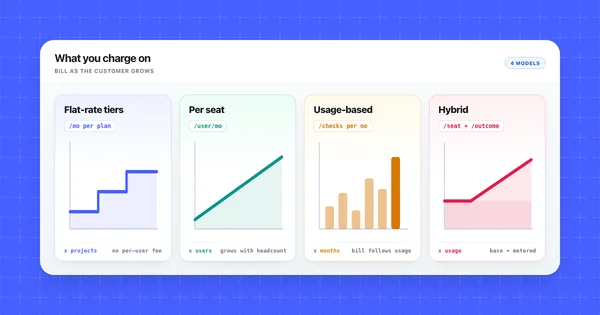
Cost-plus pricing, also called cost-based pricing, adds a margin to what it costs you to serve an account. It ignores what rivals charge and what buyers would pay. Value-based pricing starts from what the product is worth to the customer. Competitor-based pricing starts from rivals' prices. In our view, you'll use all three: value sets the ceiling, cost sets the floor, and competitors' prices show where buyers will place you between the two. The unit you charge by is a separate choice from the price level, covered in SaaS pricing models.
Price at, below or above the market
There are three competitive pricing methods: price at the market (parity), below it (penetration or undercutting), or above it (premium). Which fits depends on how easily buyers can compare you line by line.
Price at the market (parity or going-rate pricing)
Parity pricing means charging about what the main rivals charge, so price drops out of the comparison and buyers decide on the product. Going-rate pricing is the same idea in a category with one well-known number. The $20 AI assistant plans in example 1 are the clearest case.
Price below the market (penetration pricing)
Penetration pricing launches below the going rate to win share, usually with a plan to raise the price later. Undercutting is the broader term for pricing under a named rival. Price matching, a retail promise to match a lower advertised price, is a store policy with no SaaS list-price equivalent. See examples 2 and 3.
Price above the market (premium pricing)
Premium pricing charges more than the main rivals and gives the buyer a reason they can check: hours saved, higher usage limits, or extras bundled in. See examples 5 and 6.
Price leaders and followers
A price leader is the company whose price the rest of a market uses as its reference. Followers set their prices against it. In SaaS, the leader is often whoever published a tier first, as in example 6. The leader isn't pricing competitively, since its price is the reference.
Competitive pricing examples from six SaaS pricing pages
Each of these is a competitor-based pricing example from a real launch post or pricing page, with the date it was published or read. The method is our classification; none of the companies uses these labels.
How we checked. Launch prices come from launch posts or launch-day archive snapshots. Live prices were read on October 25, 2026 from a US location, with billing toggles checked both ways where a page has one. Anything we couldn't confirm is marked "not verified" and the number is left out.
| Example | Method | What the page says (date) | Lesson for your price |
|---|---|---|---|
| $20 AI plans | At the market (parity) | ChatGPT Plus "$20/month" (Feb 1, 2023); Claude Pro "$20 (US)" (Sep 7, 2023); Gemini Advanced "$19.99/month" (Feb 8, 2024) | Once a category has a going rate, a different number needs a reason |
| Mistral | Below the market | Le Chat Pro "starting at $14.99 per month" (Feb 6, 2025); still $14.99/month on Oct 25, 2026 | A lower price reads as a positioning claim even when the vendor never names a rival |
| Freshdesk | Below a named rival | "Buy two Freshdesk licenses for the price of a single Zendesk Suite license" (page labelled December 2025, live Oct 25, 2026) | The gap depends on which plans you pair |
| Brevo | Below a named rival, re-checked | "Based on the Mailchimp pricing page checked on August 7, 2026" (Brevo vs Mailchimp, live Oct 25, 2026) | Date-stamp the rival's price and list what you excluded |
| Superhuman | Above the market (premium) | "Gmail is free but slow. Superhuman Mail costs $25/month but saves 4 hours per week." (Nov 17, 2025) | A premium over a free product needs its arithmetic in public |
| $200 AI tiers | Leader and followers | ChatGPT Pro "$200 monthly plan" (Dec 5, 2024); Claude Max $100 / $200 per month (Apr 9, 2025); Google AI Ultra $249.99/month (May 20, 2025) | The first published top tier became the reference point |
1. The $20 AI assistant: pricing at the going rate
The table quotes the three launch posts; none names a rival's price. Google's $19.99 plan also included 2TB of storage (February 8, 2024).
On October 25, 2026 (US), Claude Pro is $20 billed monthly or $17 a month billed annually. Google's plan, renamed Google AI Pro in May 2025, lists at $19.99/month. Today's ChatGPT price: not verified.
Our read: with a going rate set, rivals compete on what's inside the plan and on the annual discount, while the headline number stays put.
2. Mistral Le Chat Pro: $14.99 under the going rate
Mistral's February 6, 2025 launch post says Le Chat "offers the vast majority of its features for free," with "upgraded limits for power users starting at $14.99 per month in the Pro tier." It pitches speed and names no rival's price, so setting $14.99 against the $20 launches (about 25% less) is our arithmetic. On October 25, 2026, Mistral's pricing page lists Pro at $14.99/month "Excluding taxes," with no annual price shown.
A lower number next to a broad free tier does positioning work the vendor never has to say out loud.
3. Freshdesk vs Zendesk: below a named rival
Freshworks' Zendesk pricing comparison page, labelled December 2025 and live on October 25, 2026, opens: "Tired of Zendesk's rising costs? Switch to Freshdesk and cut your support costs by 44%." It adds: "Buy two Freshdesk licenses for the price of a single Zendesk Suite license." The version labelled October 2024 said "50%."
Per agent per month billed annually, as of October 25, 2026: Zendesk Support Team $19 and Suite Team $55, Freshdesk Growth $19, and Freshdesk Omni Growth $29.
Our read: the entry plans tie at $19, so the page's gap sits between the suites. Two Omni Growth seats cost $58 against $55 for one Suite Team seat, so two-for-one holds within $3.
4. Brevo vs Mailchimp: a comparison page that gets re-checked
Brevo's Mailchimp comparison page, live on October 25, 2026, shows 10,000 contacts at $32 for Brevo against $110 for Mailchimp, under the footnote "Based on the Mailchimp pricing page checked on August 7, 2026. Monthly USD list prices shown. Promotional offers, annual discounts, taxes, and add-ons are excluded." The Mailchimp figures are Brevo's.
The September 2023 page cited Mailchimp's December 2022 increase "of 16% on average for existing users," and the November 30, 2023 page "up to 14.5% for existing users in November 2023." Brevo's own price at 10,000 contacts rose from $25 (April 2024) to $29 (January 2025) to $32 (June 2026 and live), and the savings framing stayed.
The lesson: date any price you publish against a named rival and list what you excluded. Your own increases shrink the gap too.
5. Superhuman Mail: a premium over a free product
Superhuman's November 17, 2025 blog post says: "Gmail is free but slow. Superhuman Mail costs $25/month but saves 4 hours per week." It adds: "The $360-480 annual cost becomes an obvious investment." On October 25, 2026, the pricing page lists Starter at $25 per member per month billed annually or $30 billed monthly (Business $33 or $40), and never mentions Gmail.
Price above a free incumbent only with arithmetic the buyer can check, and put it where buyers compare.
6. The $200 AI tier: one leader, two followers
OpenAI introduced ChatGPT Pro as "a $200 monthly plan" on December 5, 2024. Claude Max launched on April 9, 2025 with "5x more usage than Pro $100 per month" and "20x more usage than Pro $200 per month." Google AI Ultra launched on May 20, 2025 "for $249.99/month," with YouTube Premium and 30 TB of storage. Nobody names a rival (Anthropic frames Max against its own Pro plan), so "follower" rests on dates and prices alone.
As of October 25, 2026, Claude Max has $100 and $200 monthly steps. Google AI Ultra launched at $249.99 in May 2025; the subscriptions page lists $99.99/month and $199.99/month as of October 2026. Today's ChatGPT Pro price: not verified.
Our read: the first published tier set the number others launched against. Google's premium above it didn't stay on the page, and the page doesn't say why.
Three of the six name the rival on their own pages; the other three only line up by date and price. For dated increases and moved plan gates, see six dated SaaS price changes.
How to set a SaaS price against competitors
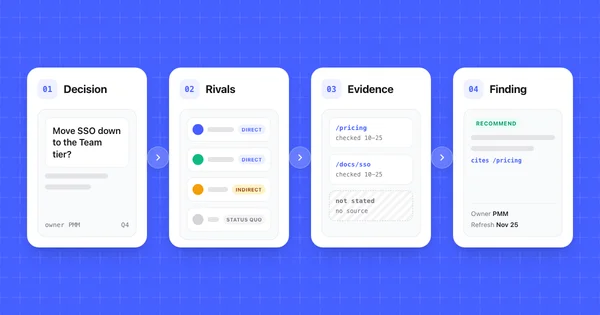
To set a SaaS price against competitors, pick three to five rivals, price one buyer scenario across all of them, and decide your position plan by plan. Then date every number and re-check it.
Pick three to five rivals your buyers compare you with
Start from lost-deal notes and the alternatives prospects name, and include the free or status-quo option, the way Superhuman's blog compares its price with free Gmail. The competitive analysis guide shows how to pick three to five competitors.
Price one buyer scenario across all of them
Use the same seats, the same billing period, and the lowest plan that fits, on every page. This is the competitive pricing analysis step; the method is in compare like with like and our pricing benchmark guide.
Example 3 shows why: pair the entry plans and Zendesk Support Team and Freshdesk Growth tie at $19 billed annually; pair the suites and it's Zendesk Suite Team at $55 against Freshdesk Omni Growth at $29. One scenario also means one region. On October 25, 2026, Claude's pricing page showed €15 and €18 from the Netherlands, and $17 and $20 from the US.
Decide your position plan by plan
You can sit at parity on the entry plan, where buyers compare line by line, and go premium on the top plan, where limits differ. Write each position as a number against a named plan, such as "at Zendesk Support Team, $19 billed annually" or "$5 under it," so you can re-check it when the rival moves. For each gap, give sales a one-line answer on the battlecard.
Check the billing toggle, plan gates, and add-ons
Annual and monthly prices change the gap. As of October 25, 2026, Zendesk Support Team is $19 billed annually and $25 billed monthly, and Freshdesk Growth $19 and $23. Add-ons can outweigh the seat price: Zendesk's Copilot add-on is $50 per agent per month billed annually, and Freddy AI Copilot is $29 billed annually or $35 billed monthly. When you publish a comparison, list what it leaves out, as Brevo's footnote does.
Date every rival price and re-check it
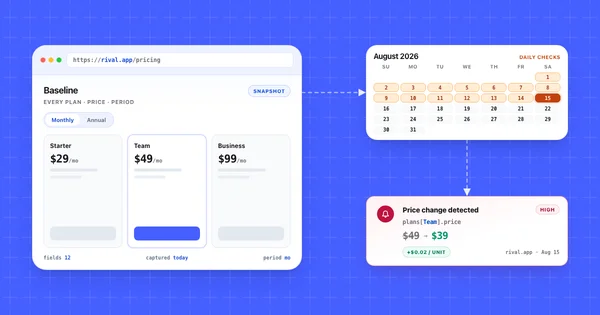
Treat any rival price older than 30 days as unverified, and write the read date next to each number. For baselines, cadence, and alert filters, see how to monitor competitor pricing pages.
Competiflow watches a rival's pricing page and reports field-level changes with the old and new value, so you know when a dated price in your comparison needs updating. See monitors for how checks run.
When competitive pricing works, and when it backfires
Competitor-based pricing works when buyers compare products feature for feature and a reference price already exists. It backfires when it ties your price to a rival's costs, bundle, or next move. The table is our read.
| Situation | Lean toward | Watch for | Example here |
|---|---|---|---|
| Going rate | At the market | Bundles differ at the same price (Google's $19.99 plan included 2TB) | 1 |
| Late entrant | Below the market | Raising a low launch price later costs trust | 2 |
| Dominant rival | Below, named on the page | The claim goes stale when either side reprices | 3, 4 |
| Measurable gain | Above the market | The gain must be one buyers can measure themselves | 5 |
| Unpriced tier | Set the reference yourself | Others will launch against your number | 6 |
| No real rival | Customer value; rivals as a ceiling check | There's no reference price to borrow | None |
The case for it is speed. Buyers make the comparison anyway, so a price set against named rivals is easy to defend, and anyone can check a public rival price.
The limit is what you can't see. A pricing page shows a rival's list price, but not its costs, discounts, or what customers pay. Copy it and you inherit someone else's economics. Undercutting a rival with deeper pockets can also start a price war, which neither side wins on margin.
When a rival changes its price, the default is to hold and answer with packaging or a sales message. Undercut only in the segment the move threatens, and match only when your core business is at risk. See competitive pricing strategy for responding to a rival's change for when to match, undercut or ignore.
Frequently Asked Questions
What is competitive pricing?
Competitive pricing means setting your price by reference to what rivals charge for a comparable product, at, below, or above their level. In SaaS, Anthropic launched Claude Pro at $20 a month seven months after ChatGPT Plus launched at the same price.
What is competitor-based pricing?
Competitor-based pricing is another name for competitive pricing, also called competition-based pricing: you set your price against what rivals charge. Mistral, for example, launched Le Chat Pro at $14.99 a month in February 2025, under the $20 OpenAI and Anthropic launched at (our comparison; Mistral named no rival).
What is it called when you price lower than competitors?
Pricing lower than competitors is called below-market pricing, or undercutting. As a launch tactic to win share, usually with a later increase planned, it's penetration pricing. SaaS teams rarely hold it long, in our experience, because raising prices on existing customers is hard.
What kinds of businesses use competitor-based pricing?
Businesses whose buyers compare near-identical offers line by line rely on competitor-based pricing most. Retail and travel are the textbook cases. In SaaS, it shows up on the pages of help desks, email marketing tools, and consumer AI assistants (examples 1 to 4).
What is parity pricing?
Parity pricing means pricing at about the same level as your main rivals, so price stops being the deciding factor. The AI assistant launches in example 1 are the standard case: $20, $20, and $19.99 a month, within about a year.
How is competitive pricing different from pricing on customer value?
Competitive pricing starts from what rivals charge, while pricing on customer value starts from what your product is worth to the buyer. Customer value tells you how high you could go, and rivals' prices tell you where buyers will place you. More in SaaS pricing models.
Is competitive pricing a good idea for SaaS?
Competitive pricing is a good check for SaaS when buyers put you side by side with known rivals, and a weak sole basis when your product does something rivals don't. It's quick to defend on a sales call; the cost is that your number rests on a rival's costs and bundle, which you can't see.
What is price leadership?
Price leadership is when one company's price becomes the reference others in the market set theirs against. ChatGPT Pro launched at $200 a month in December 2024; Claude Max launched with a $200 monthly step in April 2025. The dates line up, but neither post names a rival.
Where to start
Pick three rivals your buyers actually name. Price one buyer scenario on each of their pages, on both billing toggles, and write the read date next to every number. That sheet shows whether you sit at, below, or above the market.
Competitive pricing only holds while the rival numbers are current, so set a re-check date. To keep watch, see how to monitor competitor pricing pages, or start a Competiflow trial with 100 checks, no credit card, and up to 3 competitors.