Most guides to competitive analysis tell you to walk past a rival's shop and read its Yelp reviews. That works for a bakery. It's less useful when the rival is a software company selling to your buyers.
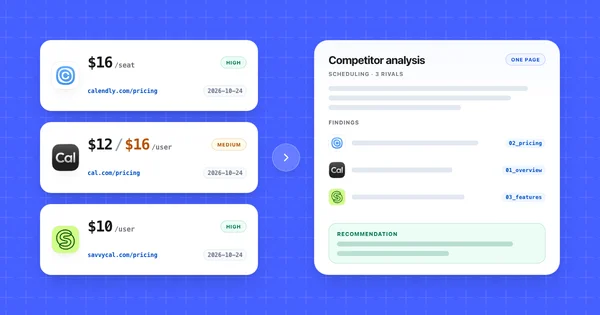
A SaaS competitor publishes most of its strategy itself, and it dates a lot of it. The pricing page shows what each plan holds back. The changelog shows what shipped last week. The docs list the real limits, and the job board hints at what comes next.
This guide builds a competitive analysis for SaaS on that public evidence, then keeps it true.
What you'll learn
- What competitive analysis is, and how it differs from competitive market analysis and competitive intelligence
- What a competitive analysis includes, component by component
- How to do a competitive analysis in seven steps, built on dated public evidence
- Which framework fits which decision, and when to skip one
- How to write a competitor SWOT where every bullet points to a source
- How often each part goes stale, and what tools cost as of October 2026
TL;DR: Competitive analysis compares your product with the alternatives your buyers weigh, so you can make one decision on pricing, product, messaging, or sales. For SaaS, build it from public evidence (pricing pages, changelogs, docs, job posts), record a source and check date for every fact, and set a refresh date before you share it.
What is competitive analysis?
Competitive analysis is the process of identifying the companies your buyers compare you with, collecting dated evidence on how they price, package, position, and sell, and comparing it with your own offer to make one specific decision. Competitor analysis means the same thing.
The purpose is a better decision, and the decision comes first. Teams run a competitive analysis to set pricing and packaging, choose roadmap bets, sharpen messaging, give sales a talk track, or write the competition section of a business plan or board deck. Each needs different evidence. An analysis with no decision attached tries to cover everything and becomes a document nobody opens. The method works the same for a student project or a small business; only the evidence sources change.
Competitive analysis vs competitor analysis vs competitive market analysis
Competitive analysis and competitor analysis are the same practice under two names. Some writers use "competitor analysis" for a rival-by-rival profile and "competitive analysis" for the side-by-side comparison, but teams use the terms interchangeably, and so does this guide.
Competitive market analysis widens the lens from rivals to the market: its size, segments, trends, and the forces that shape it. It sits closer to market intelligence and usually comes earlier, when you're deciding whether a market is worth entering at all.
Competitive intelligence is the standing program that keeps answering questions about rivals. A competitive analysis is one project inside it, with a question at the start and a finish date at the end.
What is included in a competitive analysis
A competitive analysis includes the competitor set and each rival's type, a short profile per rival, pricing and packaging, the product capabilities your buyers decide on, positioning and messaging, go-to-market and entry motion, customer sentiment, momentum signals, a SWOT, and findings with recommendations. Underneath all of it, every fact carries a source and a checked date.
| Component | Question it answers | Best source |
|---|---|---|
| Competitor set | Who do buyers compare us with? | Lost deals, discovery notes |
| Profile | Who is this rival and who does it sell to? | Homepage, about page |
| Pricing | What does each plan cost, and what does it gate? | Pricing page |
| Capabilities | Can it do the things buyers choose on? | Docs, your own trial |
| Messaging | What does it claim, and to whom? | Homepage |
| Entry motion | How does a buyer start: free plan, trial, or demo? | Pricing page, signup flow |
| Sentiment | What do customers praise and complain about? | Review sites |
| Momentum | What shipped lately, and who is it hiring? | Changelog, job posts |
| SWOT | What does this rival mean for us? | Your judgment on the rows above |
| Findings | What should we do about it? | The comparison itself |
In SaaS, plan gates often matter more than list prices. Two rivals can list the same seat price while one puts SSO on its base plan and the other holds it for Enterprise. A price-only comparison never shows that gap.
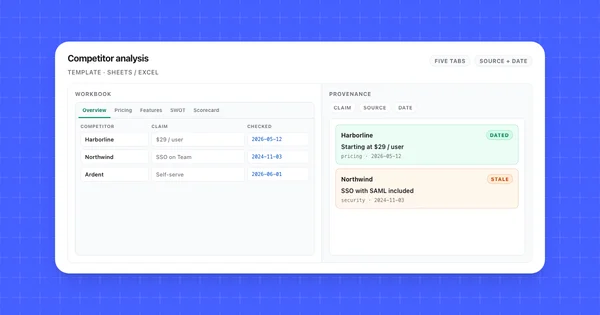
To set these components up as a workbook, start from our competitor analysis template. To see every component filled in for three real rivals, with a source on each cell, read the competitor analysis example.
The four types of competitors
Most lists name four types of competitors: direct, indirect, replacement (or substitute), and potential. Lists vary, and some fold replacement into indirect. In SaaS, the status quo (a spreadsheet, an in-house script, or doing nothing) is the replacement teams lose to most quietly, because a deal lost to inertia doesn't show up as a loss to anyone.
| Type | What it is | SaaS example (generic) | How deep to analyze |
|---|---|---|---|
| Direct | A similar product for the same buyer and problem | Another invoicing tool for agencies at a similar price | Full analysis |
| Indirect | A different product that solves the same problem | An accounting suite with a basic invoicing module | Profile plus the overlap |
| Replacement | The status quo, DIY, or doing nothing | A spreadsheet and manual email reminders | Cost and effort of staying put |
| Potential | A company that could enter the space soon | An adjacent vendor whose job posts mention your category | Watchlist only |
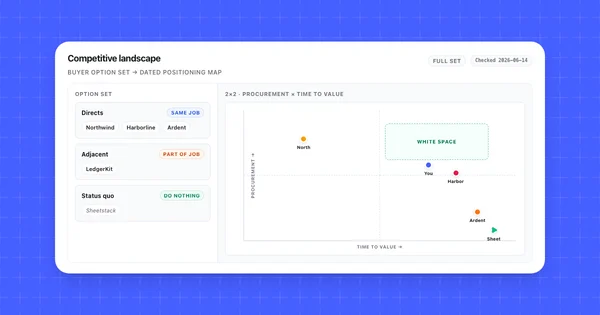
Our competitive landscape analysis guide splits the same set into directs, adjacents, and status quo. Use it to map the full buyer option set before you narrow it down.
For the analysis itself, pick three to five rivals for deep work. Everyone else goes on a watchlist with a name, a URL, and one line on why they matter.
How to do a competitive analysis in seven steps
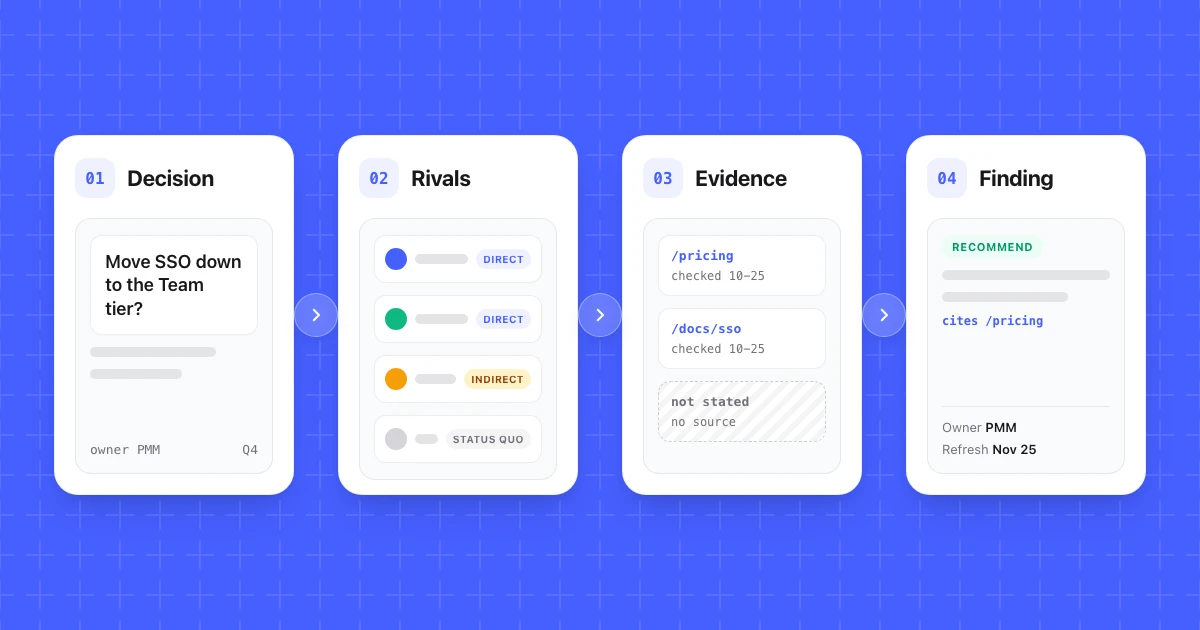
To do a competitive analysis, start from one decision, pick three to five competitors, choose the dimensions buyers decide on, collect dated public evidence, compare like with like, write findings and recommendations, and share the result with an owner and a refresh date. The last step loops back to the first. When a refresh changes a fact, it can reopen the decision.
Step 1: Start from one decision
Write the question the analysis must answer before you open a single competitor page. "Should we move SSO down a tier?" is a question. "Understand the competition" isn't one, and it produces a document with no end. A good question names the decision, who makes it, and when.
The question also tells you what to skip. An SSO question needs plan gates, security pages, and lost-deal notes, and no review-site sentiment study. If your team runs a CI process, these are your key intelligence questions. Handed three questions, run three short analyses.
Step 2: Pick three to five competitors
Build the set from evidence of who buyers actually weigh: lost deals, discovery call notes, and the alternatives prospects name without being asked. A list built from memory tends to favor the rival with the loudest marketing.
Mix the types from the section above. Three direct rivals and nothing else misses the spreadsheet a prospect decided to keep, so include one indirect or replacement option when it shows up in deals. Three to five is enough to see a spread and few enough to keep current.
Step 3: Choose the dimensions buyers decide on
Compare rivals on the criteria buyers use to choose. Your own feature list is a poor starting point, because it's weighted toward what you built. Pull criteria from lost-deal reasons, discovery questions, and security questionnaires.
Typical SaaS dimensions are the price at a realistic seat count, the plan that includes SSO or API access, time to first value, integrations, support commitments, and security posture. Eight to twelve is plenty. Our comparison grid guide covers how to find the criteria your buyers actually decide on.
Step 4: Collect dated public evidence
Record one fact per entry, with one source URL, one checked date, and one confidence level. When no page says something, write "not stated" instead of guessing. A blank cell invites a guess six months later. "Not stated" tells the next reader that someone looked.
Most of this evidence sits on the rival's own site, and the next section lists where. Write the date you read each page, and when a page could decide something, save an archived copy; the Zapier change below is provable because archived copies of its pricing page exist. Use your own trial for what the pages don't settle, such as setup effort. When evidence comes from people instead of pages, say who you are: the Strategic Consortium of Intelligence Professionals (SCIP) code of ethics asks practitioners to disclose their identity and organization before any interview and to comply with all applicable laws.
Step 5: Compare like with like
Normalize before you compare. Price one buyer scenario across every rival: the same seat count, the same billing period, and the lowest plan that includes what that buyer needs. A rival that looks cheaper on its entry plan can cost more once SSO forces an upgrade. If the comparison is for setting your own price, competitive pricing covers pricing at, below or above the market.
Don't average scores across rows that measure unlike things, such as price and a security certification. The total hides the row where you lose. Our competitive benchmarking guide covers normalizing and weighting, and the grid guide from step 3 covers scoring.
Step 6: Write findings and recommendations
A finding is a comparison you can defend, and each one cites the evidence it comes from. "Two of three rivals include SSO on their mid tier" is a finding, because it names three cells. "We're behind on security" is a conclusion still waiting for its cells.
Recommendations are judgment, so label them that way and give each a next verification step: "Move SSO to Growth. First, confirm SSO gating came up in recent lost deals." The one-page report in our worked example shows the format. Test recommendations with buyers in win-loss interviews before they become pricing changes.
Step 7: Share it with an owner and a refresh date
Ship the analysis in the format its readers already use: a one-page memo for leadership, battlecards for sales, or a proposal for whoever owns pricing.
Name one owner and put a refresh date on the first page. Without both, the analysis starts aging the day you send it, and nobody is responsible for noticing. The refresh date sends you back to step 1 to ask whether anything new changes the decision.
Where SaaS competitive analysis gets its evidence
A SaaS rival publishes most of what an analysis needs on its own site. The work is reading the right surfaces, recording when you read them, and knowing which ones go stale fastest.
| Surface | What it reveals | Goes stale | Record as |
|---|---|---|---|
| Pricing page | Plans, gates, limits, billing period, footnotes | Fast | Plan-level facts with URL and date, footnotes included |
| Changelog | Momentum and direction | Fast | Dated entries, grouped by theme |
| Docs and API | Real limits and the plan each applies to | Medium | The limit, plus the plan it needs |
| Security page | Certifications and their scope | Slow | The claim and its scope, as worded |
| Job posts | Hiring direction | Medium | Inference, labelled as inference |
| Reviews | Customer sentiment, with a lag | Slow | Themes, with review dates |
| Homepage | Positioning claims | Medium | The vendor's claim, in quotes |
| Status page | Reliability history | Medium | Incidents with dates |
| Your trial | Setup and workflow as a buyer meets them | Each release | What happened, and the date you tried |
| Win-loss notes | What buyers believed | Each deal | Buyer belief, kept apart from facts |
Give every fact a confidence level. High means the vendor's own page states it in words. Medium means you derived it from vendor pages that don't say it outright, such as a monthly price worked out from an annual one. Low covers buyer quotes and anything relayed secondhand. A price a rep heard from a prospect is a lead to verify before it goes into a cell. Our grid guide shows how to rank your sources by how far they sit from the vendor.
Record what a vendor says about itself as the vendor's claim, in quotes, with the URL. A "#1 rated" badge or a customer count on a homepage is evidence of messaging. It shows what the rival wants buyers to believe.
How fast desk research ages
Two facts from our competitor analysis example on scheduling tools, both read on the vendors' own pages:
- Cal.com announced it was going closed source in an April 14, 2026 blog post. The public code continues as Cal.diy under the MIT license.
- Calendly's September 30, 2026 release note renamed Workflows to Automations ("previously Workflows").
A desk-research version from last year would have both wrong. The example lists seven beliefs that one day of reading vendor pages changed.
Competitive analysis frameworks and when to use each
The frameworks teams use for competitive analysis are SWOT, Porter's Five Forces, the 4 Ps, the 5 C's, a perceptual map, a strategy canvas, VRIO, and benchmarking. Frameworks organize evidence. They don't replace it. Pick the one that matches your decision and skip the rest.
| Framework | Question it answers | Use it when | Skip it when |
|---|---|---|---|
| SWOT | What does this rival mean for us? | You need a one-page judgment per rival | The facts aren't collected yet |
| Porter's Five Forces | How attractive is this industry? | Market entry or an investor question | You're setting a price or a message |
| 4 Ps | How does each rival go to market? | Profiling offers side by side | The decision touches only one P |
| 5 C's | What is our whole situation? | Annual planning or a business plan | The question is about specific rivals |
| Perceptual map | Where do buyers place each option? | Messaging and positioning work | You can't name two axes buyers use |
| Strategy canvas | Where do offers differ, factor by factor? | Deciding what to raise, cut, or drop | The factors aren't scored from evidence |
| VRIO | Is our advantage defensible? | Testing the strengths in your own SWOT | You're profiling a rival from outside |
| Benchmarking | How do we perform against rivals on a metric? | Tracking a measurable gap over time; see competitive benchmarking | No comparable metric exists |
SWOT gets its own section below, and the 5 C's get a short FAQ answer. The rest each fit a narrower set of decisions than most guides admit.
Porter's Five Forces
Porter's Five Forces looks at an industry, not one rival: rivalry among existing players, the threat of new entrants, the threat of substitutes, buyer power, and supplier power. It helps with a market-entry question, or when an investor asks why margins in your category will hold. It rarely changes a SaaS pricing or messaging decision, because your direct rivals face the same five forces you do. For a question about one plan gate or one talk track, skip it.
The 4 Ps of competitive analysis
The 4 Ps are product, price, place, and promotion, and you run each rival through all four: what the product does for your buyer, how it's priced and packaged, where it's sold, and how it's promoted. For SaaS, place is mostly entry motion. A free plan, a trial, and a demo gate meet different buyers. The 4 Ps are a quick check that a profile doesn't stop at features. When the decision touches only one P, skip the other three.
Perceptual map
A perceptual map, also called a positioning map, places each option on two axes buyers care about, such as price predictability and setup effort. It shows clusters and empty space at a glance, which helps messaging work. It's only as honest as its axes: "innovation" or "quality" lets the author put every vendor anywhere. Our guide to the competitor map builds one from two buyer-real axes, and the competitive landscape analysis guide maps a wider option set.
Strategy canvas
A strategy canvas puts the factors a market competes on along the x-axis and the level each offer provides on the y-axis, with one line per competitor. Where lines bunch, everyone competes on the same thing. Where one breaks away, that vendor made a choice. Use it to decide what to raise, cut, or drop in your own offer. The levels must come from evidence, so draw it after step 4.
VRIO
VRIO asks whether a competitive advantage is defensible: is the resource or capability behind it valuable, rare, hard to imitate, and organized to capture its value? It's an internal lens on your own advantage, so it belongs in your own SWOT, where it tests each strength. A "strength" a rival could copy in a quarter fails the imitation test. VRIO is weak for profiling rivals, because public pages don't show their internal resources.
How to do a competitor SWOT analysis
A competitor SWOT puts a rival's strengths and weaknesses on one side and the opportunities and threats they create for you on the other. It only holds up when each bullet points to a sourced fact. Without those facts underneath, it's a list of opinions with four headings.
- Fill the fact components first. Pricing, capabilities, entry motion, and momentum come before any SWOT bullet.
- Write strengths and weaknesses from the rival's evidence. Each bullet cites a page and a checked date.
- Write opportunities and threats as your judgment. They describe what the rival's position means for you, so label them as judgment.
- Cap each quadrant at four or five bullets. Cut any bullet that wouldn't change a decision.
Here's a SWOT for Northwind, an illustrative composite rival used in our matrix and template guides. Its URLs and dates are illustrative too.
| Quadrant | Entry | Source (illustrative) | Checked |
|---|---|---|---|
| Strength | SAML SSO included on the Team plan | docs.northwind.example/sso |
2026-07-14 |
| Strength | 4-hour support SLA on Team | northwind.example/support |
2026-06-02 |
| Weakness | Team is $39/mo plus $0.02 per unit, so the bill grows with usage | northwind.example/pricing |
2026-07-14 |
| Weakness | Demo required before a trial | northwind.example/pricing |
2026-07-14 |
| Weakness | Public REST API on Enterprise only | northwind.example/pricing |
2026-07-14 |
| Opportunity | Judgment: self-serve buyers who won't book a demo to try a product | Follows from the demo gate | |
| Opportunity | Judgment: high-volume buyers who want a predictable bill | Follows from the per-unit rate | |
| Threat | Judgment: SSO on Team sets the bar in security-reviewed deals | Follows from the SSO entry |
Write one SWOT per direct rival, or a cluster SWOT per group when you track many. Then write an honest one on yourself, where VRIO earns its place: run each strength through the imitation test. For a filled competitor SWOT on a real rival, see the Cal.com SWOT in our competitor analysis example.
How to keep a competitive analysis current
A competitive analysis goes stale surface by surface, not all at once. Re-check each surface on its own cadence, and re-check it early when an event fires.
| Surface | Re-check | Trigger for an early check |
|---|---|---|
| Prices and plan gates | Every 30 days | A pricing-page change, a launch, or a deal lost on price |
| Changelog | Weekly | A major release or a new product line |
| Docs limits | Monthly | An API, quota, or billing announcement |
| Security page | Every 90 days | A new certification or a disclosed incident |
| Messaging | Monthly | A homepage redesign or a new tagline |
| Job posts | Monthly | Several roles opening in a new area |
A price cell older than 30 days counts as unverified until someone re-opens its URL.
Prices alone don't tell you when a plan changed. In January 2025, Zapier's Team plan kept the same headline price on its pricing page: "Starting from $69 USD per month, billed annually" in both the before and after archived copies. In the same change, SAML SSO went from a paid add-on ("SSO add-on (contact us)") to included on Team "at no extra cost," per Zapier's help center, and the Team user limit went from "Unlimited" to "25 users" (sources checked 2026-10-24). A check that only watched the price would have stayed silent while two plan gates moved. Diff every field on the plan card, since the headline price was the one field that didn't move.
For two rivals, a recurring calendar block and a spreadsheet work fine. Past that, someone has to watch the pages. Our guides on how to monitor competitor pricing pages and on competitor monitoring cover the options.
Competiflow finds a rival's pricing, changelog, docs, blog, and homepage pages from its homepage, checks them on a schedule as monitors, and returns field-level changes with the old value, the new value, a severity, a summary, and why it matters. Each change maps to one cell in the analysis, so you update the value and its checked date without re-reading the page. A page monitor reads public pages, though. It can't tell you deal-level win rates or what a rival's product does past the paywall, so trials and win-loss interviews stay on your list.
This refresh loop is where a one-off analysis becomes competitive intelligence: questions keep arriving, and the pages are watched on a schedule.
How much does a competitive analysis cost?
Most of the cost of a competitive analysis is analyst time. Tool spend runs from $0 for a spreadsheet and a calendar to a five-figure annual contract for an enterprise CI platform (Vendr's median for both Klue and Crayon is $30,000 a year, checked October 2026).
Estimate time with arithmetic. The first pass is rivals times surfaces: three rivals across the eight page surfaces in the evidence table (everything but your trial and win-loss notes) is 24 pages to read, record, and date, plus a trial where one is offered. After that, the cadence table sets the refresh cost. For three rivals, it comes to roughly 25 page reads a month (an estimate from the cadence above, not a benchmark).
| Tier | What you get | Price (checked 2026-10-25) | Source |
|---|---|---|---|
| Spreadsheet | A workbook plus calendar reminders | $0 | |
| Page monitor | Alerts when a watched page changes | Visualping: free for 5 pages and 150 checks a month; Personal from $14/mo billed monthly or $120/yr; Business from $140/mo or $1,200/yr | Visualping pricing |
| Page monitor | Alerts when a watched page changes | Distill: free for 25 monitors (5 in the cloud) and 1,000 cloud checks a month; Starter $15/mo for 30,000 cloud checks | Distill pricing |
| Monitoring | Rival pages found from a homepage, with field-level changes | Competiflow: free trial with 100 checks and up to 3 competitors; check-based plans from Starter at $19/mo (2,000 checks) to Pro at $99/mo (10,000 checks) | Billing |
| Traffic data | Traffic estimates for rival sites (optional) | Similarweb: self-serve plans start at $125 a month billed annually, $199 billed monthly | Packages |
| Enterprise CI | A managed CI platform for sales and marketing teams | Klue: no published prices. Vendr median $30,000/yr, range $16,000 to $60,000 across 108 purchases, last updated February 2026 | Vendr |
| Enterprise CI | A managed CI platform for sales and marketing teams | Crayon: a "Request an Estimate" form, no prices. Vendr median $30,000/yr, range $12,700 to $46,000 across 93 purchases, last updated February 2026 | Vendr, pricing |
| Agency | A one-off study by an outside team | Quoted per project; no published benchmark |
Enterprise CI earns its contract when a large sales org needs curated battlecards, a team to maintain them, and a win-loss program feeding the same system. For a PMM or founder tracking three to five rivals, that's more platform than the job needs: a spreadsheet plus a monitor covers the evidence. To go deeper, compare monitoring tools by detection model and cost.
Common competitive analysis mistakes
Most competitive analyses fail on process. Each of these six mistakes is a process gap with a cheap fix.
- Analyzing everyone. Twelve rivals at equal depth means none gets a careful read. Pick three to five and keep the rest on a watchlist.
- Feature checklists instead of buyer criteria. A list of every feature rewards breadth and hides the two rows that decide deals. Start from lost-deal reasons, and drop rows no buyer has asked about.
- Undated facts. A price with no checked date can't be defended in a review or refreshed on schedule. Put a source URL and a date on every fact.
- Rep hearsay entered as fact. "A prospect said Northwind includes SSO" is a lead, often relayed by a buyer with a reason to push your price down. Log it as a Low-confidence claim until a vendor page confirms it.
- A SWOT with no evidence. Bullets like "strong brand" with nothing behind them get argued away in the first meeting. Tie strengths and weaknesses to sourced facts, and label the rest as judgment.
- No decision, no owner, no refresh date. An analysis without a question has no finish line, and one without an owner goes stale unnoticed. Put all three on the first page.
Frequently Asked Questions
What are the 5 steps of a competitive analysis?
The five steps of a competitive analysis are: decide the question, pick the competitors, collect dated evidence, compare and write findings, and share the result with a refresh date. This guide splits the same work into seven steps, so buyer criteria and normalization each get their own.
What is the difference between direct and indirect competitors?
Direct competitors sell a similar product to the same buyer, while indirect competitors solve the same problem in a different way. For an invoicing tool sold to agencies, another agency invoicing tool is a direct competitor. An accounting suite with a basic invoicing module is an indirect one, and a spreadsheet is the replacement both of them lose to.
What is the difference between SWOT analysis and competitor analysis?
A SWOT analysis is one part of a competitor analysis, not a substitute for it. The competitor analysis holds the dated facts: what each plan costs and gates, what the product does, how a buyer gets in, and what shipped lately. The SWOT sits on top and records what those facts mean for you.
What are the 5 C's of marketing analysis?
The 5 C's of marketing analysis are usually company, customers, competitors, collaborators, and context, with "climate" sometimes in place of context. Versions differ. It's a situation analysis, wider than a competitor analysis, since competitors are one of the five.
How often should you update a competitive analysis?
Update prices and plan gates in a competitive analysis every 30 days, changelogs weekly, and security claims every 90 days. Check early when an event fires, such as a launch or a deal lost on price.
Can ChatGPT do a competitive analysis?
ChatGPT can draft and summarize a competitive analysis, but the facts in it still need sources you checked. It can propose a structure, summarize pages you give it, and suggest competitors, and you should treat any fact it states without a source as a lead to verify. Its scheduled tasks can monitor for changes up to once an hour on eligible paid plans and once a day on Free, with 3 to 15 active tasks depending on plan, and OpenAI says monitoring tasks "can use information from previous runs" (as of October 2026). OpenAI doesn't document a stored page snapshot, a field-level diff, or a change history you can audit later.
How do you write a competitive analysis for a business plan?
A competitive analysis for a business plan shows where your price and entry motion sit against named rivals, with sources an investor can check. Name three to five real competitors, cite each price with its URL and checked date, and label your own position as a plan, since you haven't sold at it yet. Our competitor analysis example covers this case in its FAQ.
What is the difference between competitive analysis and competitive intelligence?
Competitive analysis is a project tied to one decision, while competitive intelligence is the standing program that keeps answering questions about rivals. An analysis has a finish date. Competitive intelligence runs continuously, and its refresh loop keeps each analysis from going stale.
Where to start
Pick one decision your team has to make this quarter and write it as a question. Then copy the competitor analysis template, choose three to five rivals, and spend a day reading their pricing pages, changelogs, and docs, with a date on every fact.
Use the competitor analysis example as the reference for what "done" looks like. If a finding can't point to a sourced fact, it goes back for more evidence until it can.