
You need website change monitoring for competitor pricing, changelogs, and docs, and you do not want to pay yet. Free tiers and self-host options can cover that job for a while. They also hide failure modes: a browser that must stay open, a monthly check cap that runs out mid-sprint, or silence that looks like coverage.
This roundup compares five free or free-to-start options for competitor and pricing page jobs. The question is which free website change monitor fits the job, where the free tier breaks, and when free is still enough.
What you'll learn
- Why free website change monitoring still matters for early competitor programs
- A side-by-side table of Google Alerts, Distill, Visualping, changedetection.io, and Competiflow
- Free-tier traps: local browser watches, check caps, and silent failures
- When free coverage is honestly enough
- When to graduate to a paid or structured tool
- FAQ answers on free limits and Distill free tier fit
TL;DR: Start free with cloud selectors or screenshots for a few URLs. Self-host changedetection.io for volume. Keep Google Alerts for mentions only. Graduate to a paid plan when check caps, local watches, or triage noise cost more than the subscription.
Why free website change monitors matter for competitor pages
Free website change monitors matter because most teams begin competitive tracking before they have a CI budget, and a working free stack beats a paid tool nobody configures. The risk is treating "free" as "finished."
Early programs usually watch three to five rivals across pricing, changelog, and one docs or homepage URL. That is a small surface. A free Distill cloud monitor, a Visualping free allowance, or a self-hosted changedetection.io box can catch real moves if someone owns the setup. Google Alerts sits beside that stack for press and funding mentions. None of these replace structured competitive intelligence forever. They buy time while you learn which pages actually move decisions.
The job on competitor pages is specific. You care when Team goes from $49 to $79, when a changelog ships a feature that undercuts you, or when a limits table gains a metering line. You do not care about cookie banners, testimonial carousels, or build hashes. Free tools differ in how close they get to that signal. Some alert on any visual or HTML change. Some let you pin a CSS node. One free trial returns field-level diffs. Matching the free option to the job is the whole game.
For the deeper Alerts-only case, see why Google Alerts fails for competitor monitoring. For leaving a specific paid product later, see Distill Web Monitor alternatives and changedetection.io alternatives.
Free website change monitors compared
Google Alerts, Distill, Visualping, changedetection.io, and Competiflow split on what they watch, whether checks run in the cloud, and what the free tier actually includes. Use the table first, then the short notes below.
| Tool | What is free | Hosting | Watches | Competitor / pricing fit | Main free-tier limit |
|---|---|---|---|---|---|
| Google Alerts | Fully free | Google's index | Keywords and new indexed results | Mentions, press, funding; silent on in-place page edits | Does not read a URL you name |
| Distill | Free tier (25 monitors) | Cloud and/or Distill Chrome extension (local) | CSS / XPath region; text or visual | Strong while selectors hold on pricing nodes | Check cadence and local-browser trap on extension watches |
| Visualping | Free 5 pages / 150 checks | Hosted | Visual snapshot diff, optional crop | Good for quieter pages; noisy on dynamic pricing | 150 checks/month burns fast on daily cadence |
| changedetection.io | Open source self-host (server cost only) | Self-host or paid hosted | Text / HTML diff, filters, ignore rules | Strong for many URLs; weak on interpreted prices | Ops load; raw diffs need triage |
| Competiflow | Time-limited free trial (100-check allowance) | Hosted | Field-level diff on CI surfaces | Built for pricing, changelog, docs, homepage | Trial allowance and daily cadence; then paid plans |
No row wins every column. Google Alerts wins on zero-cost mentions. Distill wins on free monitor count with precise selectors. Visualping wins when you want a screenshot. changedetection.io wins on self-host volume. Competiflow's time-limited trial wins when you need both prices in the change record before committing to a paid plan.
Google Alerts
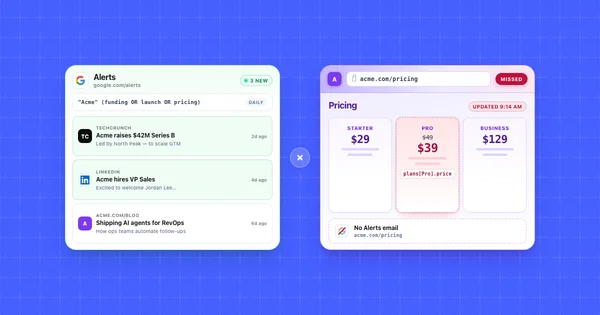
Google Alerts watches Google's search index for newly indexed content matching a keyword. It catches press coverage, funding news, and new blog posts, not in-place page edits. If a pricing page changes from $49 to $79 without fresh indexing, Alerts produces nothing. Keep it as a mention layer beside your page monitors, not as one. For full setup and blind spots, see the Google Alerts competitor monitoring guide.
Distill (free tier)
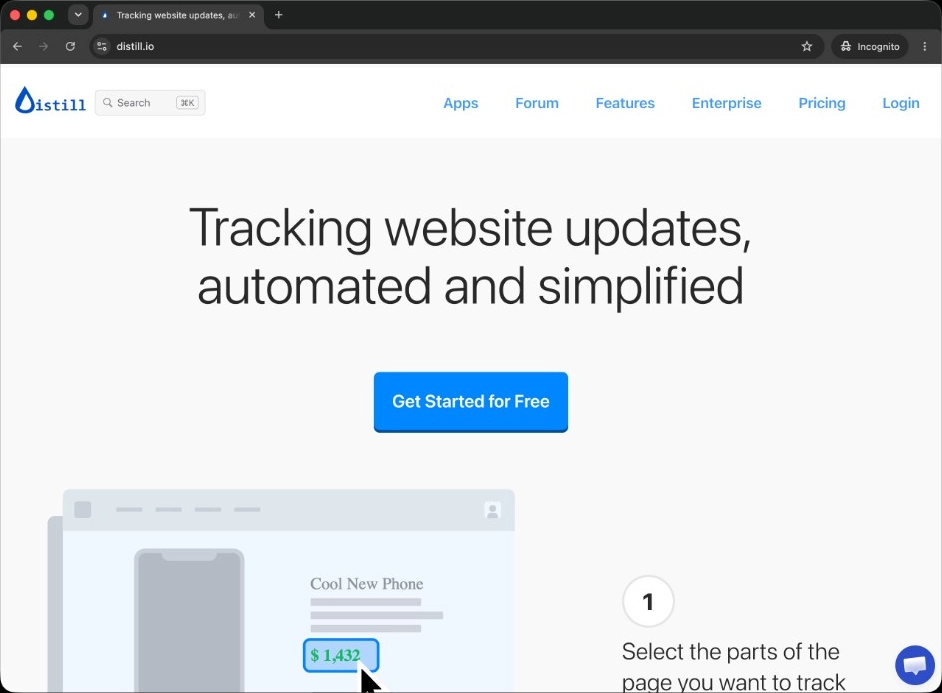
Distill (often searched as Distill Web Monitor) is a website change monitor built around CSS and XPath selectors. The free tier covers 25 monitors. You isolate a price cell or changelog heading and Distill diffs that slice. Cloud monitors run on Distill's servers. Local monitors run through the Distill Chrome extension only while that browser session is alive. For competitor pricing, prefer cloud. Distill free fits a technical owner who will maintain selectors and keep watches in the cloud. Starter is about $15 a month and Professional about $35 with a larger check allowance (verified at draft time; confirm on their pricing page). The free-tier trap is quiet failure after a redesign: the selector dies, the monitor looks healthy, and silence looks like coverage.
Visualping (free tier)
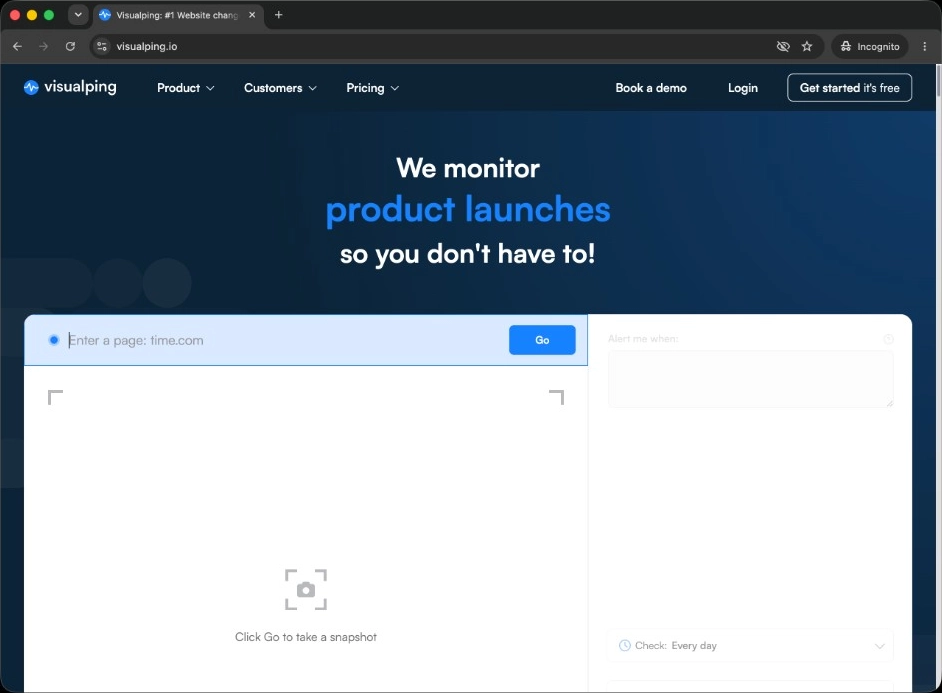
Visualping screenshots a page or cropped region on a schedule and compares renders. The free tier covers 5 monitored pages and 150 checks a month. Personal plans start from about $10 a month; Business with team workspaces and Slack from about $100 a month (draft-time figures). Visualping free fits teams watching relatively static pages who want a picture in the alert. On dynamic SaaS pricing pages, a rotated logo and a price change both look like "the image moved." The check math is the other constraint: one page checked daily uses about 30 checks a month; hourly on one page alone exceeds the free 150. Use Visualping free for a short watch list on a daily cadence, not for dense hourly coverage.
changedetection.io (self-host)
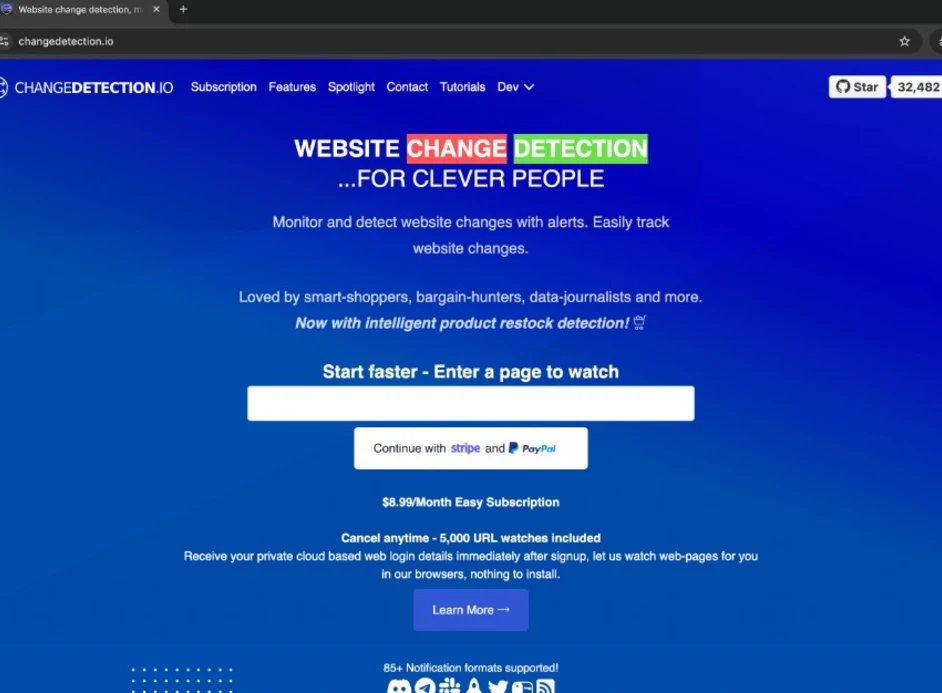
changedetection.io is an open source website change detection tool you can run on a VPS. Self-host is free beyond the server. You get text or HTML diffs, CSS and XPath filters, ignore rules, and optional browser steps. Hosted sits around $8.99 a month for up to about 5,000 URL watches (verify current pricing). Self-host fits engineers who need data residency, air-gapped watches, or URL volume that blows past hosted free tiers. The cost you pay is ops: Docker, storage, notification plumbing, and filter upkeep. Raw diffs still need a human to find the price inside the hunk unless filters are tight. Keep it when you already run infra; skip it when "free" means an unpaid second job.
Competiflow (free trial)
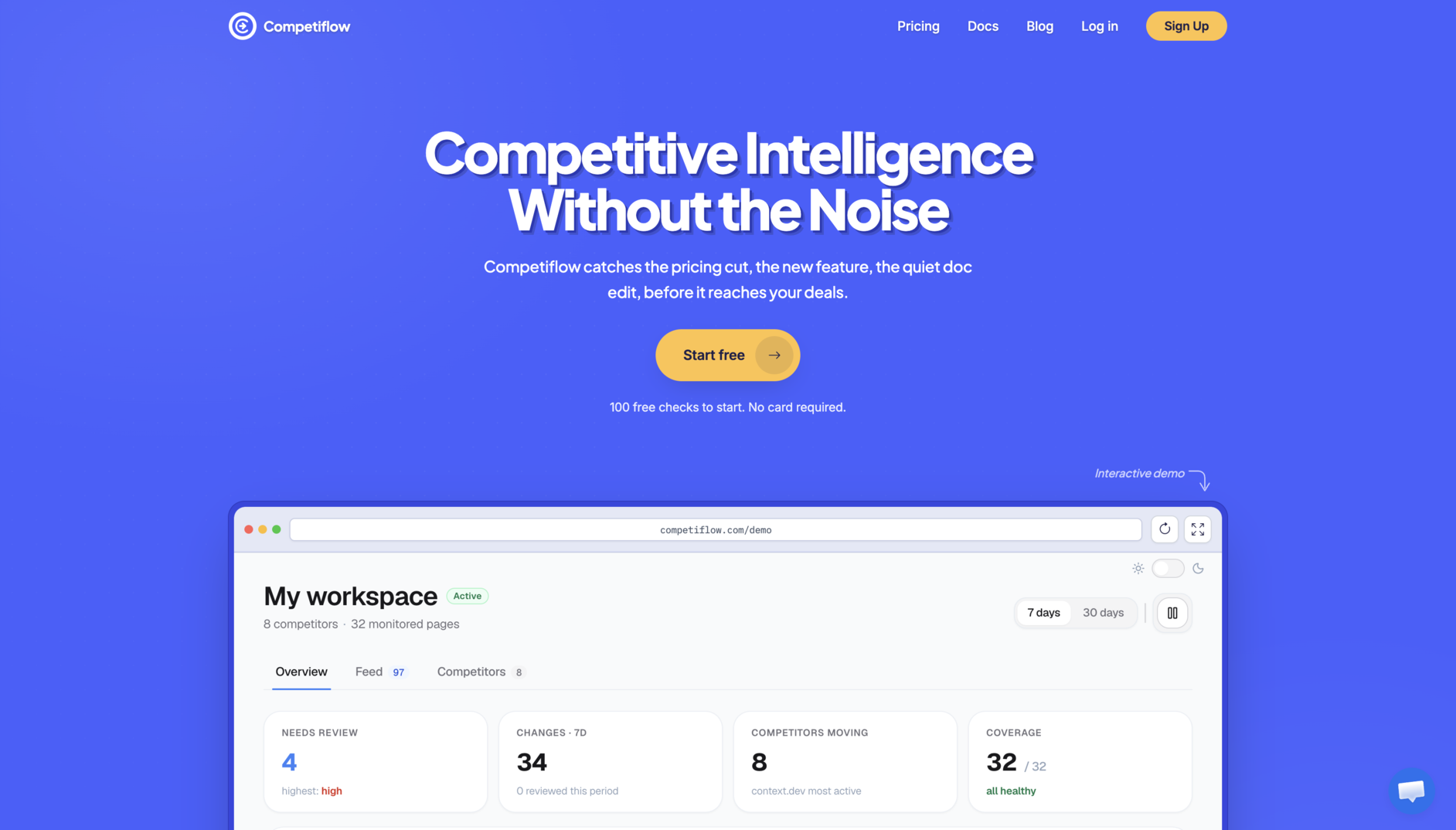
Competiflow extracts competitor surfaces into normalized fields, then diffs those fields. On pricing, that means plan name, price, billing period, and related tier content. The free trial includes 100 checks, up to 3 competitors, and up to 15 monitors on a daily cadence. Starter is $19 a month for 2,000 checks and 20 monitors with unlimited competitors, Growth $49 for 5,000 checks on a six-hourly cadence, and Pro $99 for 10,000 checks hourly. Plans bill by checks, not seats. The trial fits a bake-off on one rival: add a homepage, let discovery find pricing and changelog, and read interpreted changes. When Team moves from $49 to $79, the change names the path, carries both values, assigns severity, and includes why it matters as competitive context, for example how the price move repositions them in mid-market deals. The trade-off is scope: Competiflow watches competitive intelligence surfaces. It is a poor fit for retail stock SKUs or thousands of arbitrary URLs.
Free-tier traps: local browser, check caps, and silence
Free tiers fail in three predictable ways on competitor jobs: local watches that need a live browser, check allowances that run out before the month ends, and silence that looks identical to "nothing changed."
Local browser traps. Distill's Chrome extension only checks while that browser session is alive. Close the laptop for a weekend and those local watches stop. Cloud Distill, Visualping, Competiflow, and a self-hosted changedetection.io VPS do not share that failure mode. If the alert must fire while you sleep, do not put competitor pricing on a local-only watch.
Check caps. Visualping's free 150 checks a month is the clearest example. Five pages checked daily already sit near the ceiling. Distill free and Competiflow's trial also throttle cadence or total checks. Teams that "go free forever" by checking hourly on every URL hit paid walls in week one. Match cadence to how often the page really moves. Daily is enough for most pricing pages.
Silence that looks like coverage. A dead Distill selector, an over-aggressive changedetection.io ignore rule, or a Google Alerts query that never matches in-place edits all produce the same inbox: empty. Empty feels like calm. On competitor pricing it often means the monitor is not looking at the value you care about. The fix is a monthly live check: open the page, confirm the selector or filter still hits the price, or confirm the structured monitor still returns the plan row.
A hybrid free stack that avoids the worst traps: Google Alerts for mentions, Distill cloud (not local) for two or three pricing nodes you will maintain, and a calendar reminder to re-verify selectors after any rival redesign. Add changedetection.io only if someone already owns the VPS.
When free is enough
Free is enough when your watch list is small, the pages are stable, and a person can still triage the inbox in a few minutes a week. Plenty of teams should stay here longer than tool marketing implies.
Four situations where free coverage is the right call:
- One to three rivals, known URLs. You already know the pricing and changelog links. Opening them Monday morning takes less time than evaluating vendors. A Distill free cloud monitor or Visualping free daily check is optional insurance, not a requirement.
- Budget is actually zero. A free layer that runs beats a paid layer somebody keeps meaning to set up. Distill free, Visualping free, self-hosted changedetection.io, and Google Alerts all qualify.
- You only need mentions plus a light page watch. Keep Google Alerts for press and funding. Add one cloud page monitor for the pricing URL that already burned you once.
- You are testing whether monitoring is worth owning. Run Distill free or Competiflow's evaluation trial for two weeks on the same rival pricing page. Count cosmetic alerts, silent gaps, and whether a real move arrived as something a teammate could brief from. Decide with that count.
Free is not enough when someone learns about a price change from a prospect, when local watches miss overnight moves, or when triage time exceeds the cost of a starter plan. That is a graduation signal, not a mandate.
When to graduate from free website change monitoring
Graduate when free-tier limits, ops load, or missing interpretation cost more than a paid check allowance. The trigger is usually human time, not a feature matrix. Some teams never hit these triggers. A small free stack with a monthly re-verification habit is a valid long-term position.
Common graduation triggers:
- Check caps block the cadence you need. You want daily checks on ten URLs and Visualping free or a trial allowance cannot hold it.
- Local watches missed a real move. Distill extension was closed when the rival shipped. Move those URLs to cloud Distill or another hosted monitor.
- Selector or filter upkeep is a second job. Redesigns keep breaking Distill or changedetection.io rules. You spend more time repairing watches than reading changes.
- PMM needs plan names, not screenshots. A Visualping highlight or HTML hunk still requires someone to write the summary. Field-level tools return the path and both values.
- The inbox is shared and noisy. Free personal inboxes do not scale to a sales enablement ritual. Shared severity and digests matter.
Illustrative field-level shape when a structured monitor catches a raise (field names match the changes API Competiflow uses):
{
  "change": {
    "summary": "Team plan raised from $49 to $79/mo",
    "severity": "high",
    "source_url": "https://northwind.io/pricing",
    "why_it_matters": "A 60% Team-tier raise moves Northwind from aggressive mid-market pricing into a premium band buyers will notice on the next bake-off",
    "field_diffs": [
      {
        "op": "updated",
        "change_type": "price_increase",
        "path": "plans[Team].price",
        "tier": "alertable",
        "old": { "price": "$49/mo" },
        "new": { "price": "$79/mo" }
      }
    ]
  }
}
That is competitive context: how the move repositions them against you. If your free tool cannot get you that close without a person rewriting every alert, graduation is cheaper than pretending the free tier still fits. Distill paid and Visualping Personal are equally valid upgrades when the only trigger is check caps inside the same detection model.
Choose Distill paid or Visualping Personal when you want more checks inside the same detection model. Choose changedetection.io hosted when self-host ops is the bottleneck. Choose Competiflow Starter when rival pricing and changelogs need field-level diffs. For pricing-page-specific Visualping trade-offs, see Visualping alternatives for pricing pages.
Frequently Asked Questions
What is the best free website change monitor?
It depends on the job. Distill free is strongest for precise cloud selectors on a few competitor URLs. Visualping free fits quieter pages when you want screenshots. changedetection.io self-host wins on volume if you will run Docker. Google Alerts is free but watches the index, not a URL. Competiflow offers a free trial for field-level competitor surfaces, then paid plans by checks.
Is Distill Web Monitor free?
Yes, with limits. Distill includes a free website change monitor tier with 25 monitors. Cloud vs local matters: local Distill Chrome extension watches only run while the browser is open. Paid Starter and Professional plans raise check allowances (about $15 and $35 a month at draft time). Confirm current limits on Distill's pricing page.
Is Visualping free for website change monitoring?
Yes, with a small allowance. Visualping free covers 5 pages and 150 checks a month. That supports a short daily watch list. Hourly checks on multiple pages push you to a paid plan quickly. Personal starts from about $10 a month at draft time.
Is changedetection.io free?
Self-host is free beyond the VPS and your time. The open source project lets you run website change monitoring on your own infrastructure. Hosted changedetection.io is paid (around $8.99 a month for a large URL allowance at draft time; verify before budgeting).
When should I leave a free tier?
Leave when check caps block needed cadence, local watches miss events, selector or filter upkeep dominates your week, or teammates need named prices instead of screenshots. Stay when the watch list is small, cloud monitors are healthy, and triage still fits in a few minutes a week.
Does Competiflow have a free plan?
Competiflow offers a free trial with 100 checks, up to 3 competitors, and up to 15 monitors on a daily cadence. Ongoing use is on paid plans billed by checks (Starter $19, Growth $49, Pro $99 a month at draft time). Use the trial to bake off against Distill free or Visualping free on the same rival pricing URL.
Can I combine free tools?
Yes. A common stack is Google Alerts for mentions, Distill cloud free for a few pricing selectors, and changedetection.io for high-volume or internal URLs. Add Competiflow when CI surfaces need field-level interpretation. You do not need one tool for every URL on the internet.
Free website change monitors earn their place: Distill free and Visualping free for small cloud watch lists, changedetection.io when you will self-host, Google Alerts for mentions, and Competiflow's trial when you want named pricing fields. The mistake is freezing on free after the job outgrows the limits.
If you are choosing now, run a two-week bake-off. Put one Distill cloud selector and one other free option on the same rival pricing URL. Count cosmetic alerts, note silent gaps, and check whether a real $49 to $79 style move arrived as a node change, a screenshot, or a named field path. That count beats any feature matrix, including this one. For structured setup, start with the API quickstart.