Between March 2 and April 1, 2020, Plausible changed its homepage headline from "Simple analytics for your website" (March 2) to "Simple and privacy-friendly alternative to Google Analytics" (April 1). Marko Saric later wrote on the company blog: "Pretending that a popular competitor and a market leader doesn't exist is something I've noticed many startups do. It's a mistake." (July 31, 2020). On October 25, 2026, the page title still says "Google Analytics alternative."
In July 2026, PostHog published "Repositioning PostHog," which says "most people still see PostHog as 'analytics++' today" after years of new homepage labels. One frame stuck for six years. The other company says its relabels didn't move how people see it.
This guide defines competitive positioning, traces its frameworks, and walks through six dated SaaS examples. Then it shows how to develop and write down your own, as one output of a competitive analysis.
What you'll learn
- What competitive positioning means, and how a competitive position differs from it
- Who named the parts: Ries and Trout, Porter, Moore, Keller, Dunford
- Six SaaS positioning moves with homepage dates and the company's own words
- How to develop your positioning from competitive alternatives
- How to write a positioning statement, and where the template misleads
TL;DR: Competitive positioning is the decision about how buyers should see your product next to the alternatives they already know: which category to judge you in and why you're the better pick there. Start from what buyers would do without you, name that alternative on your homepage, write it down with Moore's template, and re-check it as rivals move.
What is competitive positioning?
Competitive positioning is the decision about how a target buyer should see your product next to the alternatives they already use or consider. It sets the category you ask to be judged in and the difference that makes you the better pick there. Your homepage headline, sales deck, and pricing page then express that decision.
Competitor positioning is the same idea seen from the rival's side: how a competitor wants buyers to see it, which you can read off its page title and headline.
Competitive position vs competitive positioning
A competitive position is where you stand against rivals today, as buyers and the market see it; competitive positioning is the choice you make about where you want to stand. Position is a state: your share, your price level, where buyers rank you. That's what "competitive market position" describes. Harvard's Institute for Strategy and Competitiveness (ISC) says: "A company's relative position within its industry matters for performance."
Positioning is the decision to change or defend that state. Buyers' picture of you can lag behind it, as PostHog's example shows.
How it differs from brand positioning, product positioning and messaging
Market positioning is a looser synonym. Product positioning applies the idea to one product in a portfolio, and brand positioning covers the company's identity and associations. Competitive positioning keeps the alternatives in the sentence: you can't state it without naming what the buyer would pick instead.
Messaging is the words that carry the decision. April Dunford puts it bluntly: "Positioning is not equivalent to messaging. It isn't a tagline." (March 15, 2021).
Positioning frameworks and who they come from
Five competitive positioning frameworks cover most of what you'll need, and each comes from a named author. Here they are in date order.
Ries and Trout: a position in the prospect's mind (1969–1981)
Jack Trout wrote about positioning in Industrial Marketing in June 1969. With Al Ries, he followed it with "The Positioning Era Cometh," an Advertising Age series from April 24, 1972, and the 1981 book Positioning: The Battle for Your Mind. The 1972 article (archived scan) says "a company must create a 'position' in the prospect's mind. A position that takes into consideration not only its own strength and weaknesses, but those of its competitors as well."
They popularized the term in marketing, though Wikipedia notes that scholars dispute whether they originated it. Their lasting point: a position is relative.
Porter: strategic positioning and the generic strategies
Michael Porter's generic strategies, from his book Competitive Strategy, are cost leadership, differentiation, and focus. In "What Is Strategy?" (HBR, November–December 1996), he wrote that "strategic positioning means performing different activities from rivals' or performing similar activities in different ways." He also describes three sources of a position: variety-based (a subset of an industry's products), needs-based (most needs of one customer group), and access-based (customers reached in a different way).
The Harvard ISC page adds that positioning "should translate into one of two things: a premium price or lower costs for the company." Trying to be all things to all customers risks getting "stuck in the middle," which Porter calls "the kiss of death." Five Forces, his industry-level tool, is in the competitive analysis guide.
Moore: the positioning statement (1991)
Geoffrey Moore's Crossing the Chasm (1991) gave product teams the "For… who… Unlike…" template that many positioning statements still follow. Its last clause makes you name the primary competitive alternative. The full template is in the statement section below.
Keller: points of parity and points of difference (2002)
In "Three Questions You Need to Ask About Your Brand" (HBR, September 2002), Kevin Lane Keller, Brian Sternthal, and Alice Tybout described points of difference, points of parity, and the frame of reference. They wrote that managers "often pay too little attention to two other aspects of competitive positioning," the frame of reference and "the features that brands have in common with competitors."
In SaaS terms (our translation), parity is what you must match to make the shortlist, like SSO or a free trial. Difference is the one claim your "Unlike…" clause rests on.
Dunford: start from competitive alternatives (2019)
April Dunford, author of Obviously Awesome (2019), defines it in a March 2021 primer: "Positioning defines how your product is a leader at delivering something that a well-defined set of customers cares a lot about." It has five components, in this order: competitive alternatives, differentiated capabilities, value for customers, target customer segment, and market category.
Her starting question is "What would a customer do if your offering didn't exist?" (December 28, 2020), and the first alternative to beat is the status quo. PostHog's Charles Cook wrote in July 2026 that he "speed ran April Dunford's process in a week" (example 6).
Types of positioning strategy
There's no single official list of competitive positioning strategy types. The best-sourced base is Porter's three generic strategies, and SaaS homepages add two more moves: positioning against a named leader and creating a new category. The table is our classification.
| Strategy | Where the idea comes from | What the homepage claims | Examples below |
|---|---|---|---|
| Cost leadership | Porter, generic strategies | The same job for less | None in this set; see the pricing note |
| Differentiation | Porter, generic strategies | Something the alternatives can't do | Plausible (privacy), PostHog |
| Focus (niche) | Porter, generic strategies | Built for one kind of buyer | Pipedrive, 2015–16 |
| Named leader | SaaS practice; Plausible's 2020 post explains it | "Alternative to [the leader]" | Plausible, Supabase |
| New category | Dunford: pick an existing category or create one | A new category name | monday.com, Webflow, PostHog |
In SaaS, cost leadership usually shows up on the pricing page; competitive pricing covers how to price at, below, or above rivals. The ISC caveat applies to every row: the position has to pay off as a premium price or lower costs.
Be careful with the last row. Dunford says you can position in an existing category or try to create one, and warns that "companies that create market categories often lose in the long run to companies that gained a market foothold after the hard work of creating the category was already done" (March 15, 2021).
Competitive positioning examples from six SaaS homepages
Each example below is a real homepage change. Where a company published its reasons, we quote them; where it didn't, we say so.
How we dated these. Archive dates are Wayback Machine capture dates: "by" marks the first capture we found showing a line, and "between" gives the last capture before a change and the first after it. We read the live homepages from a US location on October 25, 2026.
| Company | Move | The line, dated | Lesson for you |
|---|---|---|---|
| Plausible | Named the leader | "Simple analytics for your website" (Mar 2, 2020) → "Simple and privacy-friendly alternative to Google Analytics" (Apr 1, 2020) | Name the alternative buyers already use |
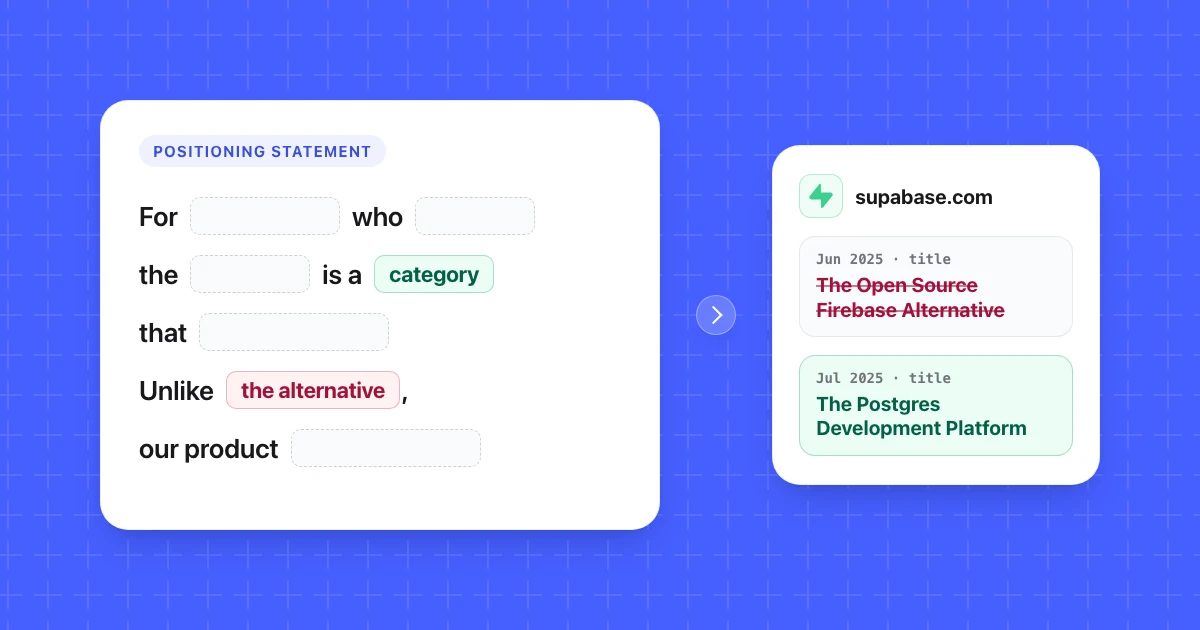
| Supabase | Named leader, then own category | "The Open Source Firebase Alternative" (Jan 2021) → title "The Postgres Development Platform" (between Jun 2 and Jul 1, 2025) | A borrowed frame can stay where buyers compare |
| Pipedrive | Niche, then broader | "Sales CRM for small teams with big ambitions" (2015) → "The easy and effective CRM for closing deals" (by Jan 1, 2025) | Dropping a segment word is a positioning decision |
| monday.com | Created a category, then renamed it | blog post: "a work operating system (Work OS), a new software category" (Feb 3, 2020) → title "The AI work platform" (by Jan 1, 2026) | A new category needs a public explanation |
| Webflow | Category set against two others | blog post: "the first Website Experience Platform" (Oct 15, 2024) → title "The agentic web platform" (between May 1 and Jun 1, 2026) | Define a new category by the options it replaces |
| PostHog | Against the status quo | "Self Hosted Product Analytics" (Feb 2020) → "Your product's context layer" (Oct 25, 2026) | Small relabels may not move how buyers see you |
1. Plausible: name the market leader in the headline
Marko Saric's July 31, 2020 post explains Plausible's switch: "We made a change to our website and positioned ourselves directly and clearly against Google Analytics…" The same post says pricing tiers and yearly billing changed then too, so the headline wasn't the only change. On October 25, 2026, the title reads "Plausible Analytics | Simple, privacy-friendly Google Analytics alternative."
Our read: if buyers already know one product in your category, naming it tells them what you are and which frame to judge you in.
2. Supabase: from "Firebase alternative" to its own category
Supabase's meta description read "realtime postgres." in March 2020. By January 2021, its H1 was "The Open Source Firebase Alternative," and the page title carried that line until at least June 2, 2025. By July 1, 2025, the title read "Supabase | The Postgres Development Platform." The H1, by then "Build in a weekend. Scale to millions." (January 2023), and the meta description didn't change with it. Supabase hasn't said why the title did. Its undated Firebase comparison page still says "open-source alternative."
Our read: when you outgrow a named-leader headline, you can keep the comparison on a comparison page, as Supabase did.
3. Pipedrive: a niche headline, then a broader one
Pipedrive's H1 read "Sales CRM for small teams with big ambitions" in 2015 and 2016, "We make salespeople unstoppable" by January 2019, and "The easy and effective CRM for closing deals" by January 1, 2025. It's still the US H1 on October 25, 2026, and Pipedrive hasn't published a reason. Its meta description calls it "the easy-to-use, #1 user-rated CRM tool," which is Pipedrive's own claim.
Our read: a segment word like "small teams" is Porter's focus strategy made visible. If you drop yours, make sure its replacement is a claim your rivals can't also make.
4. monday.com: creating a category, then renaming it
On February 3, 2020, monday.com's Roy Mann announced "a work operating system (Work OS), a new software category," because work tools are "typically disjointed" and leave "ill-managed or unmanaged work." The company's "Our Story" timeline (read October 25, 2026) lists "April 2026 | Going all in on AI | From Work Management Platform to AI Work Platform," though the homepage title already read "monday.com | The AI work platform" by January 1, 2026.
The title read "The AI Work Platform for People & Agents | monday.com" on June 1, 2026; on October 25, 2026, it is "The AI Workspace for People & Agents | monday.com." We haven't checked when that changed, and the company hasn't said why.
Our read: the 2020 move came with a public explanation of the problem the category solves. If you name a category, publish why it exists.
5. Webflow: a new category defined by the two it replaces
On October 15, 2024, Webflow CEO Linda Tong called it "the first Website Experience Platform," set against "an easy-to-use but limited website builder" and an "old-school Digital Experience Platform (DXP)." The homepage title kept "Visual website builder" until at least May 1, 2026, about 19 months later. By June 1, 2026, it read "Webflow: The agentic web platform for modern businesses," as it still does. No announcement explains the switch.
Our read: a new category is easiest to grasp when you define it against two that buyers know, one too limited and one too heavy.
6. PostHog: repositioning against the old way of working
PostHog's title went from "Self Hosted Product Analytics" (February 2020) to "The open source Product OS" (by January 2023). On October 25, 2026, it reads "PostHog – Your product's context layer," and the page also says "self-driving."
In his July 23, 2026 post, Charles Cook wrote that "most people still see PostHog as 'analytics++' today," and that "mostly it's because repositioning is just hard." He named the rival that counts: "The truest competitor for our ICP that we should care about is the old way of working."
Our read: your most important competitor can be the status quo. Relabeling one step at a time may leave buyers' picture of you where it was.
Our observation from these six snapshots, and nothing wider: monday.com, Webflow, and PostHog all moved to AI or agent category language between 2025 and 2026. When rivals relabel together, a word that set you apart can become everyone's word.
How to develop competitive positioning
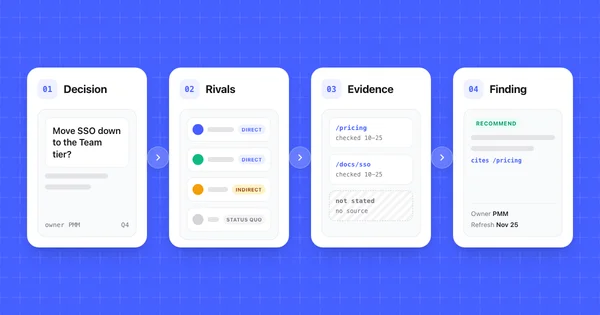
Start from what buyers would do without you, read how those alternatives present themselves, and pick a frame. Then write it down, test it in deals, and re-check it.
1. List the competitive alternatives, starting with the status quo
Ask Dunford's question: what would a customer do if your product didn't exist? Honest answers include a shared spreadsheet or nothing at all. Dunford writes that enterprise software teams "typically lose between 20% and 30% of deals to 'no decision'" (her figure). Skip "phantom competitors" that never show up in deals. The four types of competitors help you spot a missing group.
2. Read each alternative's homepage, and its history, with dates
Record each alternative's page title, H1, and meta description, with the date you read them. Then pull one or two older captures from the Wayback Machine to see which frame they've used and for how long. Read from your buyers' region: Pipedrive sends some non-US visitors to a local-language page.
3. Pick the frame: named leader, niche, or new category
Pick a named leader when buyers already know one product in your space, and a niche when one segment cares far more about what you do well. Create a new category only when every existing one makes you look worse.
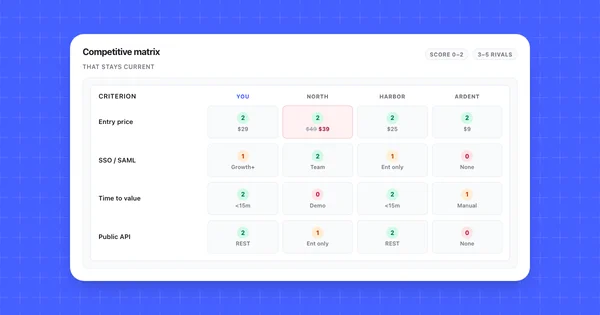
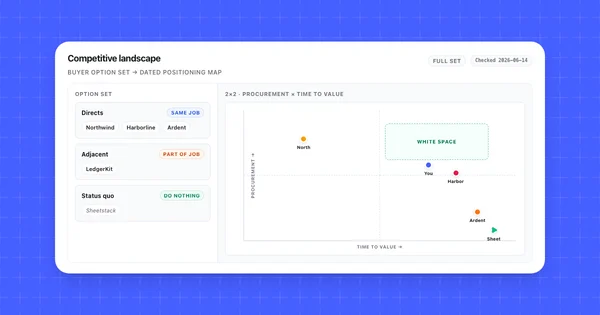
If a picture helps the team agree, a competitive positioning map plots three to five rivals on two axes buyers care about, and the competitive landscape analysis guide maps the wider set of options.
4. Write it down as a positioning statement
Put the decision into one or two sentences with Moore's template. Fill the "Unlike" slot with the alternative from step 1, even when it's a spreadsheet.
5. Test it in deals before you test it in ads
Ask won and lost buyers which alternative they compared you with; win-loss interviews are where you'll hear it most directly. Once the frame holds, it goes on the sales battlecard. PostHog's post admits "It might hurt signups," so decide in advance which number you'll watch and for how long.
6. Re-check it when the alternatives move
Your statement names an alternative, so it goes stale when that alternative relabels; the last section covers how often to look.
Write a positioning statement with Moore's template
A competitive positioning statement is a one- or two-sentence internal record of your positioning. Teams use it to brief copy, sales, and product; customers never see it. Geoffrey Moore's template from Crossing the Chasm (1991) is the usual starting point, in the wording TechTarget quotes:
"For (target customer) who (statement of the need or opportunity), the (product name) is a (product category) that (statement of key benefit – that is, compelling reason to buy). Unlike (primary competitive alternative), our product (statement of primary differentiation)."
Here it is filled in for Ledgerline, a fictional time-tracking and invoicing tool:
For design agencies of 5 to 30 people who bill clients by the hour, Ledgerline is a time-tracking and invoicing tool that turns a month of tracked hours into a client-ready invoice in one step. Unlike a spreadsheet plus a separate accounting app, our product ties every invoice line to the timer entry behind it.
Its "Unlike" slot names the status quo from step 1.
Dunford is wary of the exercise. She calls the fill-in positioning statement "a sort of 'Mad Libs' fill in the blanks exercise" and "potentially dangerous," because it "assumes that there is only one answer for each of the blanks, and you simply 'know' what it is" (March 15, 2021). She doesn't name Moore in that post.
Both views hold if you change the order. Do the component work first: alternatives, then differences, value, the buyers who care most, and category last. Use the template only to record the answer. Keller's points of parity get you onto the shortlist; the "Unlike" clause carries the point of difference.
Keep your positioning current as rivals move
Your positioning is written against alternatives, so it goes stale when they change. monday.com's homepage title changed again after its June 1, 2026 snapshot. Webflow's held one label for about 19 months and then switched.
Our suggestion: check the two or three alternatives from step 1 monthly, with dates, and re-run steps 1 to 3 when one changes its headline or category word.
Competiflow's homepage monitor reads a rival's whole homepage and records changes field by field. A new hero headline or feature-list change creates a change to review; the subheadline, buttons, logo strips, stats, and page links such as demo or pricing buttons are kept as context and don't alert alone. Headline moves like Plausible's, Pipedrive's, or PostHog's are what it catches. It doesn't read page titles or meta descriptions, so a title-only move like Supabase's in 2025 or Webflow's "agentic" line needs a Wayback or page-source check. See monitors.
Frequently Asked Questions
What is competitive positioning in marketing?
In marketing, competitive positioning is how you want buyers to see your product next to the alternatives they already know, and the claim that makes you the better pick. Plausible's "alternative to Google Analytics" headline is one example.
What is the difference between competitive positioning and competitive advantage?
Competitive advantage is the edge you have, such as lower costs or a capability rivals lack; competitive positioning is the choice of which buyers and which frame let that edge count. Harvard's ISC page adds that positioning should pay off as a premium price or lower costs.
What are the four types of competitive positioning?
There is no canonical list of four types of competitive positioning; lists vary by source. The best-sourced base is Porter's generic strategies: cost leadership, differentiation, and focus. SaaS homepages add two moves: naming a leader, as Plausible did, and creating a new category, as monday.com did with Work OS.
What is another term for competitive positioning?
Strategic positioning and market positioning are the closest terms. Strategic positioning is Porter's phrase from his 1996 HBR article "What Is Strategy?" "Competitor positioning" usually means how a rival positions itself.
What is an example of competitive positioning?
Supabase called itself "The Open Source Firebase Alternative" on its homepage by January 2021, then changed its page title to "The Postgres Development Platform" between June and July 2025. The company hasn't said why.
What is the difference between positioning and messaging?
Positioning is the decision about where you win; messaging is the words that express it on a page or in a pitch. PostHog's July 2026 post says "Self-driving is now how we are positioning ourselves," while its homepage title reads "Your product's context layer."
What are the elements of a positioning statement?
Geoffrey Moore's template has seven slots: target customer, their need, product name, product category, key benefit, the primary competitive alternative, and your primary difference. Grouped, they answer four questions: who it's for, what it is, why it matters, and how it differs from the alternative.
Where to start
Write down what your best-fit buyer would do if you didn't exist. Read that alternative's homepage and one archived version of it, note both dates, and fill in the "Unlike" line.
That sentence is the core of your competitive positioning, and it holds only while the alternative stays put. To keep rivals' homepages in view, start a Competiflow trial with 100 checks and up to 3 competitors.